

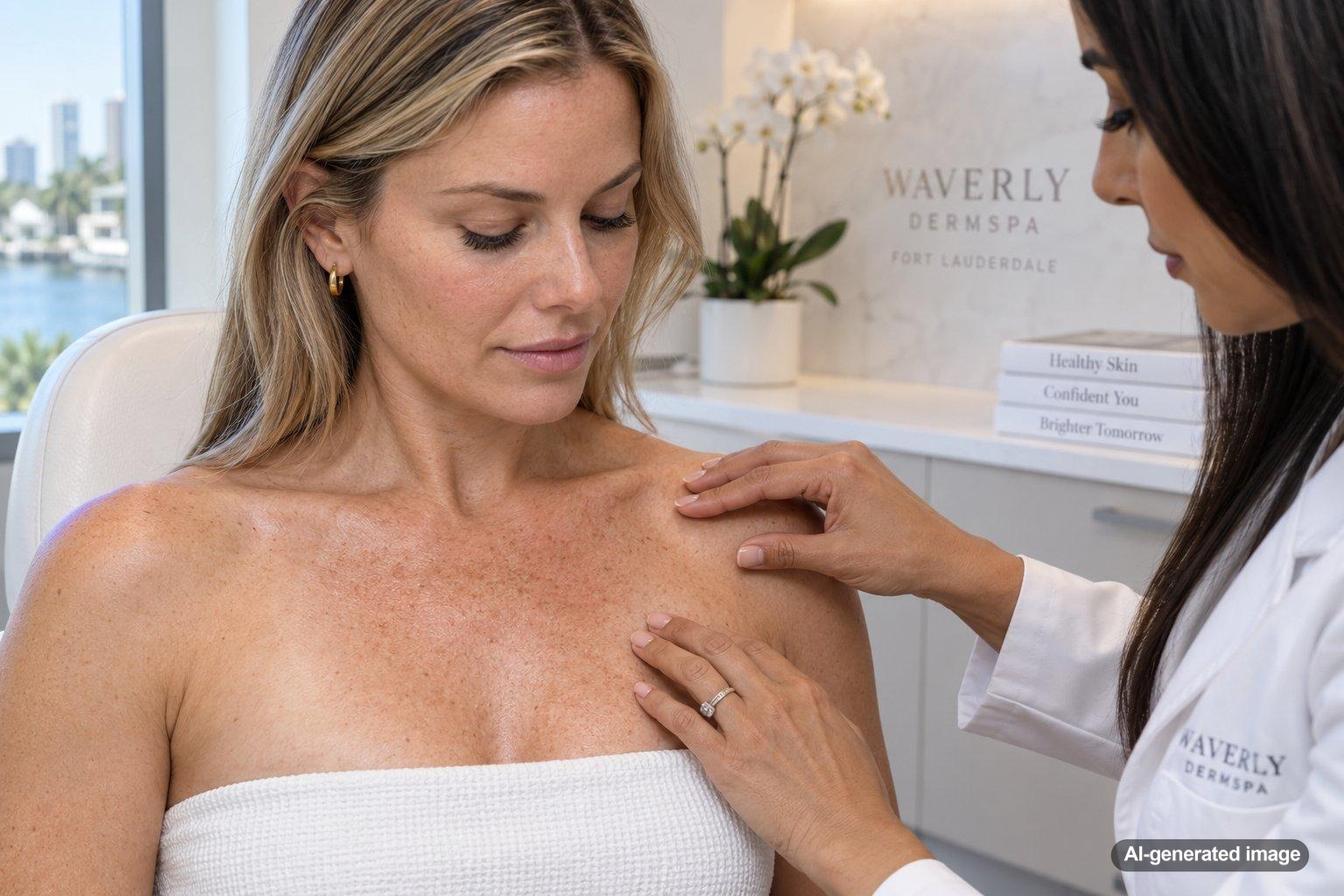
The upper chest receives years of incidental ultraviolet exposure from driving, walking, outdoor dining, and wearing open-neck clothing. Because this delicate area is often protected less consistently than the face, accumulated sun damage may eventually make it feel rough, dry, crepey, or uneven. Changes in pigment and visible redness can appear at the same time.
Diffuse texture changes may reflect photoaging, but a persistent rough or scaly spot can also have a medical cause that deserves evaluation. A dermatologist can distinguish general sun damage from actinic keratosis, irritation, or another skin condition before recommending cosmetic or medical care.
Quick answer
- Repeated ultraviolet exposure can damage collagen, elastin, pigment-producing cells, and the skin barrier.
- The upper chest may develop dryness, fine lines, mottled color, redness, or a leathery texture.
- A distinct rough, crusted, tender, or recurring patch should not automatically be treated as ordinary dryness.
- Daily sun protection and gentle moisturization may help prevent additional damage, but they cannot identify a suspicious lesion.
- A dermatologist can examine the skin and discuss appropriate medical or cosmetic options.
What long-term sun exposure does to chest skin
Ultraviolet radiation creates gradual changes within the skin. Over time, collagen may become less organized, elastin may lose its normal structure, and the outer barrier may retain moisture less effectively. These changes can produce fine lines, a crinkled appearance, uneven texture, and skin that feels persistently dry despite regular moisturizer.
Sun exposure can also create a mixed pattern of brown spots, pale areas, and persistent redness. This combination is often more noticeable across the V-shaped area of the upper chest because the skin there is relatively thin and repeatedly exposed. The changes represent cumulative exposure rather than the effect of one recent day in the sun.
Common reasons the area may feel rough
- Photoaging: Broad areas of fine, dry, or crepey texture may develop as ultraviolet exposure alters collagen, elastin, and the skin barrier.
- Simple dryness: Hot showers, low humidity, fragranced body products, and insufficient moisturizer can make sun-damaged skin feel even rougher.
- Irritation: Perfume, essential oils, necklaces, detergent residue, or strong exfoliating products may cause redness, stinging, or scaling.
- Actinic keratosis: A persistent dry, gritty, scaly, or crusted spot on sun-exposed skin may be a precancerous growth. It can sometimes be easier to feel than see.
- Another skin condition: Eczema, contact dermatitis, and other conditions can affect the chest, so texture alone cannot establish the cause.
What you can do at home
Use a gentle, fragrance-free cleanser or simply rinse the area when a cleanser is unnecessary. After bathing, apply a bland moisturizer while the skin is still slightly damp. Ingredients such as ceramides, glycerin, and hyaluronic acid may support hydration without aggressive exfoliation.
Protect the chest every day it may be exposed. A broad-spectrum, water-resistant sunscreen with SPF 30 or higher is a practical baseline. Apply enough to cover the entire exposed area and reapply during extended outdoor time, especially after swimming or sweating. Clothing with good coverage, shade, and avoiding indoor tanning provide additional protection.
Be cautious with scrubs, exfoliating brushes, high-strength acids, and frequent retinoid use. These products can worsen irritation when the barrier is already dry or sensitive. Do not try to sand, peel, freeze, or pick off a persistent rough spot. Take a clear photograph and arrange an examination if it does not resolve or if it changes.
Professional options depend on the diagnosis
A dermatologist should first determine whether the concern is diffuse cosmetic photoaging, an isolated precancerous growth, dermatitis, or another condition. Medical evaluation may include a close visual and tactile examination. A lesion that appears suspicious may require additional testing rather than a cosmetic treatment.
For general sun-related texture and discoloration, professional options may include carefully selected topical products, chemical peels, microneedling, or light- and laser-based treatments. The appropriate choice depends on skin tone, sensitivity, the pattern of damage, medical history, and the amount of recovery time a person can accommodate. Results and treatment needs vary.
If actinic keratoses are present, a dermatologist may discuss lesion-directed or field-directed therapies. These are medical treatments selected according to the number, location, and characteristics of the growths. At Waverly DermSpa, we offer Photodynamic Therapy (PDT) and can help you understand whether it may be appropriate.
When to see a dermatologist
Schedule an examination if the chest has a rough patch that persists, repeatedly crusts, bleeds, becomes tender, grows, changes color, or returns after seeming to heal. A new or changing mole, a sore that does not heal, or a spot that looks different from the surrounding marks should also be checked.
Even when the concern seems purely cosmetic, an examination is valuable before resurfacing or exfoliating treatment. Treating over an unidentified lesion may delay appropriate care. People with extensive sun exposure, a history of indoor tanning, prior skin cancer, or many changing spots should ask a dermatologist how often they need professional skin examinations.
FAQ
Can moisturizer reverse years of chest sun damage?
Moisturizer may improve dryness and temporarily soften the appearance of fine texture, but it does not reverse every structural change caused by accumulated ultraviolet exposure. Consistent sun protection helps limit further damage.
Is every rough chest patch an actinic keratosis?
No. Dryness, irritation, eczema, and general photoaging can also feel rough. Because different conditions can look similar, a persistent or changing spot should be examined instead of diagnosed by texture alone.
Can I use my facial retinoid on my chest?
The chest can be more reactive than the face. A product or frequency that works well on facial skin may cause redness, peeling, or burning on the chest. Ask your clinician whether a retinoid is appropriate and how to introduce it conservatively.
Why does my chest look more sun-damaged than my face?
Many people apply skincare and sunscreen carefully to the face but stop at the jawline. The chest may therefore accumulate years of exposure without the same level of protection, while its relatively thin skin makes changes easier to notice.
Will a peel or laser make the texture completely smooth?
No treatment can promise completely smooth skin. Procedures may help selected concerns, but the expected improvement, number of sessions, and recovery experience vary. An examination is needed to choose an approach safely.
Ready to get help?
Schedule an appointment or send a message and our team will get back to you.
Prefer to call? 954-666-3736
This article is for educational purposes and is not medical advice. For diagnosis and personalized treatment, please book an appointment with a board-certified dermatologist.
Sources & further reading
- American Academy of Dermatology (AAD) – Actinic keratosis: Overview
- The Skin Cancer Foundation – Actinic Keratosis Overview
- DermNet – Solar Elastosis
