

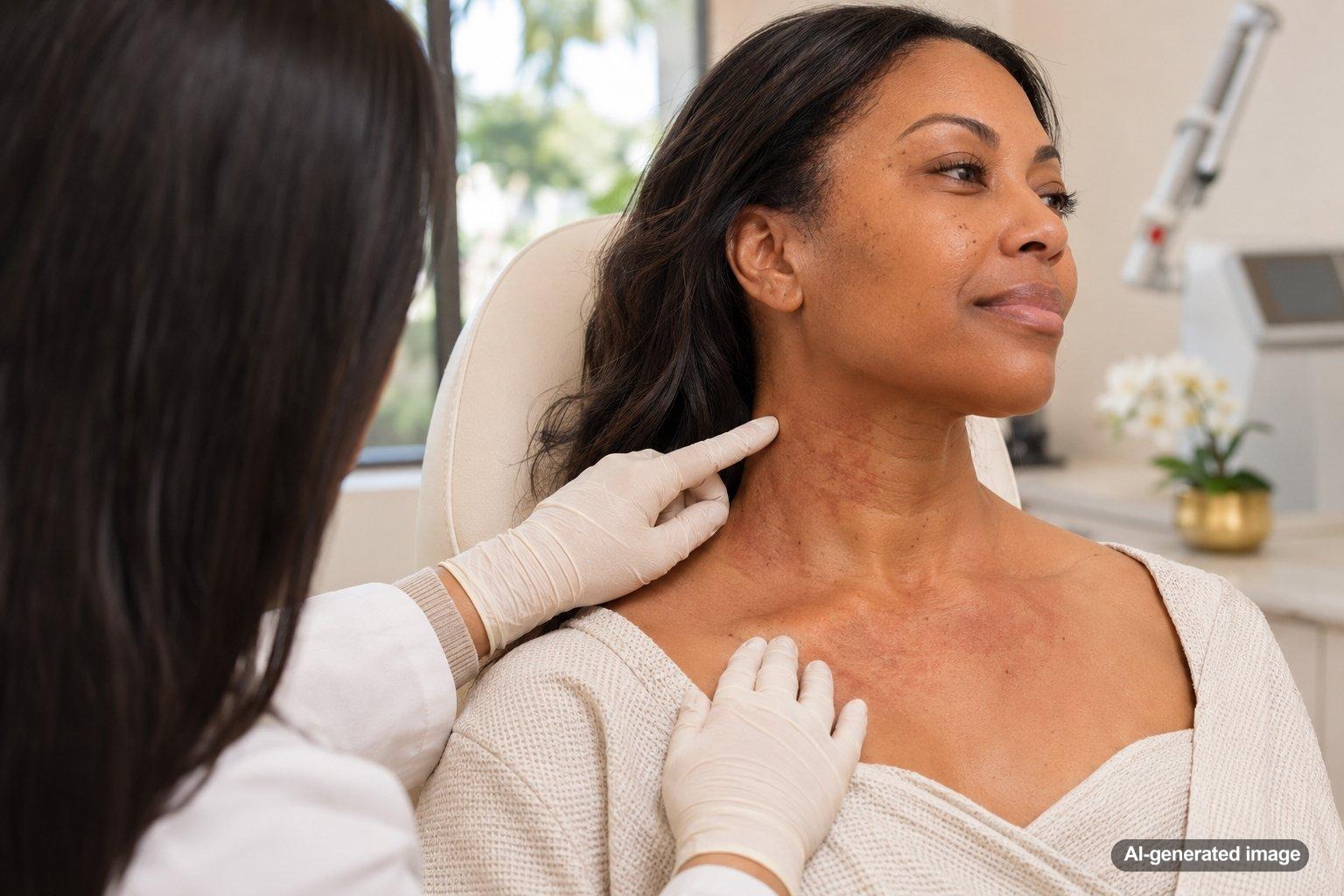
Yes, laser treatment may improve both the redness and brown discoloration associated with poikiloderma, particularly poikiloderma of Civatte, a chronic skin condition that commonly affects the sides of the neck and upper chest. Certain lasers target visible blood vessels, while other laser and light-based approaches may help address uneven pigmentation. The degree of improvement depends on the skin’s characteristics, the treatment selected, and individual response.
For many people, the concern is not a single dark spot or a patch of redness. It is a persistent mixture of reddish, brown, and sometimes lighter areas that makes the skin look uneven. This combination requires a thoughtful approach because treating pigment and treating blood vessels are not necessarily the same process. A dermatologist can evaluate the pattern and help determine whether laser treatment is appropriate.
Quick Answer: Can Lasers Improve Poikiloderma?
- Redness: Vascular lasers may help reduce the appearance of small, dilated blood vessels that contribute to persistent redness.
- Brown discoloration: Selected laser and light-based treatments may improve certain areas of excess pigmentation.
- Combined discoloration: Some treatments address both vascular and pigment-related changes, although responses can differ.
- Multiple sessions: Gradual improvement may require more than one appointment, depending on the treatment plan.
- Long-term care: Consistent sun protection remains important because additional ultraviolet exposure can contribute to recurring discoloration.
Laser treatment is generally intended to improve the visible appearance of poikiloderma rather than eliminate the underlying tendency toward sun-related skin changes.
What Is Poikiloderma of Civatte?
Poikiloderma of Civatte is a chronic condition characterized by a combination of pigmentation changes, fine visible blood vessels, and sometimes thinning of the skin. It most often develops in areas that have experienced repeated sun exposure over time.
The sides of the neck are particularly common locations. The upper chest and lower portions of the cheeks may also be affected. A distinguishing feature is that the shaded skin directly beneath the chin often remains relatively unaffected.
The discoloration can appear mottled rather than uniform. Some areas look reddish because of dilated superficial blood vessels, while others appear tan or brown because of increased pigmentation. Small lighter areas may also be present.
Although poikiloderma of Civatte is generally considered benign, not every red or brown patch on the neck represents this condition. A dermatologist can distinguish it from other causes of discoloration before recommending treatment.
Why Does Poikiloderma Cause Both Red and Brown Discoloration?
The mixed appearance reflects several skin changes occurring together. Repeated ultraviolet exposure is a major contributing factor, but other influences may also play a role.
Common contributors include:
- Long-term sun exposure: Ultraviolet radiation can contribute to pigmentation irregularities and changes in superficial blood vessels.
- Visible capillaries: Small, dilated vessels beneath the skin contribute to the reddish appearance.
- Altered pigmentation: Uneven melanin distribution contributes to brown patches and mottling.
- Skin aging: Changes in skin structure over time may make discoloration and small blood vessels more noticeable.
- Fragrance sensitivity: Perfumes and fragranced products applied to sun-exposed skin may contribute to the condition in some individuals.
- Individual susceptibility: Skin type, cumulative environmental exposure, and other personal factors may influence the appearance.
Because these changes involve different structures within the skin, a treatment that improves redness may not improve brown pigmentation to the same degree.
How Laser Treatment May Reduce Redness
The reddish component of poikiloderma is often associated with telangiectasia, the medical term for small, enlarged blood vessels visible near the skin’s surface.
Vascular lasers deliver controlled light energy that is absorbed by blood-related structures within the targeted vessels. This process can reduce the appearance of selected vessels while limiting effects on surrounding tissue when the device and treatment settings are appropriately chosen.
Several vascular laser technologies have been used for poikiloderma, including pulsed dye lasers and certain potassium titanyl phosphate, or KTP, lasers.
Some patients notice that redness becomes less prominent or more evenly distributed after treatment. However, the amount of improvement varies, and areas containing both vascular and pigment changes may need a more individualized approach.
The neck and chest deserve particular care because their skin characteristics differ from those of the face. Treatment settings should reflect these differences rather than simply applying a facial laser protocol to another area.
Can Laser Treatment Also Improve Brown Pigmentation?
Brown discoloration develops through pigment-related changes rather than enlarged blood vessels alone. Certain laser wavelengths and light-based treatments can interact with melanin, the pigment responsible for much of the skin’s color.
Depending on the pattern and depth of pigmentation, a dermatologist may consider options that target pigment directly or provide broader treatment of both brown and red discoloration.
Intense pulsed light, commonly called IPL, is one option frequently discussed for poikiloderma of Civatte. Although IPL is not technically a laser, it uses filtered light to address selected pigment and vascular changes. Published dermatology references describe its use in improving the mixed discoloration associated with this condition.
Some nonablative fractional laser approaches have also been studied for improving aspects of poikiloderma, including pigmentation, vascular changes, and texture.
Not every brown patch responds equally. Pigmentation depth, natural skin tone, recent tanning, and the presence of other pigmentary conditions can influence treatment selection and outcomes.
Which Professional Treatments May Be Considered?
The most appropriate option depends on whether redness, brown pigmentation, or a combination of both is the main concern.
Vascular Laser Treatments
These treatments primarily target small visible blood vessels. They may be considered when persistent redness is the most noticeable component of poikiloderma. The specific wavelength and settings are selected according to skin type, treatment area, and vessel characteristics.
Intense Pulsed Light
IPL may address certain superficial brown spots and redness within the same treatment approach. Its suitability depends on individual skin characteristics, and it is not appropriate for every skin tone or pigmentation pattern.
Fractional Nonablative Lasers
Selected fractional treatments may be considered when textural changes accompany discoloration. Their ability to improve different components of poikiloderma varies, so they should not be assumed to replace a vascular-specific treatment.
Topical Pigment Management
A dermatologist may also discuss topical products that help manage certain forms of excess pigmentation. These products generally have a more limited effect on visible blood vessels, and irritated or fragile skin may require a conservative approach.
At Waverly DermSpa, we offer Excel V+ and can help you understand whether it may be appropriate.
What Can You Do at Home to Support Your Skin?
Even when professional treatment is being considered, daily skin care remains important. The goal is to reduce additional sun-related damage and avoid unnecessary irritation.
- Protect the neck and chest daily: Apply a broad-spectrum sunscreen with SPF 30 or higher to exposed skin, following product directions for reapplication. Higher protection may be appropriate depending on your circumstances.
- Use protective clothing: Hats, high-neck clothing, and shade can help reduce ultraviolet exposure during outdoor activities.
- Avoid applying fragrance to affected areas: Consider placing perfume on clothing instead of directly on the neck or chest, while being mindful of fabric sensitivity.
- Choose gentle skincare: Mild cleansers and fragrance-free moisturizers may be more comfortable than aggressive exfoliating products.
- Be cautious with strong active ingredients: Do not assume that a more intensive pigment-correcting routine will improve the condition faster. Irritation can complicate skin discoloration.
- Maintain consistent habits: Sun protection matters during ordinary activities such as driving, walking, and spending time near windows, not just during beach visits.
For people who spend time in South Florida, year-round attention to sun exposure is especially relevant. Regular outdoor activities, travel, and time on the water can add to cumulative exposure.
What Should You Expect Before and After Treatment?
A consultation typically begins with an examination of the discoloration, discussion of your skin history, and assessment of the treatment area. Your dermatologist may ask about previous laser procedures, tanning, sensitivity, medications, and skincare products.
Recent sun exposure and natural skin pigmentation are important considerations because laser and light treatments can sometimes cause unintended pigment changes.
After treatment, temporary redness, swelling, or a change in the appearance of treated pigment may occur. Certain vascular laser settings can also produce bruising. Less common complications include burns, prolonged discoloration, and scarring.
The exact recovery experience depends on the technology used and the individual’s response. Your clinician should provide treatment-specific aftercare instructions, including guidance about sun exposure and when to resume active skincare products.
Improvement is often assessed over time rather than immediately after a session. Some areas may respond more readily than others, and additional treatments or maintenance may be discussed.
When Should You See a Dermatologist?
A dermatologist should evaluate persistent or unexplained red and brown discoloration before cosmetic treatment, particularly when the pattern is new or changing.
Schedule an assessment if:
- Discoloration is spreading or changing noticeably.
- A patch becomes painful, bleeds, crusts, or develops a new raised area.
- The skin appears unusually thin, inflamed, or fragile.
- You notice a new or changing individual spot within a larger area of discoloration.
- Previous skincare products or procedures have caused significant irritation or darkening.
- You are uncertain whether the changes represent poikiloderma or another skin condition.
These findings do not necessarily indicate a serious problem, but they deserve an appropriate examination. A dermatologist can evaluate the skin, identify concerns that require medical attention, and determine whether cosmetic treatment should be considered.
Frequently Asked Questions
Can laser treatment remove all the redness and brown discoloration?
Complete clearing cannot be assumed. Laser and light treatments may reduce visible redness and certain pigment changes, but results vary. Poikiloderma is a chronic condition, and residual or recurring discoloration is possible.
Is IPL better than a vascular laser for poikiloderma?
Neither is universally preferable. IPL may be useful when both superficial pigmentation and redness are present, while a vascular laser may be selected when visible blood vessels are the primary concern. Skin type and individual treatment risks help guide the decision.
How many laser sessions are needed for poikiloderma?
The number varies according to the extent of discoloration, the device used, treatment settings, and individual response. Some treatment plans involve multiple sessions, but an accurate estimate requires an in-person assessment.
Can poikiloderma return after laser treatment?
Yes. Additional ultraviolet exposure and ongoing skin changes can contribute to the reappearance or progression of discoloration. Consistent sun protection may help preserve improvement and reduce further damage.
Is laser treatment appropriate for darker skin tones?
Some laser treatments may be considered for darker skin tones, but the risk of unwanted pigmentation changes can be higher with certain devices and settings. A dermatologist experienced in treating diverse skin tones can evaluate available options and their limitations.
Can skincare products replace laser treatment?
Some topical products may improve certain pigment changes, but they generally cannot address visible dilated blood vessels in the same way as a vascular laser. Gentle skincare and sun protection remain useful regardless of whether a procedure is selected.
The Bottom Line
Laser treatment may improve the red and brown discoloration associated with poikiloderma of Civatte, particularly when the treatment is selected to address the specific combination of visible blood vessels and pigmentation changes. However, the condition is chronic, treatment responses vary, and the neck and chest require careful consideration.
A personalized dermatology evaluation is the most useful starting point for understanding which changes may respond to treatment, what limitations to expect, and how to protect the skin afterward.
Ready to get help?
Schedule an appointment or send a message and our team will get back to you.
Prefer to call? 954-666-3736
Disclaimer
This article is for educational purposes and is not medical advice. For diagnosis and personalized treatment, please book an appointment with a board-certified dermatologist.
Sources & further reading
- DermNet – Poikiloderma of Civatte
- American Academy of Dermatology (AAD) – Skin conditions that lasers can treat
- DermNet – KTP laser treatment
