

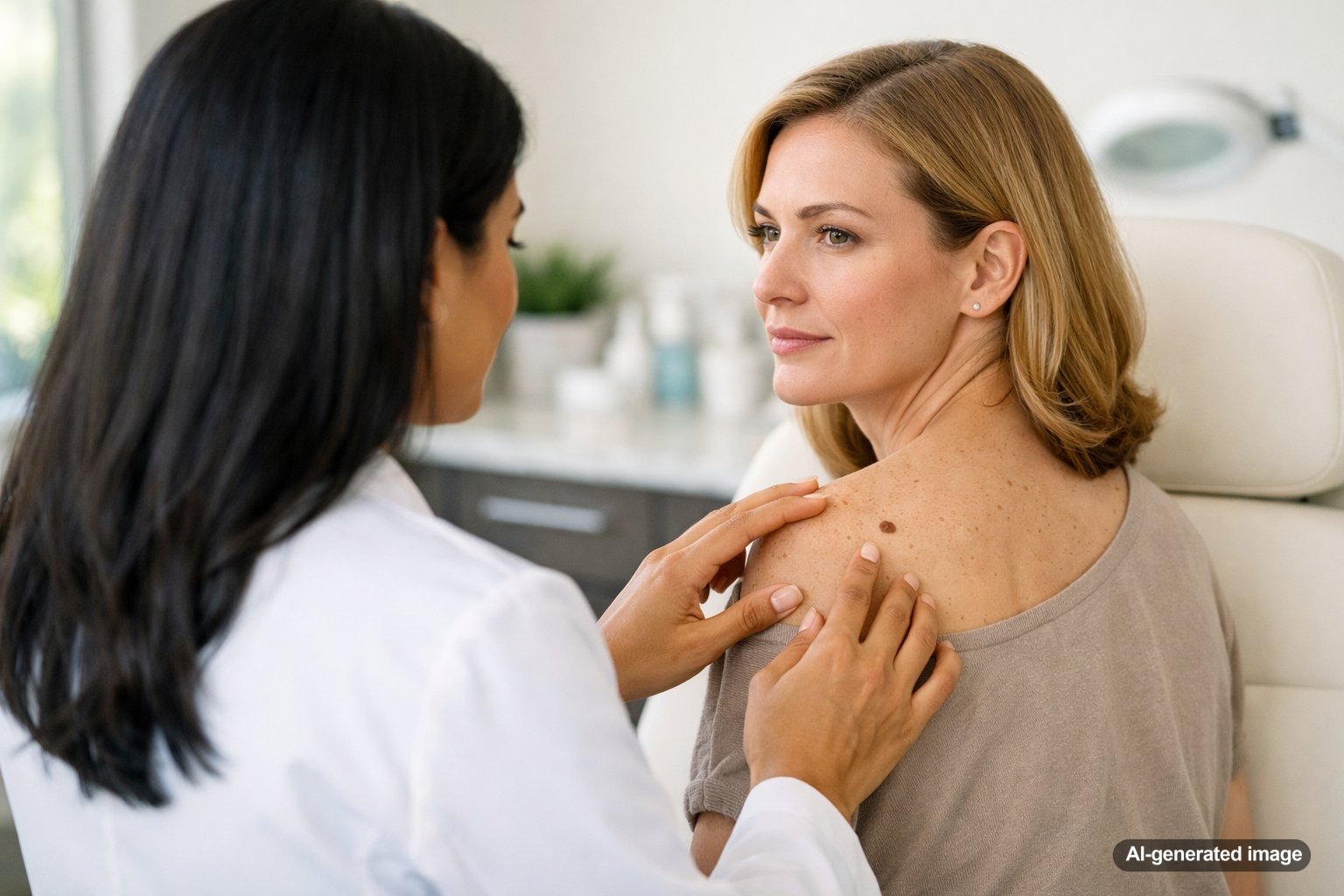
Most freckles are harmless, and many moles are harmless too. The part that matters is not whether a spot is dark or flat, but whether it is new, changing, unusual for you, or acting differently. A freckle is usually a small flat spot that becomes more noticeable with sun exposure. A mole is often a more defined growth or mark that may be flat or raised and tends to stay more stable over time.
That said, it is not always possible to tell the difference at home, especially if a spot has changed in color, border, size, or feel. If you’re unsure, it’s worth getting checked. A dermatologist can evaluate a spot closely and decide whether it looks benign, needs monitoring, or should be biopsied.
Quick answer
- Freckles are usually small, flat, sun-related pigment spots and are often uniform in color.
- Moles can be flat or raised and may be tan, brown, pink, or darker.
- A spot deserves attention if it is changing, itching, bleeding, crusting, or stands out from your other spots.
- The ABCDE rule can help you notice warning signs, but it does not replace an exam.
- If a mole or freckle looks different from the rest, a dermatologist can evaluate it.
What is the difference between a freckle and a mole?
Freckles are flat pigment spots that commonly appear on sun-exposed skin. They often become darker in sunny months and lighter when sun exposure decreases. They are usually small and fairly even in color.
Moles are clusters of pigment-producing cells. They can be flat or raised, smooth or slightly textured, and they may appear anywhere on the body. Many are completely benign and remain stable for years.
A spot becomes more concerning when it breaks its usual pattern. That can mean a mole that starts changing or a dark spot that does not behave like your other freckles.
Common clues that a spot may need a closer look
- Asymmetry: one half does not match the other.
- Border changes: edges look ragged, blurred, or uneven.
- Color variation: more than one shade appears in the same spot.
- Diameter: the spot is getting larger, especially beyond about 6 mm, though smaller lesions can still matter.
- Evolving: the spot changes in size, shape, color, texture, or symptoms.
- Symptoms: itching, tenderness, bleeding, crusting, or a sore that does not seem to heal.
- Ugly duckling sign: one spot looks noticeably different from the others on your skin.
What you can do at home
It is reasonable to keep an eye on your skin between visits. Once a month, check your skin in good lighting and note any spot that looks new or different. Taking a simple photo can help you notice whether a lesion is stable or changing over time.
Daily sun protection matters too. Broad-spectrum sunscreen, shade, and protective clothing can help limit new sun damage and make it easier to notice meaningful changes instead of ongoing irritation or darkening from UV exposure.
Avoid picking at a spot or trying to remove it yourself. Trauma can make a lesion look more inflamed and can make it harder to evaluate.
Professional options
A dermatologist may examine a spot visually and with a dermatoscope, which helps reveal patterns not visible to the naked eye. If a lesion appears suspicious, common next steps may include close monitoring, photography for comparison, or a biopsy to identify exactly what it is.
Because this topic centers on distinguishing benign spots from possible skin cancer, an in-person evaluation is often the most helpful next step when something is changing or does not look right.
When to see a dermatologist
- A spot is new and looks unusual for you.
- An existing mole has changed in size, shape, color, or texture.
- The area itches, bleeds, crusts, or becomes tender.
- You notice a dark streak under a nail or a new pigmented spot on the palms, soles, or mucosal skin.
- You have many moles, a history of atypical moles, heavy sun exposure, or a personal or family history of skin cancer.
FAQ
Can a freckle turn into skin cancer?
A typical freckle is usually harmless. The bigger concern is a spot that looks like a freckle at first but starts changing, darkening unevenly, or behaving differently from nearby spots.
Are raised spots more dangerous than flat ones?
Not necessarily. Some harmless moles are raised, and some concerning lesions are flat. Change over time is often more important than whether a spot is flat or raised.
Does every suspicious mole need a biopsy?
Not always. Some spots can be monitored, while others should be sampled. A dermatologist can help decide which approach makes the most sense.
Should I worry if a mole has always looked unusual?
Long-standing stable moles are often less concerning than spots that are changing. Still, if one has an irregular look or you are not sure what is normal for you, it is reasonable to have it checked.
Ready to get help?
Schedule an appointment or send a message and our team will get back to you.
Prefer to call? 954-666-3736
This article is for educational purposes and is not medical advice. For diagnosis and personalized treatment, please book an appointment with a board-certified dermatologist.
Sources & further reading
- American Academy of Dermatology (AAD) – ABCDEs of melanoma
- Cleveland Clinic – Freckles: What They Are, vs. Moles, Causes & Removal
- Mayo Clinic – Melanoma – Symptoms and causes
