

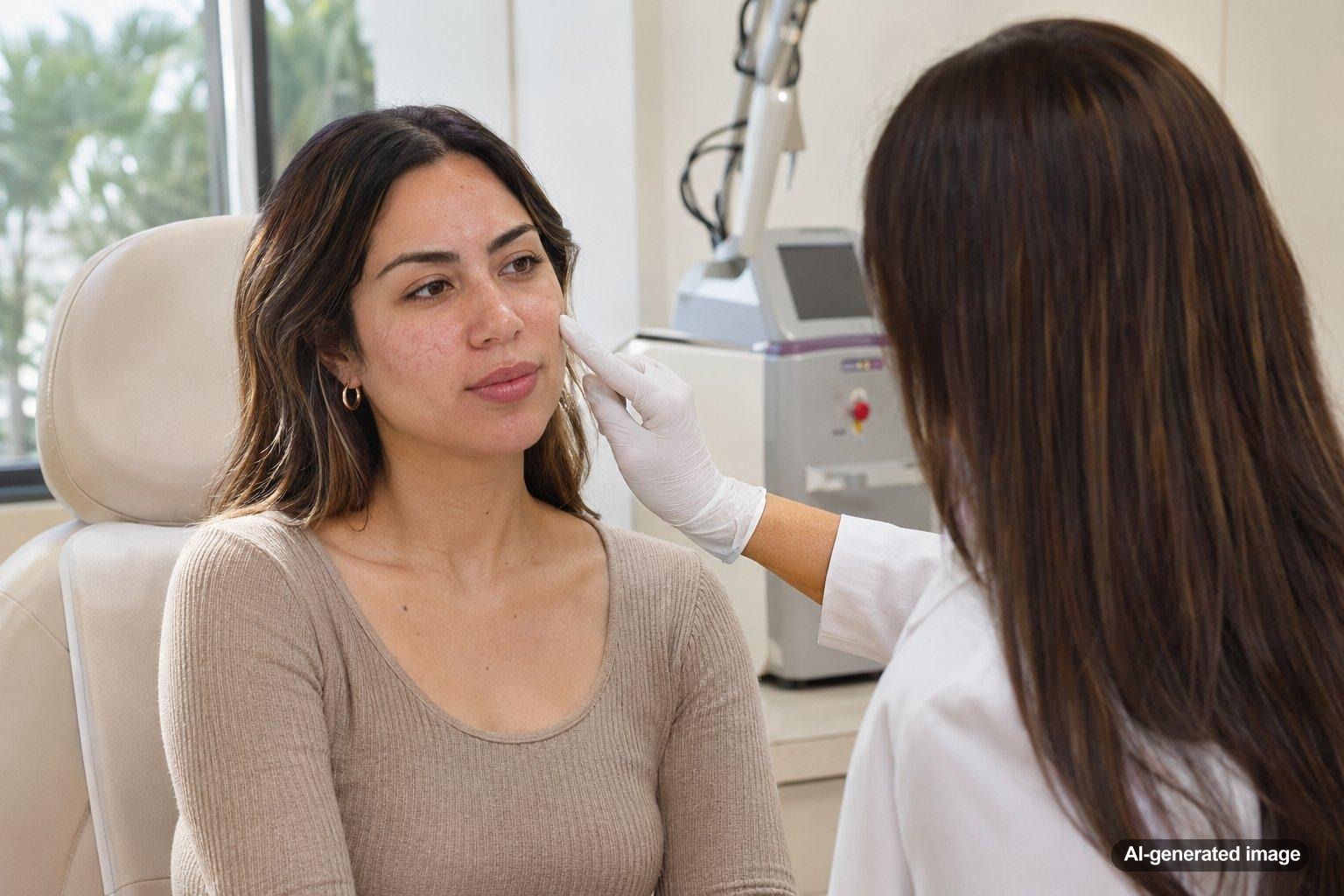
Many people need approximately one to three laser sessions to improve visible facial spider veins, although some may need additional treatments. Small, isolated vessels may respond after a single visit, while more extensive redness or networks of visible blood vessels often require a series of sessions. The number depends on the vessels themselves, the treatment technology, your skin characteristics, and how your skin responds.
Facial spider veins can be frustrating because they may remain visible even when your skincare routine is otherwise working well. They commonly appear around the nose, across the cheeks, or on other sun-exposed areas. Fortunately, vascular laser treatments may help reduce their appearance. Understanding what determines the number of sessions can make the consultation process more straightforward and help establish realistic expectations.
Quick Answer: How Many Sessions Are Typically Needed?
- One session: Some small, superficial facial vessels may improve substantially after one treatment.
- Two to three sessions: A short series is often considered when several vessels are present or when the initial treatment produces only partial improvement.
- Additional sessions: More extensive vascular changes, persistent background redness, or vessels that respond gradually may require further treatment.
- Treatment spacing: Appointments are commonly separated by several weeks so the skin can recover and the clinician can evaluate the response.
- Individual evaluation matters: A dermatologist can assess the vessel pattern and recommend an appropriate approach rather than assigning a fixed number of sessions in advance.
These ranges are general planning estimates, not a prediction of an individual result. A treatment plan may change after the first session once the response becomes clearer.
What Are Facial Spider Veins?
Facial spider veins are small, visible blood vessels near the surface of the skin. Dermatologists often refer to these enlarged superficial vessels as telangiectasias. They may look like delicate red lines, branching patterns, or fine networks of vessels beneath the skin.
They are especially noticeable around the sides of the nose and across the cheeks. Some appear as distinct individual lines, while others blend into areas of persistent facial redness.
Although the term spider veins is also used for visible leg veins, facial vessels are different in important ways. Their size, depth, location, and surrounding skin influence which treatment methods may be appropriate.
Facial spider veins are often cosmetic concerns, but not every red line or persistent red patch represents a simple superficial vessel. A dermatologist can examine the area and determine whether additional evaluation is appropriate before cosmetic treatment.
Why Do Some People Need More Laser Sessions Than Others?
The number of appointments depends on more than how noticeable a vessel looks in the mirror. Several characteristics can influence its response to treatment.
Vessel Size and Depth
Very fine, superficial vessels may respond differently from larger or deeper vessels. Laser energy must reach the appropriate target while limiting unnecessary effects on surrounding tissue. Some vessels may become less visible after one session, while others need repeated treatment.
The Number of Visible Vessels
A single line near the nose presents a different treatment situation from numerous vessels extending across both cheeks. Widespread networks may need more than one appointment to address the area appropriately and assess improvement.
Whether Background Redness Is Present
Distinct facial vessels and diffuse redness are related but not identical concerns. Someone with a few isolated vessels may have different treatment goals from someone experiencing persistent flushing or rosacea-associated redness.
When both individual vessels and broader redness are present, treatment may be planned in stages, and the overall response may be more gradual.
Skin Tone and Treatment Settings
Skin pigmentation influences how laser energy interacts with the skin. A dermatologist considers skin tone, recent tanning, pigmentation history, and other individual characteristics when selecting treatment settings. Safety and appropriate treatment selection take priority over attempting to obtain the fastest visible change.
Response to the First Session
The first appointment can provide useful information about how the targeted vessels respond. Some may become less noticeable relatively quickly, while others change gradually or remain visible. A follow-up assessment helps determine whether further treatment makes sense.
What Causes Spider Veins on the Face?
Several factors may contribute to the development of visible facial blood vessels. More than one factor can be present at the same time.
- Sun exposure: Repeated ultraviolet exposure can contribute to changes in the skin and the appearance of superficial blood vessels.
- Rosacea: This inflammatory skin condition can be associated with persistent redness, flushing, and visible facial vessels.
- Genetics: Some people are more prone to developing noticeable superficial vessels.
- Age-related skin changes: Changes in skin structure over time can make certain vessels more apparent.
- Repeated flushing: Heat, temperature changes, alcohol, and other individual triggers may contribute to visible redness, particularly in people with rosacea.
- Local irritation or injury: Certain forms of skin irritation or trauma may be associated with localized vascular changes.
Identifying contributing factors can help guide a broader skincare and maintenance plan, but the visible appearance alone does not establish a specific cause.
How Does Laser Treatment Work on Facial Spider Veins?
Vascular laser treatments use carefully selected wavelengths of light that can be absorbed by hemoglobin, the pigment in blood. This energy produces a controlled effect within targeted blood vessels. Over time, the treated vessels may become less noticeable as the body processes the affected tissue.
Different vascular systems use different wavelengths and treatment approaches. The appropriate choice depends on the vessel characteristics, skin type, and clinical assessment.
During treatment, patients may notice brief sensations of warmth or snapping against the skin. Cooling methods may be used to improve comfort and protect the skin. Sensations and tolerability vary, and the treatment team can discuss what to expect before proceeding.
Temporary redness, swelling, or localized discoloration may follow a session. Depending on the treatment approach, some vessels may temporarily appear darker before they become less visible. Less common complications can include blistering, changes in skin pigmentation, scarring, or other unwanted skin reactions.
Because treatment involves medical laser equipment and individual skin considerations, a dermatologist should evaluate the area and explain the potential benefits, limitations, and risks.
How Long Should You Wait Between Laser Sessions?
Facial vascular laser appointments are often spaced several weeks apart, commonly around four to six weeks or longer depending on the device, treatment intensity, and individual recovery. This is a general range rather than a required schedule.
Spacing sessions gives the skin an opportunity to settle and allows the clinician to assess how much improvement has occurred. Treating an area again before the response is clear may not be necessary or appropriate.
For example, someone who notices substantial improvement after the initial session may not need another treatment immediately. Someone with remaining visible vessels may benefit from reassessment once temporary post-treatment redness has resolved.
The interval may also depend on recent sun exposure, skin sensitivity, travel plans, and the condition of the treatment area.
When Will Facial Spider Veins Look Better After Laser Treatment?
Visible improvement does not always happen immediately after a laser appointment. Some treated vessels may look less noticeable relatively soon, while others may take several weeks to fade. Temporary swelling or redness can also make early results difficult to judge.
The expected timeline depends on the type of vascular laser, the vessels being treated, and the settings used. A clinician may recommend waiting until the area has recovered before deciding whether another session is necessary.
It is also helpful to distinguish improvement in individual vessels from improvement in overall facial redness. These changes may occur at different rates, particularly when rosacea or another underlying condition contributes to the appearance.
Taking photographs under consistent lighting may make gradual changes easier to evaluate. Your treatment team may use standardized clinical photography to compare progress between visits.
Can Facial Spider Veins Return After Laser Treatment?
Successfully treated vessels may remain less visible for an extended period, but new superficial vessels can develop later. Laser treatment addresses targeted visible vessels; it does not eliminate every factor that contributes to future vascular changes.
For example, continued sun exposure, genetic tendencies, rosacea, and other skin-related factors may influence whether additional vessels become noticeable over time.
Some people choose occasional follow-up treatments when new vessels appear. Others may be satisfied with their improvement and need no further appointments for a considerable period.
Maintenance is individualized rather than automatically scheduled. A dermatologist can help distinguish remaining vessels from newly developing ones and discuss whether another treatment is worthwhile.
What Can You Do at Home to Support Your Skin?
Home skincare generally cannot remove established facial telangiectasias, but gentle habits may help support the surrounding skin and reduce avoidable irritation.
- Use consistent sun protection: Choose a broad-spectrum sunscreen with SPF 30 or higher and follow the product directions for application and reapplication.
- Keep skincare gentle: A mild cleanser and appropriate moisturizer may help maintain comfort, particularly if the skin is prone to redness.
- Recognize flushing triggers: If heat, particular beverages, or environmental conditions repeatedly cause flushing, paying attention to those patterns may be useful.
- Avoid aggressive home procedures: Harsh scrubs, excessive exfoliation, and attempts to treat visible vessels with unapproved home devices may irritate the skin.
- Follow individualized aftercare: After a laser appointment, use the instructions provided by the treating clinician rather than assuming that every laser procedure has the same recovery requirements.
These measures are supportive, not substitutes for evaluating persistent or changing facial redness.
What Professional Treatment Options Are Available?
Vascular laser treatment is one professional option for reducing the appearance of facial spider veins. Depending on the pattern of redness and vessel characteristics, a dermatologist may also consider other light-based technologies or treatment approaches.
Vascular lasers are designed to target blood vessels and may be especially relevant when distinct superficial vessels are visible. Different wavelengths can be selected for different clinical situations.
Intense pulsed light (IPL) uses a range of light wavelengths rather than a single laser wavelength. It may be considered for selected forms of diffuse facial redness or visible vascular changes, depending on individual skin characteristics.
Management of associated skin conditions may also be important. If rosacea or another condition contributes to ongoing redness, addressing that condition can complement discussions about cosmetic vessel treatment.
At Waverly DermSpa, we offer Excel V+ and can help you understand whether it may be appropriate.
A consultation with Dr. Maryann Mikhail, MD, can help clarify which concerns are suitable for treatment, what level of improvement may be realistic, and how a treatment series might be organized.
When Should You See a Dermatologist?
A dermatology evaluation is useful before treating facial vessels, especially if the redness is new, changing, or accompanied by other symptoms.
Consider professional assessment when:
- Facial redness persists or gradually spreads without a clear explanation.
- Visible vessels occur alongside frequent flushing, burning, stinging, or inflammatory bumps.
- A red spot or lesion bleeds, crusts, changes appearance, or does not heal.
- Redness develops suddenly or is associated with unusual swelling or other concerning symptoms.
- Previous laser or light treatments caused significant irritation or pigmentation changes.
- You have a history of pigment changes, recent tanning, or other factors that may influence procedural planning.
Not every visible red mark should be treated as a cosmetic spider vein. A dermatologist can determine whether the appearance is consistent with superficial telangiectasia or whether another explanation needs attention.
Frequently Asked Questions
Can facial spider veins disappear after just one laser session?
Some small, superficial vessels may become substantially less noticeable after one session. Others require additional treatment or respond only partially. The likelihood of improvement depends on the vessel characteristics, skin type, and selected treatment approach.
Is two or three sessions a normal treatment plan?
Yes. A plan involving approximately two or three sessions is a reasonable possibility for certain facial vascular concerns. However, this is not a universal requirement. Some individuals need fewer sessions, while others benefit from further evaluation and treatment.
Does laser treatment for facial spider veins hurt?
Patients may experience brief warmth or a snapping sensation during treatment. Comfort varies according to the treatment area, settings, device, and individual sensitivity. Cooling techniques may be used, and the clinician can explain available comfort measures.
Can laser treatment help spider veins around the nose?
Vascular laser treatment may help reduce certain visible vessels around the nose. These vessels can vary in size and depth, and the area may require more than one session. A dermatologist can assess the pattern and explain the available options.
Will laser treatment help facial redness caused by rosacea?
Vascular laser treatments may improve some visible vessels and persistent redness associated with rosacea. However, rosacea is a chronic condition that may also require individualized medical management and attention to triggers. Laser treatment does not address every feature of rosacea.
Can facial spider veins come back after treatment?
Previously treated vessels may remain less visible, but additional vessels can appear over time. Individual factors such as sun exposure, underlying skin conditions, and genetic tendencies can influence future changes. Some people may consider additional treatments if new vessels become bothersome.
Planning Your Facial Spider Vein Treatment
For many patients, one to three laser sessions is a useful starting point for discussing facial spider vein treatment, but the appropriate number can only be estimated after examining the skin. Vessel size, depth, distribution, background redness, and the response to the first treatment all influence the plan.
The most practical approach is to begin with a dermatology consultation, establish realistic goals, and reassess the results before committing to additional sessions. This allows treatment decisions to reflect your individual skin rather than a fixed schedule.
Ready to get help?
Schedule an appointment or send a message and our team will get back to you.
Prefer to call? 954-666-3736
Disclaimer
This article is for educational purposes and is not medical advice. For diagnosis and personalized treatment, please book an appointment with a board-certified dermatologist.
