

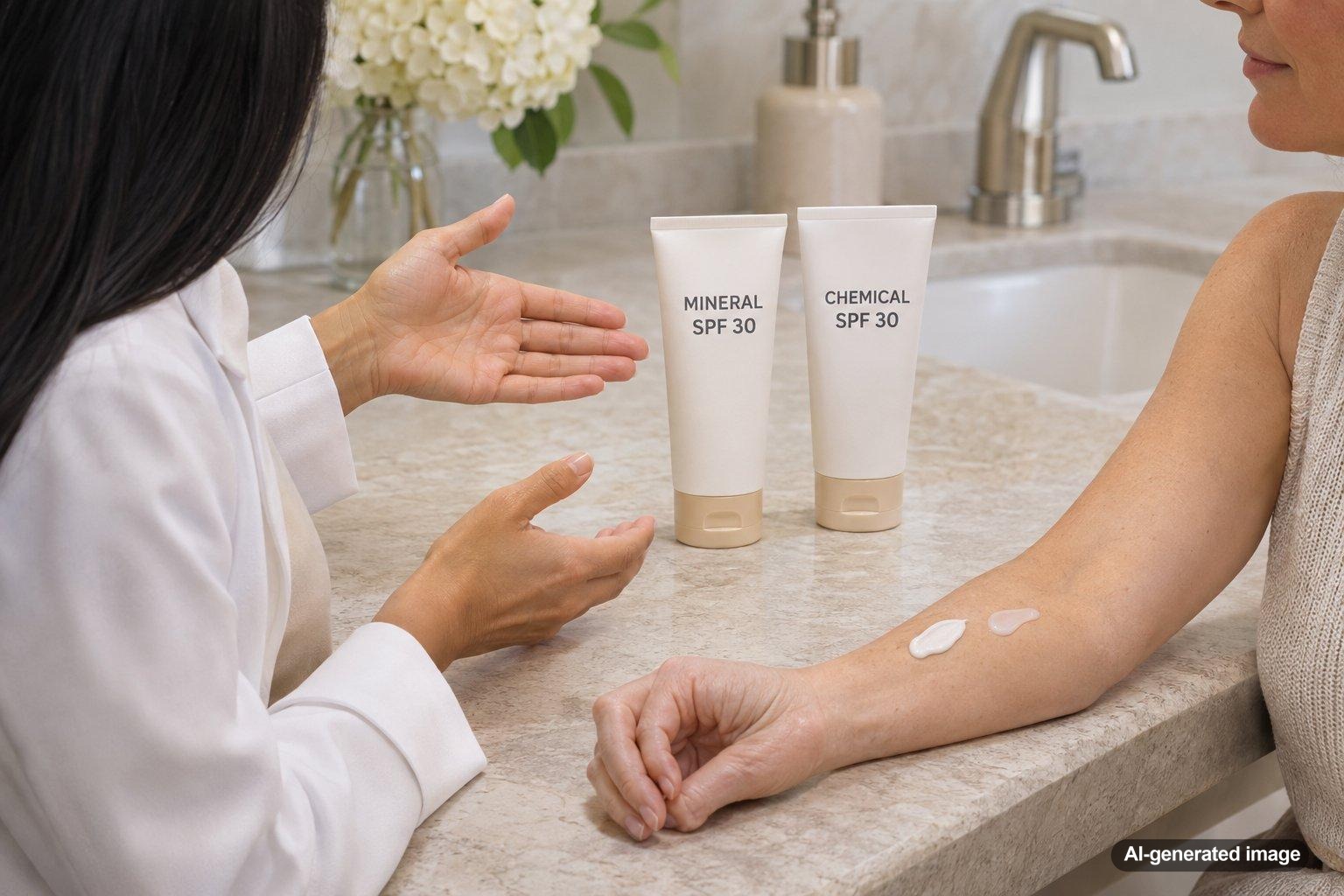
Mineral and chemical sunscreens both protect skin from ultraviolet (UV) radiation, but they differ in their active ingredients, formulation characteristics, and how they interact with sunlight. Mineral sunscreens use zinc oxide, titanium dioxide, or both, while chemical sunscreens rely on other UV-filtering ingredients. Neither category is automatically better for everyone. The most useful choice is a sunscreen that provides appropriate protection, feels comfortable on your skin, and fits naturally into your daily routine.
In Fort Lauderdale, where outdoor dining, boating, beach visits, and year-round sunshine are part of everyday life, understanding these differences can make sunscreen selection easier. Whether your priorities include sensitive skin, a lightweight finish, avoiding a white cast, or managing uneven pigmentation, the details matter more than the category name alone.
Quick Answer: Mineral vs. Chemical Sunscreen
- Mineral sunscreen: Uses zinc oxide, titanium dioxide, or both to protect against UV radiation.
- Chemical sunscreen: Uses other UV filters, such as avobenzone, octocrylene, octisalate, or newer approved ingredients, depending on the formula.
- How they work: Both categories absorb UV radiation. Mineral filters also reflect and scatter some UV radiation.
- Skin compatibility: Mineral formulas are often preferred for sensitive or easily irritated skin, while chemical formulas may offer a lighter or more transparent cosmetic finish.
- Protection matters most: Look for broad-spectrum SPF 30 or higher, appropriate water resistance, and a texture you are comfortable applying generously and regularly.
What Is Mineral Sunscreen?
Mineral sunscreen, also called physical sunscreen, contains zinc oxide, titanium dioxide, or a combination of the two as its active UV-filtering ingredients. These mineral particles work primarily by absorbing ultraviolet radiation, while also reflecting and scattering a portion of incoming light.
Older descriptions sometimes suggest that mineral sunscreen simply sits on the skin and acts like a mirror. That explanation is incomplete. Both mineral and chemical sunscreen filters absorb UV energy, although their optical properties and ingredient chemistry differ.
Many mineral sunscreens are formulated for people who experience stinging, redness, or discomfort with certain skincare products. Fragrance-free mineral options may be especially appealing when skin is easily irritated.
Advantages of mineral sunscreen
- Zinc oxide and titanium dioxide are often well tolerated by sensitive skin.
- Mineral-only formulas may be useful when other sunscreen filters cause discomfort.
- Tinted versions can help reduce the visible white cast associated with some untinted formulas.
- Certain tinted mineral products contain iron oxides, which may provide additional protection against visible light that can contribute to dark spots.
Potential disadvantages of mineral sunscreen
Some mineral products feel thicker, require more blending, or leave a pale or grayish residue, particularly on deeper skin tones. Formulation advances have improved cosmetic elegance, but results vary considerably. A tinted formulation or a more fluid mineral sunscreen may be easier to incorporate into daily use.
What Is Chemical Sunscreen?
Chemical sunscreen uses organic UV-filtering compounds rather than relying exclusively on zinc oxide or titanium dioxide. Common examples include avobenzone, octisalate, octocrylene, and octinoxate. Other filters may be available depending on the product and regulatory market.
These ingredients absorb UV radiation and convert the absorbed energy through molecular processes, including release as small amounts of heat. Mineral filters also absorb UV radiation, so the distinction is not simply that one type absorbs sunlight while the other reflects it.
Chemical sunscreens are available in lotions, lightweight fluids, gels, sprays, and moisturizing formulations. Many blend transparently and work comfortably under makeup, making them popular for everyday facial protection.
Advantages of chemical sunscreen
- Many formulas provide a lightweight, cosmetically transparent finish.
- Some are especially convenient under foundation or other facial products.
- A wide range of textures accommodates different skin preferences.
- Well-formulated products can provide effective broad-spectrum protection.
Potential disadvantages of chemical sunscreen
Some chemical sunscreen formulations may sting around the eyes or irritate sensitive skin. Fragrance, preservatives, and other inactive ingredients may also contribute to discomfort. These reactions are not universal, and the presence of a particular chemical UV filter does not mean a product will necessarily cause irritation.
The word ‘chemical’ should not be interpreted as inherently harmful. Mineral ingredients are chemicals as well. Sunscreen selection is better guided by the product’s protection, tolerability, and current regulatory information than by the terminology used to market it.
Mineral vs. Chemical Sunscreen: Key Differences
| Feature | Mineral Sunscreen | Chemical Sunscreen |
|---|---|---|
| Active ingredients | Zinc oxide and/or titanium dioxide | Other approved UV filters, depending on the product |
| UV protection mechanism | Primarily absorption, with some reflection and scattering | Primarily absorption |
| Typical appearance | May leave a white cast unless appropriately formulated or tinted | Often transparent after application |
| Sensitive skin | Often a useful starting point | Can be comfortable, but certain formulas may sting |
| Texture | Varies from rich creams to lightweight fluids | Often available in lightweight gels, lotions, and fluids |
| Effectiveness | Can provide effective broad-spectrum protection | Can provide effective broad-spectrum protection |
Hybrid sunscreens also exist. These combine mineral and chemical UV filters in one product, potentially offering a balance of texture, appearance, and skin compatibility. The active ingredient list is the most reliable way to identify which category a sunscreen belongs to.
Which Sunscreen Is Better for Sensitive or Acne-Prone Skin?
If your skin frequently stings or becomes uncomfortable after applying skincare products, a fragrance-free mineral sunscreen may be a sensible starting point. Zinc oxide and titanium dioxide are commonly recommended for sensitive skin, although the complete formulation still matters.
For acne-prone skin, look for descriptions such as ‘non-comedogenic’ or ‘won’t clog pores.’ Both mineral and chemical sunscreens are available in lighter formulations that may be comfortable for oily skin. A thick texture does not automatically mean a sunscreen will cause breakouts, just as a lightweight texture does not ensure that it will suit everyone.
People who experience ongoing redness, irritation, or burning should consider whether fragrance, moisturizers, preservatives, or other ingredients may be contributing. A dermatologist can evaluate persistent reactions and help distinguish product intolerance from an underlying skin condition.
Which Sunscreen Is Better for Melasma and Dark Spots?
For people concerned about melasma or uneven pigmentation, the most important features are dependable broad-spectrum UV protection and consistent application. Visible light can also contribute to pigmentation in some individuals, particularly those with darker skin tones.
A tinted sunscreen containing iron oxides may offer an additional advantage because iron oxides can help protect against visible light. This benefit is related to the tinting ingredients and the overall formulation rather than mineral sunscreen alone.
Not every tinted sunscreen contains the same ingredients or provides the same level of visible-light protection. Check the label and remember that even a carefully selected sunscreen is only one part of a broader pigmentation-management approach. Protective clothing, shade, and individualized dermatologic guidance may also be helpful.
Does Mineral Sunscreen Work Immediately?
A common claim is that mineral sunscreen works immediately while chemical sunscreen must always wait 15 to 30 minutes before becoming effective. This is an oversimplification.
Both types need to be applied thoroughly and evenly to form a protective film. Differences in drying time, film formation, and product instructions can affect practical use. Rather than relying on an assumed universal waiting period for either category, follow the directions on your particular sunscreen.
Applying sunscreen before heading outdoors gives you time to establish even coverage and reduces the chance of missing exposed areas.
How to Choose the Right Sunscreen for Everyday Use
When comparing products, start with the protection information on the label rather than the marketing category.
- Choose broad-spectrum protection: This indicates protection against both UVA and UVB radiation.
- Look for SPF 30 or higher: This is the minimum SPF generally recommended by the American Academy of Dermatology for everyday sun protection.
- Consider water resistance: For swimming, outdoor exercise, or humid conditions, look for a water-resistant product labeled for 40 or 80 minutes.
- Match the texture to your preferences: Lightweight fluids, moisturizing creams, and tinted options can accommodate different skincare routines.
- Consider fragrance-free formulas: These may be more comfortable for easily irritated skin.
- Evaluate the finish: A sunscreen that looks and feels comfortable is more likely to become a consistent part of your routine.
In South Florida, where outdoor exposure can occur during ordinary activities such as walking between appointments or sitting near a sunny window, a practical daily sunscreen routine is especially valuable. UVA radiation can pass through ordinary window glass, so protection may also matter during prolonged exposure near windows.
How to Apply Sunscreen Correctly
The effectiveness of either sunscreen category depends heavily on application. A high SPF number cannot compensate for applying too little product or failing to reapply during extended outdoor activities.
- Apply sunscreen generously to exposed skin before going outdoors.
- Remember frequently missed areas, including the ears, neck, upper chest, and backs of the hands.
- Use a broad-spectrum SPF lip balm to protect exposed lips.
- Reapply approximately every two hours while outdoors and after swimming, sweating, or towel drying, according to the product label.
- Do not assume that makeup containing SPF provides adequate protection if only a small amount is applied.
- Combine sunscreen with shade, protective clothing, and a wide-brimmed hat.
No sunscreen is completely waterproof or blocks all UV radiation. Water-resistant labeling indicates tested protection for a specified period during water exposure, not unlimited protection during swimming or exercise.
When Should You Ask a Dermatologist About Sunscreen?
Professional guidance may be helpful when multiple sunscreens cause persistent burning, itching, redness, or other troublesome reactions. A dermatologist can assess whether a particular ingredient, product formulation, or underlying skin concern may be involved.
It is also worth discussing sunscreen selection if you have persistent pigmentation concerns, use medications that increase sun sensitivity, or have a history of skin cancer or other conditions requiring particularly careful sun protection.
A new or changing skin growth, a lesion that bleeds without an obvious explanation, or a sore that does not heal warrants professional assessment rather than attempting to manage the concern with sunscreen alone.
At Waverly DermSpa in Fort Lauderdale, Dr. Maryann Mikhail, MD, can help patients understand sun protection as part of an individualized skincare plan, including how sunscreen choices may relate to skin sensitivity and pigmentation concerns.
Frequently Asked Questions
Is mineral sunscreen safer than chemical sunscreen?
Mineral sunscreen has a different ingredient profile and is often recommended for sensitive skin. However, that does not establish that every chemical sunscreen is harmful. The FDA evaluates sunscreen ingredients using available scientific evidence, and regulatory assessments can evolve as new data become available. Product-specific guidance is more useful than broad assumptions about either category.
Can chemical sunscreen cause acne?
Some sunscreen formulations may contribute to breakouts in susceptible individuals, but the chemical sunscreen category itself does not determine whether a product will clog pores. Look for a texture that suits your skin and consider products labeled non-comedogenic.
Does mineral sunscreen leave a white cast?
Some mineral sunscreens leave a visible white or grayish residue because of their zinc oxide or titanium dioxide particles. Tinted mineral sunscreens and newer formulations may reduce this effect. Results depend on the specific product and your skin tone.
Is SPF 50 chemical sunscreen better than SPF 30 mineral sunscreen?
SPF 50 provides a higher measured level of protection against sunburn than SPF 30 when products are tested and applied as directed. However, chemical versus mineral ingredients do not independently determine overall quality. Broad-spectrum coverage, water resistance, sufficient application, and consistent reapplication remain important.
Can I use mineral sunscreen under makeup?
Yes. Many mineral sunscreens are designed for daily facial use and can be worn beneath makeup. Allow the sunscreen to settle according to its instructions before layering other products. If makeup causes pilling or disrupts the sunscreen film, consider adjusting the combination of formulas.
Can I combine mineral and chemical sunscreen?
Products containing both mineral and chemical filters are available. Layering separate sunscreens is also possible, but it should not be assumed to produce the sum of their SPF ratings. Focus on applying an adequate amount of a tested broad-spectrum product and avoid mixing separate sunscreen formulas together before application.
The Bottom Line
Mineral and chemical sunscreens use different UV-filtering ingredients, but both can provide meaningful protection when appropriately formulated and used correctly. Mineral formulas may be particularly appealing for sensitive skin, while chemical formulas often provide a lighter, less visible finish. Hybrid and tinted options offer additional choices.
The most important sunscreen is one you can use consistently. Prioritize broad-spectrum SPF 30 or higher, comfortable application, appropriate water resistance, and regular reapplication. If you have persistent irritation or more complex pigmentation concerns, individualized guidance from a dermatologist can help simplify your decision.
Ready to get help?
Schedule an appointment or send a message and our team will get back to you.
Prefer to call? 954-666-3736
This article is for educational purposes and is not medical advice. For diagnosis and personalized treatment, please book an appointment with a board-certified dermatologist.
Sources & Further Reading
- American Academy of Dermatology (AAD) – How to decode a sunscreen label
- U.S. Food and Drug Administration (FDA) – Sunscreen: How to Help Protect Your Skin from the Sun
- American Academy of Dermatology (AAD) – How do I know if I’m using the right sunscreen?
