

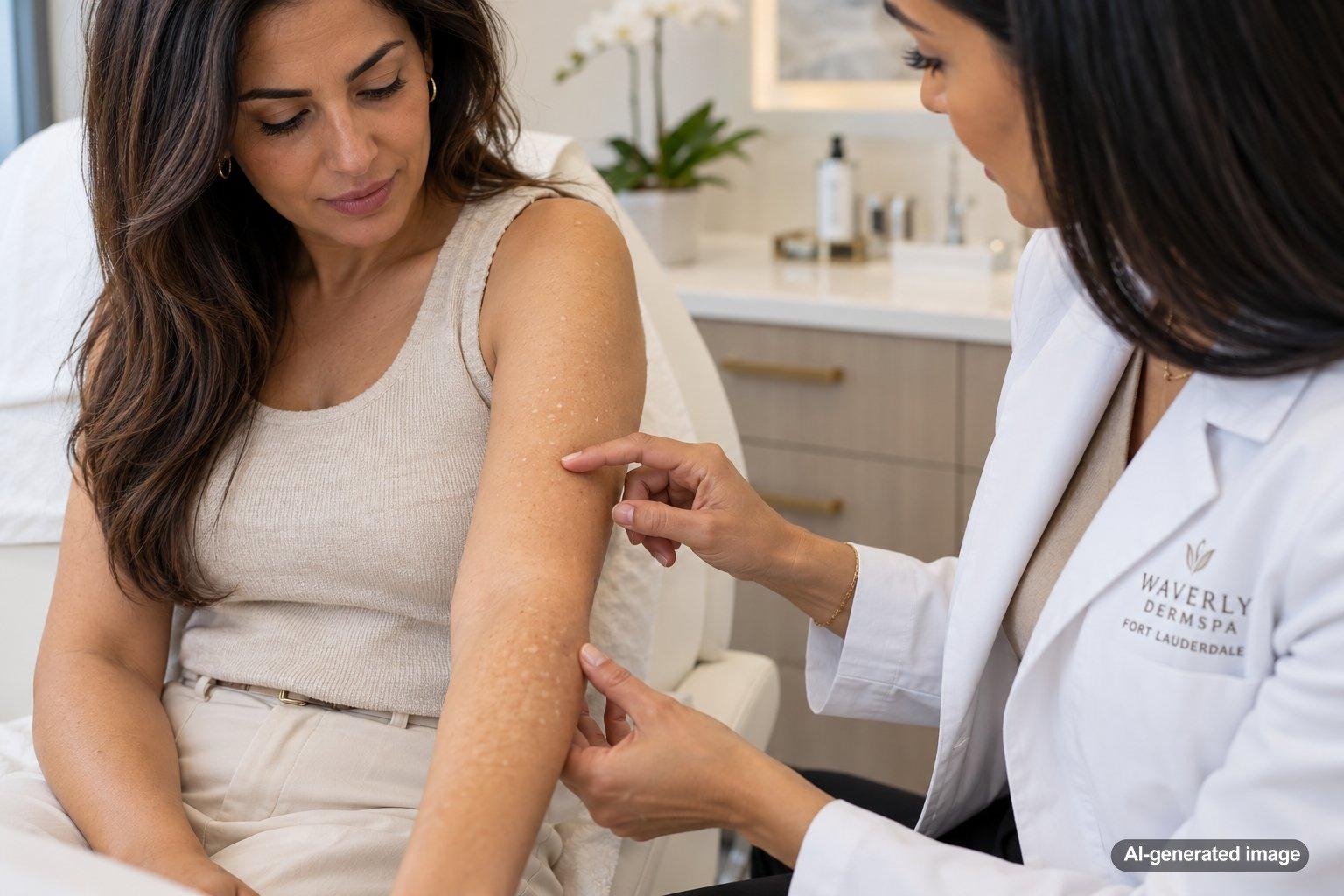
If you notice tiny white dots on your arms that seem to stay pale even when the surrounding skin gets darker, the difference is usually related to how pigment is being produced or distributed in those small areas. One possible explanation is idiopathic guttate hypomelanosis, often shortened to IGH, which can appear as small, flat, light-colored spots on sun-exposed skin. However, not every white spot has the same cause, so appearance alone isn’t enough to identify what you’re seeing.
These spots can become especially noticeable after time outdoors because the surrounding skin may tan while the lighter areas remain relatively unchanged. A dermatologist can examine the pattern, texture, location, and history of the spots to help distinguish among possible causes.
Quick answer
- Tiny white spots on the arms can develop when small areas of skin contain less visible pigment than the surrounding skin.
- One possible cause is idiopathic guttate hypomelanosis, which commonly appears as small, flat, pale spots on sun-exposed areas.
- A tan can make the spots look more obvious because the surrounding skin darkens while the pale areas may not.
- Other pigment conditions can look similar, so persistent, spreading, scaly, or otherwise changing spots are worth having evaluated.
- Consistent sun protection can reduce contrast and help limit additional sun-related pigment changes.
What are these tiny white dots?
Dermatologists use the term hypopigmentation when an area of skin appears lighter because it has less visible pigment than the skin around it. Small hypopigmented spots can develop for several reasons.
When the spots are tiny, flat, smooth, and scattered across sun-exposed forearms, one condition a dermatologist may consider is idiopathic guttate hypomelanosis. The name sounds complicated, but it describes small areas where the skin has lost some visible pigmentation. These spots are often noticed more easily when the surrounding skin becomes darker from sun exposure.
That pattern isn’t the only possibility. Previous inflammation or irritation, certain pigment disorders, and some superficial skin conditions may also produce lighter areas. An in-person examination can help clarify the difference.
Why don’t the white spots tan like the rest of my arm?
A tan develops when ultraviolet exposure stimulates pigment-related activity in the skin. If a small area has reduced pigment production or reduced visible pigment, it may not darken at the same rate as the surrounding skin.
This can create a stronger contrast after sun exposure. In other words, the spot may not suddenly be getting whiter. Instead, the skin around it may be getting darker, making an existing pale area easier to see.
Common reasons for small white spots on the arms
Several conditions can cause pale or white areas, and they don’t all behave the same way. Possibilities a dermatologist may consider include:
- Idiopathic guttate hypomelanosis: Small, usually flat pale spots that can occur on frequently sun-exposed areas such as the forearms and lower legs.
- Post-inflammatory hypopigmentation: Skin may temporarily or persistently look lighter after irritation, a rash, an injury, or another inflammatory process has settled.
- Vitiligo: A pigment condition that can create clearly lighter or white areas, although its pattern and distribution may differ from tiny scattered sun-related spots.
- Superficial skin conditions: Some conditions associated with subtle scaling or texture changes can also make areas appear lighter than surrounding skin.
The size, borders, texture, distribution, and progression of the spots can provide useful clues. Trying to identify the cause based only on color can be misleading.
Does sun exposure cause the spots?
Long-term sun exposure may contribute to some types of small pale spots, including patterns consistent with idiopathic guttate hypomelanosis. At the same time, sun exposure can make nearly any hypopigmented area more visually obvious by increasing pigment in the surrounding skin.
For someone living in or visiting South Florida, where exposed arms may receive substantial year-round sunlight, the contrast can be particularly noticeable. That doesn’t mean you should intentionally tan the area to test it. Additional ultraviolet exposure can create other unwanted skin changes.
What can I do at home?
Conservative skin care is usually the safest approach until you know what is causing the color difference.
- Use broad-spectrum sunscreen on exposed arms and reapply as appropriate for your activities.
- Avoid deliberately tanning the surrounding skin in an attempt to blend the spots.
- Use a gentle moisturizer if the skin is dry or irritated.
- Avoid aggressive scrubs, acids, bleaching products, or spot treatments unless you know what you’re treating.
- Take occasional photos in similar lighting if you want to track whether the number, size, or shape of the spots is changing.
Sunless tanning products may temporarily reduce visible contrast for some people, but they don’t address the underlying reason for pigment differences.
What professional options are available?
The first step is identifying the likely cause. A dermatologist may be able to distinguish common pigment patterns through examination and, when useful, additional office-based evaluation.
If the spots are consistent with a harmless pigment change, treatment may not be medically necessary. For people who are bothered by their appearance, a clinician can discuss whether topical or procedural approaches are reasonable. Results can vary, and some types of hypopigmentation can be difficult to blend completely with surrounding skin.
If another condition is suspected, management depends on that specific diagnosis. This is one reason it’s better to have persistent white spots evaluated before trying strong treatments at home.
When should I see a dermatologist?
Consider scheduling an evaluation if the spots are new and rapidly increasing, becoming much larger, merging into broader patches, developing scale or texture changes, or appearing alongside itching, irritation, or other symptoms. It’s also reasonable to get checked whenever you’re uncertain whether a pigment change is harmless.
A dermatologist can also examine the rest of your sun-exposed skin during the visit and help you build a practical sun-protection plan based on your skin type and lifestyle.
FAQ
Are tiny white dots on my arms always from sun damage?
No. Sun exposure can contribute to certain pigment patterns and can make existing pale spots more noticeable, but several unrelated conditions can also cause lighter areas of skin.
Why do I notice them more after vacation?
The surrounding skin may become darker with increased sun exposure while the pale spots change less, creating more visible contrast. This can make previously subtle spots suddenly seem prominent.
Can moisturizer make the white dots disappear?
Moisturizer can support dry or irritated skin, but it generally won’t restore pigment when the color difference is caused by reduced pigmentation. It may still help if dryness or surface scaling is making the contrast more noticeable.
Should I tan more to make the spots blend in?
No. Additional tanning often increases the contrast because the surrounding skin darkens. Consistent sun protection is a more skin-friendly approach.
Can tiny white spots spread?
Some pigment patterns may gradually become more numerous, while others remain stable or change for different reasons. If you’re noticing rapid spread or larger areas of pigment loss, a dermatologist can evaluate the pattern.
Ready to get help?
Schedule an appointment or send a message and our team will get back to you.
Prefer to call? 954-666-3736
This article is for educational purposes and is not medical advice. For diagnosis and personalized treatment, please book an appointment with a board-certified dermatologist.
