

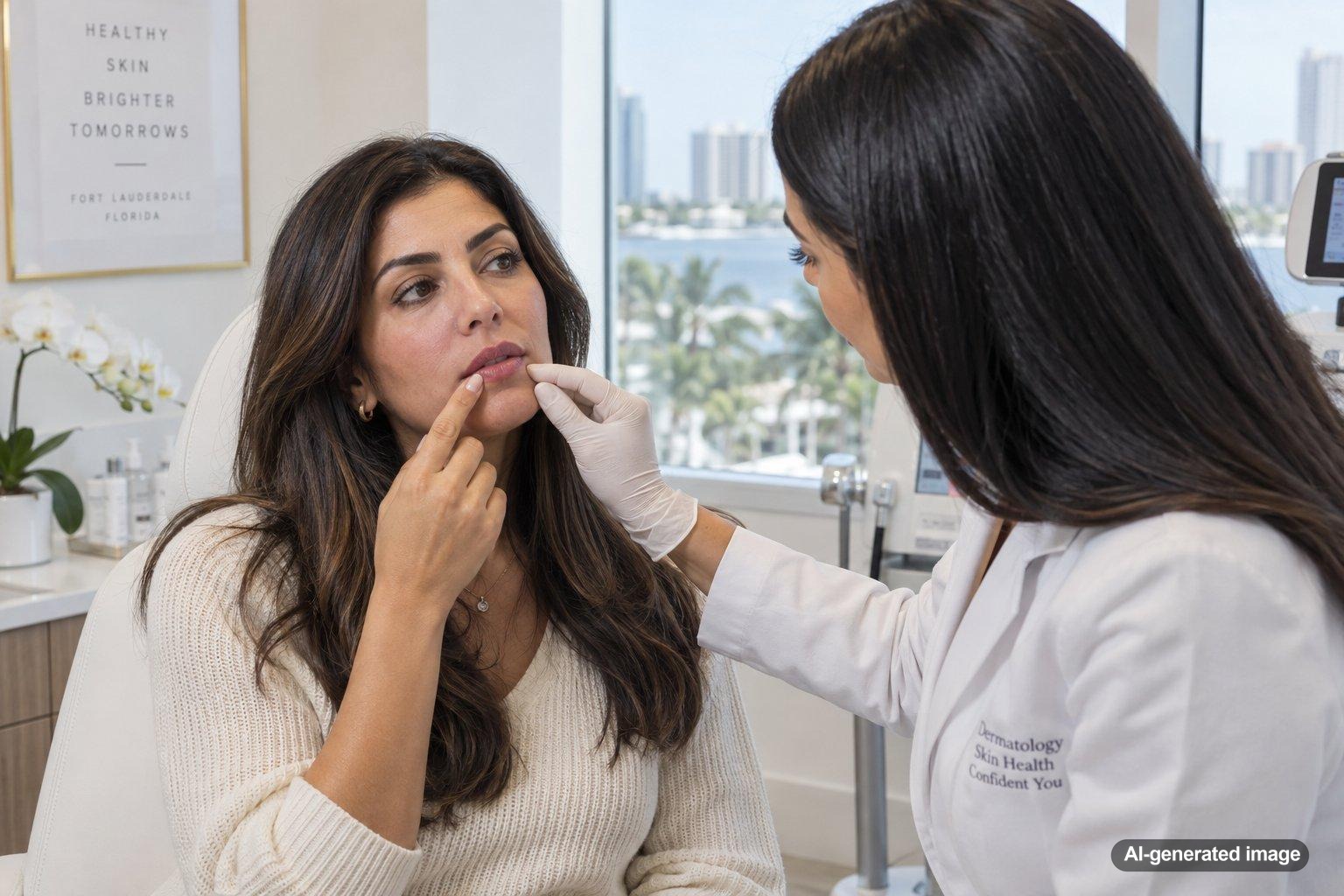
A rough patch on your lip that repeatedly disappears and returns can have several possible explanations. Sometimes the cause is relatively simple, such as dryness, repeated licking, or irritation from a lip product. In other cases, a persistent scaly area can be associated with chronic sun damage or another condition that deserves a closer look.
The important clue is the pattern. A patch that keeps developing in the same location, especially one that never seems to heal completely, is worth mentioning to a dermatologist rather than assuming it is ordinary chapping.
Quick answer
- Dryness and repeated irritation can create a rough area that improves and then returns.
- Lip balms, cosmetics, toothpaste, foods, or other substances that touch the lips can sometimes contribute to irritation.
- Long-term ultraviolet exposure can cause a persistently dry or scaly lip condition called actinic cheilitis.
- A spot that repeatedly crusts, bleeds, becomes tender, changes, or does not fully heal should be evaluated by a dermatologist.
- Because several conditions can look similar, an examination is often more useful than trying to identify the cause from appearance alone.
Why can the same rough lip patch keep returning?
Lip skin is thin and exposed to sun, wind, saliva, foods, skincare products, and frequent movement throughout the day. That combination makes it easy for a small irritated area to be repeatedly disrupted before the skin barrier has fully recovered.
It is also possible for different conditions to produce similar-looking dryness or scale. The location, duration, symptoms, sun exposure history, products you use, and whether the area completely heals between episodes can all help a dermatologist narrow down the possibilities.
Common causes and triggers
- Simple dryness: Dry air, wind, air conditioning, dehydration, and frequent washing around the mouth can leave the lip surface rough or flaky.
- Lip licking or biting: Saliva and repeated mechanical irritation can interfere with the skin barrier and create an ongoing cycle of dryness and irritation.
- Product irritation: Fragrances, flavorings, cosmetics, lip products, toothpaste, mouthwash, and skincare ingredients can sometimes irritate sensitive lip skin.
- Contact allergy: Some people develop an allergic reaction to an ingredient that repeatedly touches the lips. Determining the responsible ingredient may require professional evaluation.
- Sun damage: Years of ultraviolet exposure can contribute to actinic cheilitis, which may cause persistent roughness, scale, cracking, discoloration, or a sandpaper-like texture, often on the lower lip.
- Other skin conditions: Several inflammatory, infectious, and precancerous conditions can affect the lips, so appearance alone is not always enough to distinguish them.
Could sun exposure be responsible?
Yes. Chronic ultraviolet exposure is one reason dermatologists take a rough lip patch that does not fully resolve seriously. Actinic cheilitis is a precancerous form of sun damage that can make part or all of a lip feel persistently dry, scaly, cracked, or rough. The American Academy of Dermatology notes that a dry, scaly lip that never heals, or heals and then returns, can be a sign of a precancerous growth.
This does not mean that every recurring dry patch is actinic cheilitis. Ordinary irritation is common. However, people who spend significant time outdoors, have accumulated substantial sun exposure, or notice a persistent change on the lower lip should consider having the area examined.
What can you do at home?
While you are monitoring the area or arranging an evaluation, keeping the routine simple can reduce unnecessary irritation.
- Use a plain, fragrance-free moisturizing lip product rather than frequently switching products.
- Avoid licking, picking, peeling, or biting the rough area.
- Temporarily stop new or strongly flavored lip products if they seem to coincide with irritation.
- Protect your lips from ultraviolet exposure with a lip product that provides sun protection and reapply it as directed.
- Consider a brimmed hat during prolonged outdoor exposure.
- Pay attention to whether the spot completely disappears or repeatedly returns in exactly the same location.
Avoid trying to burn, scrape, freeze, or otherwise remove a persistent spot yourself. Different lip conditions can look alike, and treatment depends on the underlying cause.
How might a dermatologist evaluate it?
A dermatologist can examine the texture, color, borders, location, and surrounding lip tissue and ask about how long the area has been present, whether it comes and goes, and what exposures or products might be involved. In many cases, the examination and history provide useful clues.
If a lesion has features that need closer evaluation, a dermatologist may discuss additional testing, which can sometimes include a small biopsy. This allows tissue to be examined more closely when the diagnosis cannot be made confidently by appearance alone.
What professional treatment options may be considered?
Treatment depends entirely on what is causing the roughness. Irritant or allergic reactions may call for identifying and avoiding a trigger. Inflammatory conditions may require a different approach. When chronic sun damage such as actinic cheilitis is identified, dermatologists have several treatment categories available, including topical medications and office-based procedures.
The appropriate option varies with the extent and location of the affected area, your medical history, and what the examination shows. A dermatologist can explain the alternatives after establishing what is actually causing the recurring patch.
When should you see a dermatologist?
It is especially worth scheduling an examination when a lip patch keeps returning in the same place or never seems to heal completely. Seek professional evaluation sooner if you notice:
- Persistent scaling, crusting, or cracking.
- Bleeding without a clear injury.
- A sore or ulcer that does not heal.
- Increasing tenderness or pain.
- A firm or thickened area.
- A noticeable change in color or texture.
- A spot that is enlarging or otherwise changing.
- Significant previous sun exposure or a history of skin cancer.
These features do not automatically indicate skin cancer, but they are reasons not to rely on repeated home treatment alone.
FAQ
Can a rough patch on my lip just be chapped skin?
Yes. Dryness, weather, saliva, and irritation can all cause chapping. However, a spot that repeatedly returns in one location or does not fully heal deserves a closer look because several other conditions can resemble ordinary chapped lips.
Can lip balm make the problem worse?
It can in some people. Fragrance, flavoring, and other ingredients may irritate sensitive lips or contribute to a contact reaction. A simple, fragrance-free product is often a reasonable choice while you are trying to minimize potential triggers.
Is a recurring rough lower lip more concerning?
The lower lip commonly receives substantial sun exposure, and actinic cheilitis frequently affects this area. Location alone cannot establish the cause, but a persistent or repeatedly scaly lower-lip patch is worth showing a dermatologist.
Does actinic cheilitis mean I have skin cancer?
No. Actinic cheilitis is considered a precancerous condition rather than the same thing as an established skin cancer. Because some cases can progress to squamous cell carcinoma, accurate diagnosis and appropriate follow-up are important.
Should I wait until the patch comes back before making an appointment?
You do not necessarily need to wait. If the area has repeatedly returned or has failed to heal normally, you can schedule an evaluation based on that history. Photos taken when the patch is most noticeable may also help document how it changes between visits.
Ready to get help?
Schedule an appointment or send a message and our team will get back to you.
Prefer to call? 954-666-3736
This article is for educational purposes and is not medical advice. For diagnosis and personalized treatment, please book an appointment with a board-certified dermatologist.
Sources & further reading
- American Academy of Dermatology (AAD) – Actinic keratosis: Signs and symptoms
- Cleveland Clinic – Actinic Cheilitis: Causes, Symptoms & Treatment
