

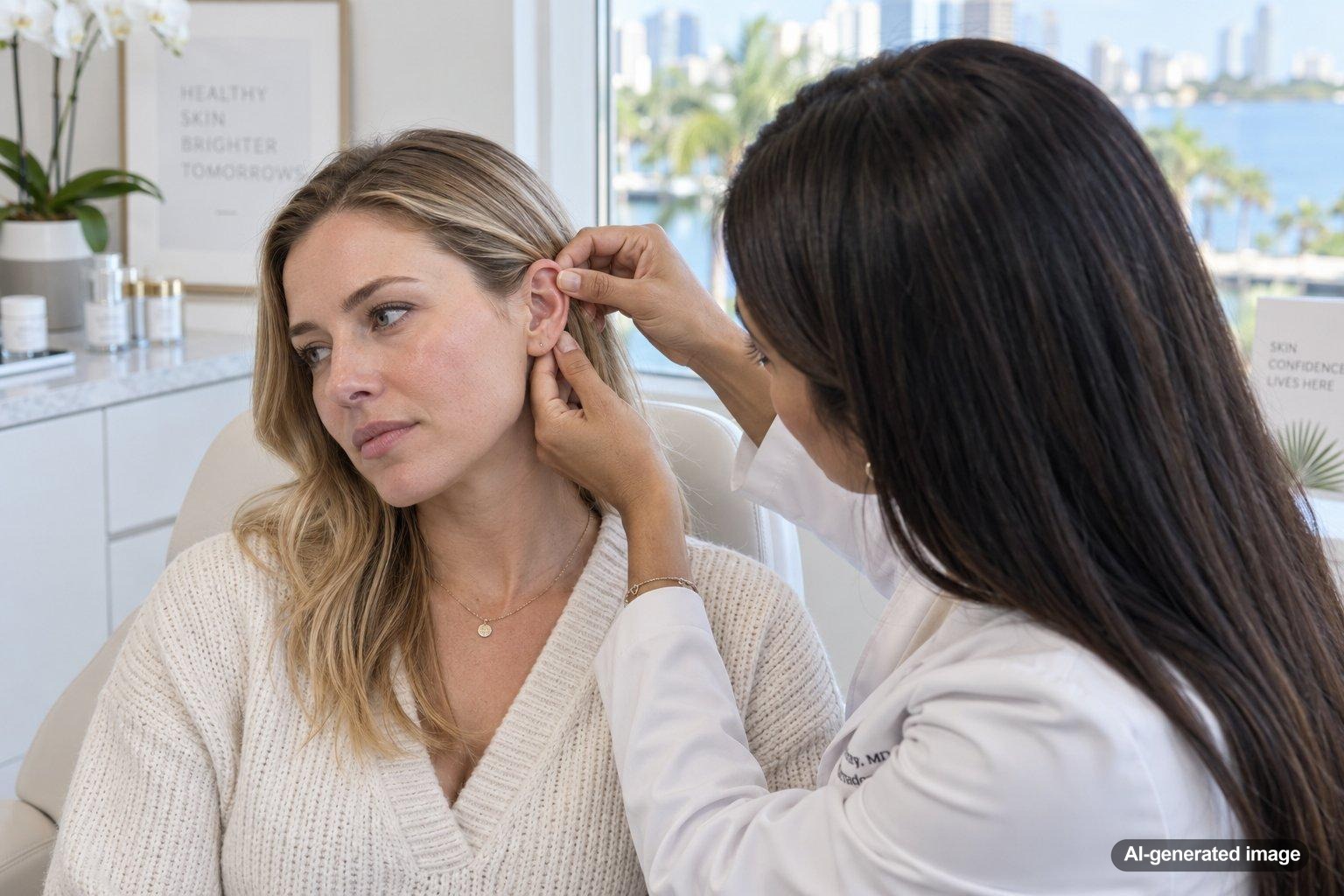
Small, painful bumps along the edge of the ear can develop for several reasons. Sometimes the problem is as simple as repeated pressure, friction, or irritated skin. In other cases, a persistent tender bump may represent an inflammatory condition or another type of skin lesion that deserves a closer look. Because the outer ear receives significant sun exposure and has very little padding over the cartilage, a bump that keeps returning, crusts, bleeds, grows, or simply does not heal should not be ignored.
A dermatologist can examine the area and help distinguish a pressure-related bump from an inflamed follicle, cyst, sun-related lesion, or another condition. Appearance alone is not always enough to identify the cause.
Quick answer
- A tender bump on the rim of the ear can be associated with repeated pressure, friction, inflammation, or irritation.
- One possible cause is chondrodermatitis nodularis, an inflammatory condition that commonly affects the helix or antihelix of the ear.
- Other possibilities include an irritated follicle, cyst, wart, sun-related change, or another skin growth.
- A bump that grows, repeatedly bleeds, crusts, ulcerates, changes, or does not heal should be evaluated by a dermatologist.
- Trying to squeeze, cut, or repeatedly pick at an unexplained ear bump can make irritation worse and may complicate evaluation.
Why the edge of the ear is prone to painful bumps
The outer rim of the ear, called the helix, is covered by relatively thin skin stretched over firm cartilage. Unlike areas with more fatty tissue underneath the skin, there is not much cushioning between the surface and the cartilage.
That anatomy can make the area sensitive to repeated pressure. Sleeping on the same side, tight headphones, helmets, hearing devices, phones, glasses, or other objects that regularly press against the ear may contribute to local irritation in some people. The ears are also frequently exposed to sunlight, wind, and temperature changes.
Chondrodermatitis nodularis can cause a tender ear bump
One condition dermatologists consider when someone develops a painful bump on the cartilage of the outer ear is chondrodermatitis nodularis. It is an inflammatory condition involving the skin and underlying cartilage of the helix or antihelix.
The typical lesion is small, firm, and quite tender. It may have a central crust or scale, and discomfort can become particularly noticeable when pressure is placed on the ear while sleeping. Repeated pressure is considered an important contributing factor, although other factors may also play a role.
Chondrodermatitis nodularis is generally considered benign, but it can resemble other skin conditions. A dermatologist may sometimes recommend additional evaluation when the appearance is not typical or when another type of lesion needs to be ruled out.
Other possible causes of painful bumps on the ear
A painful ear bump is not automatically chondrodermatitis nodularis. Several different problems can produce bumps, tenderness, redness, crusting, or swelling in this area.
- Friction or pressure irritation: Repeated rubbing or pressure from sleeping position, eyewear, headphones, hats, helmets, or devices may irritate the skin.
- Inflamed hair follicles: Follicles around the ear can become irritated or inflamed and may resemble small pimples.
- Cysts: A blocked or inflamed cyst can create a firm or tender lump beneath the skin.
- Contact irritation: Hair products, skincare products, metals, earbuds, or other materials contacting the ear may contribute to irritated skin in some people.
- Warts or other benign growths: Some harmless skin growths can develop on the ear and become sore when repeatedly rubbed or traumatized.
- Sun-related lesions: Long-term ultraviolet exposure can contribute to rough, crusted, or persistent spots on exposed areas such as the ears.
- Skin cancer: Certain skin cancers may appear as a persistent bump, scaly area, sore, or growth that bleeds, changes, or does not heal. A dermatologist can determine whether testing or a biopsy is appropriate.
Can sleeping on your ear cause a painful bump?
Repeated nighttime pressure may contribute to some painful bumps, particularly chondrodermatitis nodularis. If a tender area is consistently on the side you sleep on, pressure may be an important clue.
Reducing direct pressure can be a reasonable conservative step while arranging evaluation. Some people find it helpful to sleep on the opposite side, use a softer pillow, or use a pillow designed with an opening that keeps the ear from pressing against the sleeping surface. These measures do not establish the diagnosis, and a persistent lesion should still be examined.
What you can do at home
Until you know what the bump is, keep care simple and avoid aggressively treating it yourself.
- Avoid squeezing, popping, cutting, or scraping the bump.
- Reduce repeated pressure or rubbing against the affected ear when practical.
- Keep the area gently clean without vigorous scrubbing.
- Avoid repeatedly applying strong acids, wart removers, or other irritating products to an undiagnosed lesion.
- Use sun protection on exposed ears, including a broad-brimmed hat or appropriately selected sunscreen.
- Pay attention to whether the bump is changing in size, color, shape, tenderness, crusting, or bleeding.
If you’re unsure what you are seeing, it’s worth getting checked rather than repeatedly experimenting with home treatments.
How a dermatologist may evaluate an ear bump
Evaluation usually begins with a close examination of the lesion and questions about how long it has been present, whether it hurts, whether it bleeds or crusts, and whether anything repeatedly presses against the area. Your dermatologist may also examine surrounding sun-exposed skin.
If the bump has features that overlap with another condition, a dermatologist may recommend sampling or removing a small amount of tissue for examination. Whether that is necessary depends on the individual lesion and cannot be determined from symptoms alone.
Professional treatment depends on the cause
Treatment is based on what the lesion actually represents. For pressure-related inflammatory bumps, reducing pressure may be part of management. A clinician may also discuss medications, injections, or procedural approaches when appropriate. Cysts, warts, infections, sun-related lesions, and suspicious growths require different approaches.
Because several conditions can look similar on the ear, treatment is usually more effective when the underlying problem has been identified first. Prescription therapies and procedures should be selected after an appropriate clinical evaluation.
When should you see a dermatologist?
Consider scheduling a dermatology evaluation when a bump on the ear is persistent, recurrent, unexplained, or noticeably painful. Prompt evaluation is particularly important if you notice:
- A bump that is getting larger or changing.
- Repeated bleeding, crusting, or ulceration.
- A sore that does not heal or repeatedly heals and returns.
- A rough or scaly growth that persists.
- Increasing redness, warmth, swelling, drainage, or significant tenderness.
- A new persistent lesion on an area with substantial past sun exposure.
- A spot that looks distinctly different from the surrounding skin or from your other spots.
These signs do not automatically indicate a serious condition, but they are good reasons to have the area assessed rather than trying to identify it at home.
Frequently asked questions
Why does the bump on my ear hurt when I sleep?
The outer ear has little cushioning over its cartilage, so direct pressure can make an irritated lesion particularly uncomfortable. Chondrodermatitis nodularis is one condition known for tenderness that may become noticeable when sleeping on the affected side, but other causes are possible.
Can a painful bump on the ear be a pimple?
It can be. Inflamed follicles and pimple-like lesions may occur around the ear. However, a bump that persists, repeatedly crusts, bleeds, or does not behave like a typical temporary blemish deserves professional evaluation.
Should I pop a painful bump on my ear?
It is generally better not to squeeze or puncture an unexplained ear bump. Manipulating it can increase irritation, introduce infection, cause bleeding, and make the original lesion more difficult to assess.
Can sun exposure cause bumps on the ears?
Long-term ultraviolet exposure can contribute to several types of skin changes on the ears, including rough or persistent lesions. Because the ears are easy to miss during sun protection, dermatologists often recommend protecting them along with the face, scalp, and neck.
How do I know if an ear bump is something serious?
There is no reliable way to determine that from pain or appearance alone. Growth, bleeding, persistent crusting, ulceration, noticeable change, or failure to heal are reasons to schedule an examination. A dermatologist can evaluate the lesion and determine whether additional testing is appropriate.
Ready to get help?
Schedule an appointment or send a message and our team will get back to you.
Prefer to call? 954-666-3736
This article is for educational purposes and is not medical advice. For diagnosis and personalized treatment, please book an appointment with a board-certified dermatologist.
Sources & further reading
- DermNet – Chondrodermatitis nodularis
- American Academy of Dermatology (AAD) – Skin cancer: Symptoms, diagnosis, and causes
