

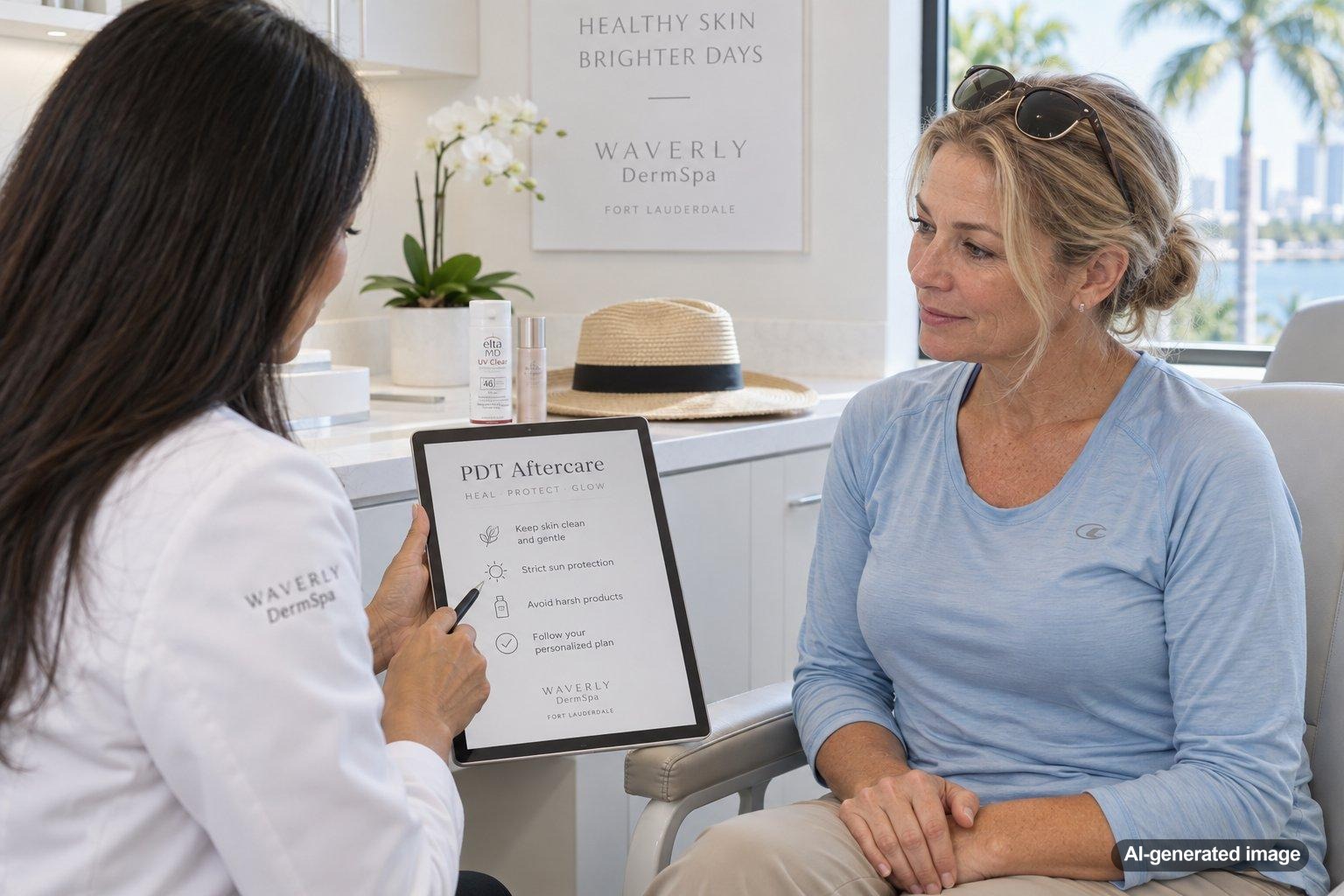
If you work outdoors in South Florida, planning for photodynamic therapy (PDT) involves more than fitting an appointment into your calendar. The photosensitizing medication used during PDT can temporarily make treated skin unusually sensitive to light, which means returning immediately to a sunny job site may not be appropriate.
For landscapers, construction workers, delivery professionals, pool technicians, hospitality staff, coaches, property managers, and others who spend significant time outside, a practical recovery plan matters. Your dermatologist’s specific instructions should always take priority because precautions can vary with the photosensitizer, treatment area, and reason for treatment.
Quick answer
- Plan your work schedule before treatment. You may need to remain indoors and avoid daylight for a period specified by your dermatologist.
- Do not assume sunscreen alone is enough immediately after PDT. Physical avoidance of light and protective covering may be especially important during the photosensitive period.
- Expect temporary skin changes. Redness, swelling, stinging, peeling, or crusting can occur as treated skin responds and heals.
- Follow your individual instructions. Different PDT protocols and photosensitizing agents can require different precautions.
- Contact your dermatologist for concerning symptoms. Severe discomfort, worsening swelling, signs of infection, or an unexpected reaction deserve professional guidance.
Why outdoor work requires extra planning after PDT
Photodynamic therapy combines a photosensitizing medication with a specific light source. After the medication has been applied and activated, residual photosensitivity can remain for a period of time. During that window, additional exposure to daylight may trigger a stronger skin reaction.
This is particularly relevant in South Florida, where outdoor workers can encounter intense sunlight during routine tasks. Cloud cover doesn’t necessarily eliminate the concern. The American Academy of Dermatology advises patients receiving PDT for actinic keratoses to avoid outdoor daylight for 48 hours after treatment because ultraviolet exposure can cause a serious skin reaction. Your own dermatologist may give different instructions based on the exact treatment protocol, so follow those directions rather than relying on a general timeline.
Schedule PDT around your actual job duties
Before treatment, tell your dermatologist what your workday really looks like. Saying that you “work outside” can mean anything from walking between buildings for a few minutes to spending an entire shift on an exposed roof.
Useful details include:
- How many hours you normally spend outdoors
- Whether you can temporarily switch to indoor duties
- Whether shade is consistently available
- Whether your job requires a hard hat, helmet, visor, or other equipment over the treated area
- Whether heat and sweating are unavoidable
- Whether you drive for long periods with sunlight entering through vehicle windows
If avoiding daylight is required after your particular PDT protocol, scheduling treatment before planned time off or a period of indoor work may be more practical than trying to improvise protection on a job site.
Light avoidance may matter more than sunscreen at first
Routine sun protection remains important, but the immediate photosensitive period after PDT is different from ordinary daily sun protection. Depending on the photosensitizer used, your clinician may instruct you to avoid daylight rather than relying primarily on sunscreen.
Protective strategies may include staying indoors, keeping the treated area covered as directed, wearing protective clothing, and using a broad-brimmed hat when appropriate. Do not apply a new sunscreen, moisturizer, ointment, or other product to freshly treated skin unless it fits the aftercare instructions you received.
Because PDT protocols differ, ask your dermatologist exactly when sunscreen should be used, what type is appropriate, and when normal outdoor activity can resume.
Be careful with heat, sweat, and friction
Outdoor work in South Florida often means heat and perspiration. Meanwhile, recently treated skin may feel tender, warm, tight, or irritated. Friction from hats, helmet straps, collars, masks, safety glasses, or repeated wiping can make an already uncomfortable area feel worse.
During recovery, treat the area gently. Follow your clinician’s cleansing and moisturizing instructions, avoid picking at peeling or crusted skin, and minimize unnecessary rubbing. If required protective equipment sits directly over the treated area, discuss that issue before treatment so you can plan around it.
Know what skin changes can occur
Temporary redness or discoloration, swelling, burning, stinging, scaling, peeling, crusting, itching, and occasionally blistering can occur after skin PDT. The intensity and duration vary considerably depending on the treatment area, photosensitizer, light source, individual response, and condition being treated.
That variability is important for outdoor workers. Even after the initial period of strict light avoidance has ended, visible peeling, crusting, or tenderness may make a full outdoor shift uncomfortable. Ask your dermatologist what activities are reasonable as your skin heals rather than assuming that the end of photosensitivity means the skin has completely recovered.
Keep aftercare simple
Immediately after a procedure isn’t the best time to experiment with complicated skincare. Use only the cleansers, moisturizers, ointments, sunscreens, or other products recommended or approved for your recovery.
A simple approach can also reduce accidental irritation from fragranced products, exfoliating acids, retinoids, scrubs, or other active ingredients while the skin barrier is recovering. Your clinician can tell you when your usual skincare routine can be restarted.
When to see a dermatologist
Some inflammation is expected after PDT, but your dermatologist should evaluate symptoms that seem severe, unusual, or progressively worse. Contact the treating office if you develop severe discomfort, extensive blistering, worsening swelling, drainage, increasing warmth, spreading redness, fever, or other symptoms that concern you.
You should also call if unexpected daylight exposure occurs during the period when you were instructed to avoid it and you develop a significant reaction. Do not try to judge a potentially serious reaction solely from photographs or online descriptions.
Questions outdoor workers should ask before PDT
Before leaving your appointment, make sure you have specific answers to practical questions such as:
- How long should I avoid outdoor daylight after my treatment?
- Can I drive home safely, and how should the treated area be protected?
- When can I return to outdoor work?
- Should the treated area remain covered?
- When should I begin or resume sunscreen?
- Are there restrictions related to sweating, exercise, helmets, hats, or other work equipment?
- Which skincare products should I use while healing?
- Which symptoms should prompt a call to the office?
Getting these answers before treatment can make recovery easier to coordinate with supervisors, coworkers, clients, or your own business schedule.
FAQ
Can I go back to an outdoor job the day after PDT?
That may not be appropriate. Some skin PDT protocols require strict avoidance of outdoor daylight for a period after treatment. The American Academy of Dermatology, for example, advises 48 hours of daylight avoidance after PDT for actinic keratoses. Follow the timeline provided for your specific treatment rather than a general rule.
Is staying in the shade enough after PDT?
Not necessarily during the photosensitive period. Shade can reduce direct exposure but doesn’t eliminate environmental light. If your dermatologist tells you to remain indoors or keep the area covered, follow those instructions even if your workplace has shaded areas.
Can I wear sunscreen and work outside after PDT?
Do not assume sunscreen makes immediate outdoor work appropriate. PDT creates temporary photosensitivity, and your clinician may require daylight avoidance or physical covering during the early recovery period. Ask specifically when sunscreen should begin and when outdoor work can safely resume.
What if I accidentally get sunlight on the treated area?
Move away from the exposure and follow the aftercare instructions provided by your dermatologist. If you experience substantial burning, swelling, blistering, or another concerning reaction, contact the treating office for guidance.
How long will my skin look irritated after PDT?
Recovery varies. Redness or discoloration can become more noticeable during the first several days, and peeling, crusting, itching, or other temporary changes may follow. The treatment area and protocol influence how quickly the skin settles, so your clinician can give you more individualized expectations.
Should I tell my dermatologist that I work outdoors?
Yes. Your typical exposure to daylight, heat, sweat, and protective equipment can affect practical recovery planning. Providing those details before treatment helps your dermatologist give instructions that make sense for your work environment.
At Waverly DermSpa, we offer Photodynamic Therapy (PDT) and can help you understand whether it may be appropriate.
Ready to get help?
Schedule an appointment or send a message and our team will get back to you.
Prefer to call? 954-666-3736
This article is for educational purposes and is not medical advice. For diagnosis and personalized treatment, please book an appointment with a board-certified dermatologist.
Sources & further reading
- American Academy of Dermatology (AAD) – Actinic keratosis: Diagnosis and treatment
- Cleveland Clinic – Photodynamic Therapy: What It Is, Procedure & Recovery
- DermNet – Photodynamic therapy (PDT)
