

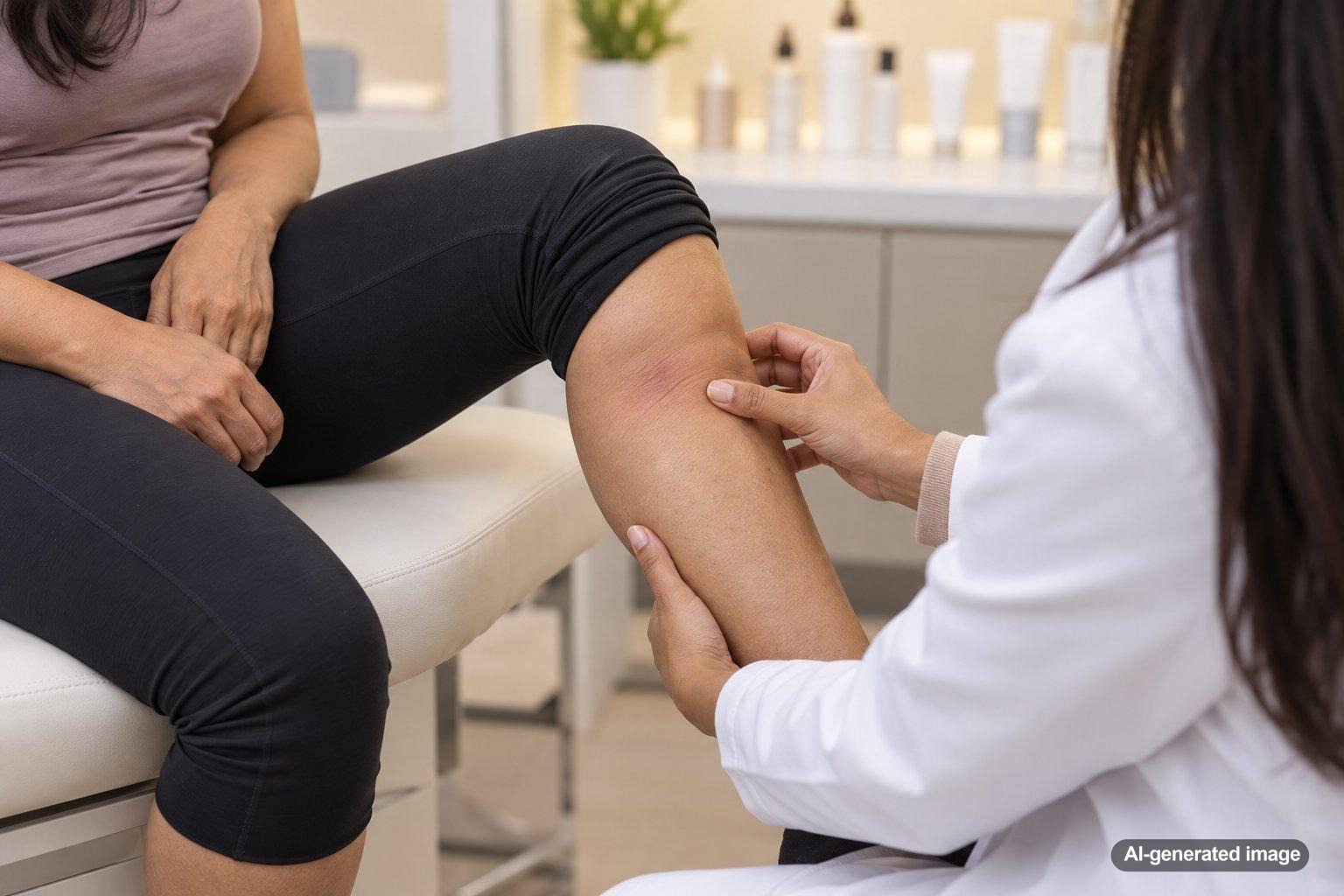
The skin behind your knees can become irritated from leggings because of a combination of friction, trapped sweat, warmth, and pressure against a naturally sensitive skin fold. Even leggings that feel comfortable elsewhere may repeatedly rub against the crease behind your knees as you walk, exercise, or sit. If that area becomes itchy, red, dry, or uncomfortable after wearing fitted clothing, the fabric and the environment underneath it may be contributing.
This irritation does not necessarily mean you are allergic to your leggings. Sometimes the problem is mechanical rubbing or moisture that weakens the skin’s protective barrier. In other situations, eczema or contact dermatitis may play a role. Understanding when the irritation appears, what it looks like, and whether certain fabrics make it worse can help you identify patterns and decide when a dermatology evaluation may be useful.
Quick Answer: Why Do Leggings Irritate the Skin Behind Your Knees?
- Repeated friction: Tight fabric can rub against the knee crease during movement, especially when leggings bunch or form folds.
- Trapped sweat: Moisture and warmth beneath fitted athletic clothing can make sensitive skin more vulnerable to irritation.
- Fabric sensitivity: Certain synthetic fabrics, textile dyes, finishing chemicals, or laundry products may contribute to contact dermatitis.
- Skin barrier disruption: Dry or previously irritated skin may react more readily to rubbing, heat, and moisture.
- Underlying eczema: The area behind the knees is a common location for flexural eczema, which can become more noticeable with sweating or friction.
If symptoms consistently appear after wearing one particular pair of leggings, the fit, material, seams, or laundering process may offer useful clues. Persistent or recurring inflammation deserves closer attention rather than repeated attempts to cover or scrub the affected area.
Why Is the Skin Behind the Knees Particularly Sensitive?
The area behind the knee is called the popliteal fossa. It is a flexible skin crease that repeatedly folds and unfolds as the knee bends. This creates a different environment from flatter areas of the legs.
When you sit, squat, climb stairs, or exercise, the skin in this crease moves against itself and against clothing. Leggings may stretch tightly over the joint while gathering slightly behind it. The combination can create localized rubbing, particularly when the fabric is damp.
Skin folds also tend to retain more warmth and moisture than exposed surfaces. When sweat remains against the skin, the outer barrier may become more susceptible to irritation. This can produce itching, tenderness, or a stinging sensation, even without a true allergy.
The knee crease is also a recognized location for atopic dermatitis, commonly called eczema. People with an existing tendency toward dry, reactive skin may find that clothing-related friction makes this area especially uncomfortable.
Common Reasons Leggings Cause Irritation Behind the Knees
1. Friction From Tight or Bunched Fabric
Leggings are designed to move closely with the body, but a close fit can create repeated contact with the skin. Behind the knees, excess fabric may gather into small horizontal folds that press against the same area throughout the day.
With walking, running, cycling, or strength training, this movement may cause mild chafing. The resulting irritation can feel like burning, stinging, or superficial tenderness.
Clues that friction may be contributing include discomfort that develops during activity, irritation concentrated where fabric gathers, and improvement after changing into looser clothing.
2. Sweat and Heat Trapped Under Athletic Leggings
Many workout leggings are made from polyester, nylon, elastane, or similar synthetic fibers. These materials can provide stretch and moisture management, but their performance varies by garment construction, fit, ventilation, and activity level.
Even moisture-wicking leggings may leave sweat against the skin, particularly in a folded area behind the knee. Heat, moisture, and rubbing can amplify one another.
In Fort Lauderdale’s warm, humid environment, perspiration may remain noticeable even during everyday activities. Spending time outdoors, exercising, or moving between air-conditioned spaces and humid weather may contribute to repeated episodes of irritation.
Moisture-related irritation may become more noticeable after prolonged wear, especially if damp leggings are not changed promptly.
3. Irritant Contact Dermatitis
Irritant contact dermatitis occurs when repeated exposure to friction, moisture, detergents, or other irritating substances disrupts the skin’s protective barrier. It does not require an immune-system allergy.
Possible contributors include residual laundry detergent, fragranced fabric softener, sweat accumulation, and repeated rubbing from tight clothing.
The affected skin may become dry, rough, red, itchy, or uncomfortable. On darker skin tones, inflammation may appear darker, violet, grayish, or more noticeable through changes in texture rather than bright redness.
Because several factors may act together, the irritation can develop even when each individual exposure seems minor.
4. Allergic Contact Dermatitis From Textile Materials
Some people develop allergic contact dermatitis in response to chemicals associated with clothing. Potential allergens include certain textile dyes, fabric finishing agents, rubber additives, and components used in elastic materials.
Unlike simple friction, allergic contact dermatitis involves an immune response to a particular substance. The reaction may not appear immediately after the clothing touches the skin. It can develop hours or sometimes days later.
Textile-related allergic reactions may affect areas where clothing fits closely, where sweat accumulates, or where fabric repeatedly rubs against the skin.
If irritation consistently occurs with a particular garment or fabric type, a dermatologist may consider allergic contact dermatitis. Patch testing can sometimes help identify relevant allergens when the history and examination support that possibility.
5. Eczema in the Knee Crease
Atopic dermatitis commonly affects skin folds, including the backs of the knees. It can cause recurring itching, dryness, inflammation, scaling, and changes in skin texture.
For someone with eczema-prone skin, fitted leggings may act as a trigger rather than the original cause. Heat, sweating, friction, and certain fabrics can aggravate an already sensitive area.
Clues that eczema may be involved include recurring patches of dry or itchy skin, similar symptoms in other body folds, and irritation that sometimes persists even when leggings are not being worn.
However, location and appearance alone cannot establish a diagnosis. A dermatologist can evaluate whether the symptoms fit eczema, contact dermatitis, or another condition.
How Can You Tell Whether the Problem Is Friction, Sweat, or a Fabric Reaction?
The timing and distribution of symptoms can help narrow the possibilities, although they cannot reliably distinguish every skin condition.
- During movement: Stinging or tenderness that begins with exercise and corresponds to areas of fabric bunching may suggest friction.
- After sweating: Itching or burning that becomes more noticeable after prolonged heat and moisture may suggest sweat-associated irritation.
- After wearing a specific garment: Reactions linked repeatedly to one pair or fabric may raise questions about textile additives, fit, or laundering residues.
- Hours or days after exposure: Delayed itching and a developing rash may be consistent with allergic contact dermatitis, although other explanations are possible.
- Even without leggings: Persistent dryness, scaling, or recurring inflammation in the knee crease may suggest an underlying inflammatory skin condition.
These patterns are helpful observations, not diagnostic rules. More than one factor can contribute to the same episode.
What Can You Do at Home to Reduce Irritation?
For mild discomfort without concerning symptoms, a few conservative changes may help reduce unnecessary friction and exposure to possible irritants.
Choose Leggings That Do Not Gather Behind the Knees
Pay attention to how leggings fit when your knees are bent, not just when you are standing. If the fabric creates tight folds or presses strongly into the knee crease, another size or construction may feel more comfortable.
Some people prefer softer, less compressive fabrics for everyday wear. Leggings designed for high compression may not be the most comfortable choice when an area is already irritated.
Change Out of Damp Clothing
Remaining in sweaty leggings after exercise can prolong contact with moisture and accumulated skin secretions. Changing into clean, dry clothing after activity may reduce exposure.
When possible, gently cleanse sweaty skin with a mild product and avoid aggressive scrubbing. Pat the area dry rather than rubbing it with a towel.
Keep Skin Care Simple
A gentle, fragrance-free moisturizer may help support the skin barrier, particularly when the area feels dry or rough. Applying moisturizer after washing, while the skin is slightly damp, can help retain moisture.
Avoid applying exfoliating acids, heavily fragranced lotions, abrasive scrubs, or multiple new products to an actively irritated knee crease. These can make it harder to determine what is causing the problem and may increase discomfort.
Review Your Laundry Products
Fragrance-free, dye-free laundry detergent may be better tolerated by sensitive skin. Consider avoiding fragranced fabric softeners or scent boosters if you notice recurring irritation.
Wash new leggings before wearing them, follow the garment’s care instructions, and make sure laundry products are properly rinsed away.
If a particular pair repeatedly causes irritation despite changes in washing, it may be worth setting that garment aside rather than continuing to test it against uncomfortable skin.
Give the Area a Break From Tight Clothing
When the knee crease is irritated, softer and looser clothing may reduce rubbing while the skin settles. Avoid scratching or picking at the area, since repeated trauma can worsen inflammation.
If symptoms are significant, spreading, or persistent, home adjustments should not replace an appropriate medical evaluation.
Are Cotton Leggings Better Than Polyester or Nylon?
There is no single fabric that feels best on every person’s skin. Cotton is often recommended for eczema-prone skin because it is generally soft and breathable. However, fabric comfort also depends on thickness, stitching, stretch, dye, finishing treatments, and garment fit.
Synthetic athletic fabrics may be comfortable during exercise when they fit appropriately and allow sweat to move away from the skin. A lightweight, well-fitting synthetic garment may feel less irritating than a heavy cotton garment that stays wet during activity.
For recurring knee-crease irritation, focus on the specific garment’s effect on your skin rather than assuming all natural fibers are suitable or all synthetic fibers are problematic.
Trying a softer construction, fewer seams, lighter compression, or a different fabric blend may help identify a more comfortable option.
What Can a Dermatologist Do for Persistent Irritation?
If irritation behind the knees keeps returning, a dermatologist can examine the skin and review the pattern of symptoms. The evaluation may include questions about exercise habits, garment materials, laundry products, skin care, previous eczema, and whether other areas are affected.
Professional care depends on the underlying cause. Common approaches may include:
- Skin examination: Evaluating the appearance and distribution of inflammation to distinguish among possible causes.
- Barrier-support recommendations: Identifying gentle cleansing, moisturizing, and clothing practices suited to the individual’s skin.
- Prescription anti-inflammatory treatment: Considering appropriate topical medications when eczema or dermatitis requires more than conservative care.
- Patch testing: Investigating suspected allergic contact dermatitis when the clinical history suggests a relevant allergen.
- Assessment for other conditions: Checking whether persistent irritation, unusual scaling, drainage, or changes in skin appearance suggest another diagnosis.
Skin folds may require particular care when choosing prescription topical treatments because medication absorption and local skin sensitivity can differ from those of thicker skin areas. A dermatologist can recommend an appropriate treatment plan rather than relying on repeated unsupervised use of medicated creams.
When Should You See a Dermatologist?
Occasional mild irritation that improves after changing clothing may not require an office visit. However, persistent or recurring symptoms are worth evaluating, especially when the cause remains unclear.
Consider arranging a dermatology appointment if:
- The rash repeatedly returns whenever you wear leggings or other fitted clothing.
- Itching interferes with sleep, exercise, or daily activities.
- The skin becomes cracked, thickened, persistently scaly, or painful.
- Symptoms spread beyond the original knee crease.
- You develop recurring discoloration after episodes of inflammation.
- Changing fabrics, laundry products, and skin care habits does not improve the problem.
- You suspect a fabric allergy or have a history of eczema or other inflammatory skin conditions.
Seek prompt medical evaluation if the area becomes increasingly painful, hot, swollen, or rapidly spreading, or if there is pus, significant drainage, or fever. These findings can sometimes indicate a complication that requires medical attention.
Frequently Asked Questions
Why do my leggings make the backs of my knees itch but not the rest of my legs?
The backs of the knees are skin folds where fabric can bunch, sweat can accumulate, and friction may increase during movement. This area is also commonly affected by eczema. Localized irritation does not necessarily mean the entire garment is causing an allergic reaction.
Can leggings cause eczema behind my knees?
Leggings do not necessarily create an underlying tendency toward atopic dermatitis, but tight fabrics, heat, sweat, and rubbing can aggravate eczema-prone skin. Clothing may also contribute to irritant or allergic contact dermatitis, which can resemble eczema.
Why does the irritation get worse after a workout?
Exercise increases perspiration, body temperature, and repetitive knee movement. These factors can increase moisture and rubbing at the knee crease, particularly when leggings are tight or remain damp after activity.
Could I be allergic to the material in my leggings?
It is possible. Some textile dyes, finishing agents, or elastic-related chemicals can contribute to allergic contact dermatitis. However, friction and irritant reactions may produce similar symptoms. A dermatologist can evaluate whether patch testing would be appropriate.
Should I stop wearing leggings if the skin behind my knees is irritated?
Temporarily switching to softer, looser clothing may help reduce friction while the area is uncomfortable. If symptoms repeatedly return with the same leggings, avoiding that garment and seeking evaluation for persistent inflammation may be reasonable.
Can irritation behind the knees leave dark marks?
Inflammation and repeated scratching can sometimes lead to post-inflammatory hyperpigmentation, particularly in skin that is prone to pigment changes. These marks may remain after the original irritation improves. Addressing recurring inflammation and avoiding further rubbing can help limit additional skin injury.
Understanding Your Skin’s Response to Everyday Clothing
Leggings are a practical part of many wardrobes, but the skin behind the knees experiences a unique combination of movement, warmth, moisture, and fabric contact. When that balance becomes uncomfortable, the underlying explanation may be as straightforward as repeated friction or as complex as eczema or contact allergy.
Noticing which garments trigger symptoms, reducing prolonged moisture exposure, and maintaining a gentle skin care routine can be useful first steps. When the irritation persists or repeatedly returns, an individualized dermatology assessment can help clarify the cause and identify suitable care options.
Ready to get help?
Schedule an appointment or send a message and our team will get back to you.
Prefer to call? 954-666-3736
This article is for educational purposes and is not medical advice. For diagnosis and personalized treatment, please book an appointment with a board-certified dermatologist.
Sources & further reading
- DermNet – Textile contact dermatitis
- American Academy of Dermatology (AAD) – Eczema types: Atopic dermatitis skin care
- DermNet – Atopic dermatitis
