

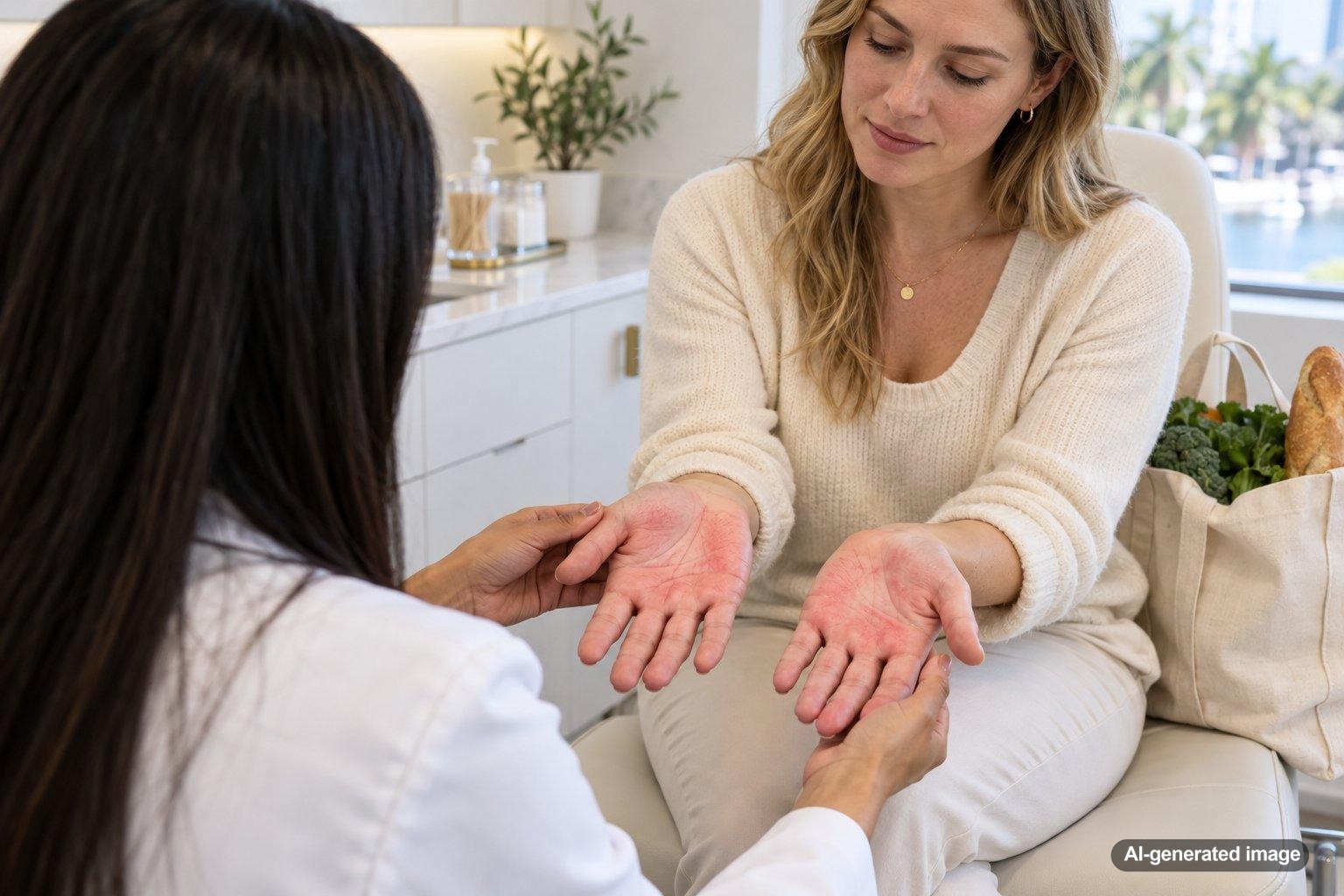
Bright red palms after carrying grocery bags can look surprisingly dramatic, especially when the color appears exactly where the handles pressed against your hands. In many cases, this temporary redness is a normal response to pressure, friction, and changes in blood flow near the skin’s surface. The narrow handles of a heavy shopping bag can concentrate considerable force against a relatively small area of your palm.
The important clues are how quickly the redness develops, whether it fades after you release the bags, and whether it comes with pain, itching, swelling, or other symptoms. Redness that appears only after carrying something heavy and gradually settles is different from redness that persists without an obvious trigger. Understanding that distinction can help you decide whether simple adjustments are enough or whether a dermatologist should evaluate your skin.
Quick Answer: Why Do Palms Turn Red After Carrying Bags?
- Concentrated pressure: Thin grocery bag handles press into the palm and temporarily affect circulation in the compressed skin.
- Blood flow changes: After pressure is released, small blood vessels near the surface may become more visibly filled with blood, producing a bright red appearance.
- Friction: Handles that slide or twist against the skin can cause additional temporary irritation.
- Grip effort: Carrying heavy bags requires sustained muscle activity and may contribute to changes in hand circulation.
- Individual skin sensitivity: Some people develop more noticeable redness in response to ordinary pressure or rubbing.
If the color fades after the pressure ends and there are no other symptoms, the explanation may be straightforward mechanical irritation. Persistent, unexplained, painful, or recurrent redness deserves closer attention.
What Happens to Your Palms When You Carry Heavy Grocery Bags?
Your palms contain an extensive network of small blood vessels that help supply the skin and regulate temperature. The amount of blood flowing through these vessels changes throughout the day in response to temperature, activity, and mechanical pressure.
When you carry several grocery bags by their handles, the weight of the groceries is transmitted through a narrow strip of material. This creates concentrated pressure against the skin and underlying tissues.
While the handle presses against your palm, some small vessels may be temporarily compressed. Once you put the bags down, that compression ends. Blood flow can increase in the previously compressed area, making the skin appear redder for a short period.
This response may be more noticeable when the handles have left visible indentations. The red marks often follow the shape or position of the handles rather than covering the entire palm evenly.
Common Reasons Grocery Bags Make Your Palms Bright Red
Pressure From Thin Plastic Handles
Thin plastic handles can become particularly narrow under the weight of groceries. As the material stretches, it may dig into the palm and create a sharply defined line of pressure.
Even a bag that does not seem unusually heavy can produce significant localized pressure when its contents are supported by a small contact area. Carrying several bags in one hand increases that concentration of force.
Temporary Changes in Surface Blood Flow
The skin’s blood vessels respond dynamically to compression and release. When pressure is removed, increased visible blood flow near the surface may create temporary redness, sometimes called reactive redness.
This is particularly plausible when the color appears immediately after the bags are set down and gradually diminishes while the hands rest.
Friction Between the Handles and Skin
Grocery bag handles rarely stay perfectly still. Walking, adjusting your grip, and shifting the weight of the bags can cause the material to rub repeatedly across the same area.
Friction may make the skin look red or feel mildly tender. More intense rubbing can produce superficial irritation or, in some circumstances, a blister.
Heat, Sweating, and Skin Sensitivity
Warm weather and physical exertion can increase blood flow near the skin’s surface. Sweaty hands may also experience more friction when gripping certain materials.
In Fort Lauderdale’s warm, humid climate, carrying groceries from a parking lot to a home or condominium may combine heat exposure, gripping effort, and pressure. These factors can make temporary hand redness more noticeable.
Reaction to Materials Touching the Skin
Not every episode of redness is caused by pressure alone. Some people experience irritation when their skin comes into contact with certain plastics, dyes, cleaning residues, or other substances on a bag’s surface.
Material-related irritation becomes more relevant when redness is accompanied by itching, burning, dryness, or a rash that persists after the bag is removed. A dermatologist can help distinguish mechanical redness from a possible skin reaction.
Why Do Some People’s Palms Become Redder Than Others?
Two people can carry similar grocery bags and develop very different visible skin reactions. Differences in skin thickness, vascular responsiveness, underlying skin sensitivity, grip strength, and the way weight is distributed may all contribute.
Natural skin tone also affects how redness appears. On lighter skin, increased surface blood flow may produce obvious pink or bright red marks. On darker skin, the same process may be less visibly red and may instead be noticed through warmth, tenderness, or a subtle color change.
Calluses can alter how pressure is distributed across the palm. Areas with thicker skin may react differently from softer regions near the fingers or base of the thumb.
These differences are not necessarily signs of a medical problem. What matters more is whether the reaction is predictable, temporary, and free of concerning symptoms.
How Long Should the Redness Last?
Simple pressure-related redness often begins to fade once the compression stops. Some people notice improvement within minutes, while others may see marks linger longer depending on the intensity of pressure, friction, and individual skin response.
There is no single duration that reliably separates an ordinary reaction from a medical concern. A faint mark after carrying several heavy bags is not equivalent to extensive redness accompanied by significant pain or swelling.
Pay attention to whether the redness steadily improves, remains unchanged, or becomes more pronounced. Repeated episodes that last unusually long or occur without carrying anything are worth discussing with a healthcare professional.
What Can You Do to Reduce Red Palms After Carrying Groceries?
If your hands become red because of pressure and friction, reducing the force placed on a small area of skin may help.
- Carry fewer bags at once: Distribute heavy purchases across multiple trips instead of concentrating the weight in one hand.
- Choose wider handles: Reusable shopping bags with broad, comfortable straps can spread pressure across a larger surface area.
- Use a grocery cart: A rolling cart or wagon can reduce sustained gripping when transporting heavy items.
- Alternate hands when practical: Avoid repeatedly placing the entire load on the same area of one palm.
- Keep handles from twisting: Flattening or adjusting straps may reduce narrow pressure points.
- Give your hands time to rest: After unloading groceries, release your grip and allow normal circulation to settle.
- Care for irritated skin: If friction leaves your palms dry or uncomfortable, a gentle, fragrance-free moisturizer may help support the skin barrier.
Avoid aggressively massaging, scrubbing, or applying extreme temperatures to an area that is already tender. If the skin is blistered or broken, additional friction can make irritation worse.
When Could Red Palms Indicate Something Other Than Pressure?
The pattern of redness provides useful information. Marks that closely match the grocery bag handles suggest a mechanical trigger. Redness that spreads across the entire palm, persists long after contact ends, or develops without carrying anything may have a different explanation.
Some skin conditions, inflammatory reactions, circulation changes, and systemic health issues can be associated with palm redness. One recognizable pattern, called palmar erythema, involves persistent redness of portions of the palms and may have several possible associations. It cannot be identified reliably from color alone.
Similarly, redness accompanied by itching, scaling, cracking, or small blisters may suggest that the skin itself is irritated rather than simply responding to temporary compression.
A dermatologist can examine the distribution, texture, and duration of the changes, review possible triggers, and determine whether further evaluation is appropriate.
When Should You See a Dermatologist?
Consider scheduling an evaluation if:
- The redness persists after the pressure has ended or repeatedly appears without an obvious trigger.
- Your palms develop itching, burning, peeling, cracking, or recurrent blisters.
- Red areas become increasingly tender, swollen, or uncomfortable.
- The reaction begins happening with very light contact or minor pressure.
- Both palms remain unusually red even when you have not been carrying anything.
- The appearance of your skin changes significantly from its usual pattern.
Seek prompt medical attention if redness is accompanied by severe pain, rapidly increasing swelling, pronounced warmth, fever, or other signs of an acute problem. Sudden hand numbness, marked weakness, or fingers that become pale, blue, or unusually cold also warrant timely medical assessment. Severe symptoms or sudden loss of hand function require urgent care rather than a routine dermatology appointment.
For a recurring but nonurgent concern, photographs taken immediately after carrying groceries and again after resting may help your clinician understand how the redness changes over time.
How Can a Dermatologist Evaluate Recurrent Palm Redness?
A dermatologist may begin by asking when the redness appears, how long it lasts, whether it affects one or both hands, and whether it is associated with pressure, heat, exercise, or exposure to specific materials.
The examination may include looking at the distribution of redness, assessing skin texture, and checking for dryness, scaling, swelling, or other visible changes.
If a skin reaction is suspected, further assessment may be considered based on the history and physical findings. If the redness appears more consistent with a circulation-related or systemic issue, referral or additional medical evaluation may be appropriate.
Management depends on the underlying explanation. For ordinary pressure-related redness, changing how bags are carried may be sufficient. Irritated skin may benefit from gentle skin care and avoiding the suspected trigger. Persistent or unexplained symptoms may require a more individualized approach.
Frequently Asked Questions
Is it normal for my palms to turn bright red after carrying heavy bags?
Temporary redness that appears where heavy handles press against the palms can be an ordinary response to compression, friction, and changing blood flow. It is more reassuring when the color steadily fades after the pressure ends and there are no additional symptoms.
Why does the redness appear only where the plastic handles touched my skin?
Bag handles concentrate weight into narrow contact areas. These regions experience more compression and friction than the surrounding skin, so they may develop visible red lines or patches that follow the handle’s shape.
Can poor circulation make my palms red after carrying groceries?
Pressure can temporarily alter local blood flow, but redness after carrying bags does not, by itself, establish a circulation disorder. Persistent color changes, unusual coldness, numbness, or significant pain deserve medical evaluation.
Could I be reacting to the plastic grocery bags?
It is possible for materials or residues touching the skin to cause irritation in some individuals. Itching, burning, scaling, or a reaction that lasts beyond the period of pressure may make a skin reaction more likely. A dermatologist can assess the pattern and possible exposures.
Why do my palms turn red even when the grocery bags are not very heavy?
The width and position of the handle can matter as much as the total weight. A relatively light bag with a thin, twisted handle may create concentrated pressure. Skin sensitivity, warmth, moisture, and gripping technique can also influence the response.
Should I worry if both palms are red even when I am not carrying anything?
Redness that occurs without pressure or remains present during rest should not automatically be attributed to grocery bags. Persistent redness on both palms has several possible explanations, and a healthcare professional can help determine whether it needs further investigation.
Ready to get help?
Schedule an appointment or send a message and our team will get back to you.
Prefer to call? 954-666-3736
Disclaimer
This article is for educational purposes and is not medical advice. For diagnosis and personalized treatment, please book an appointment with a board-certified dermatologist.
