

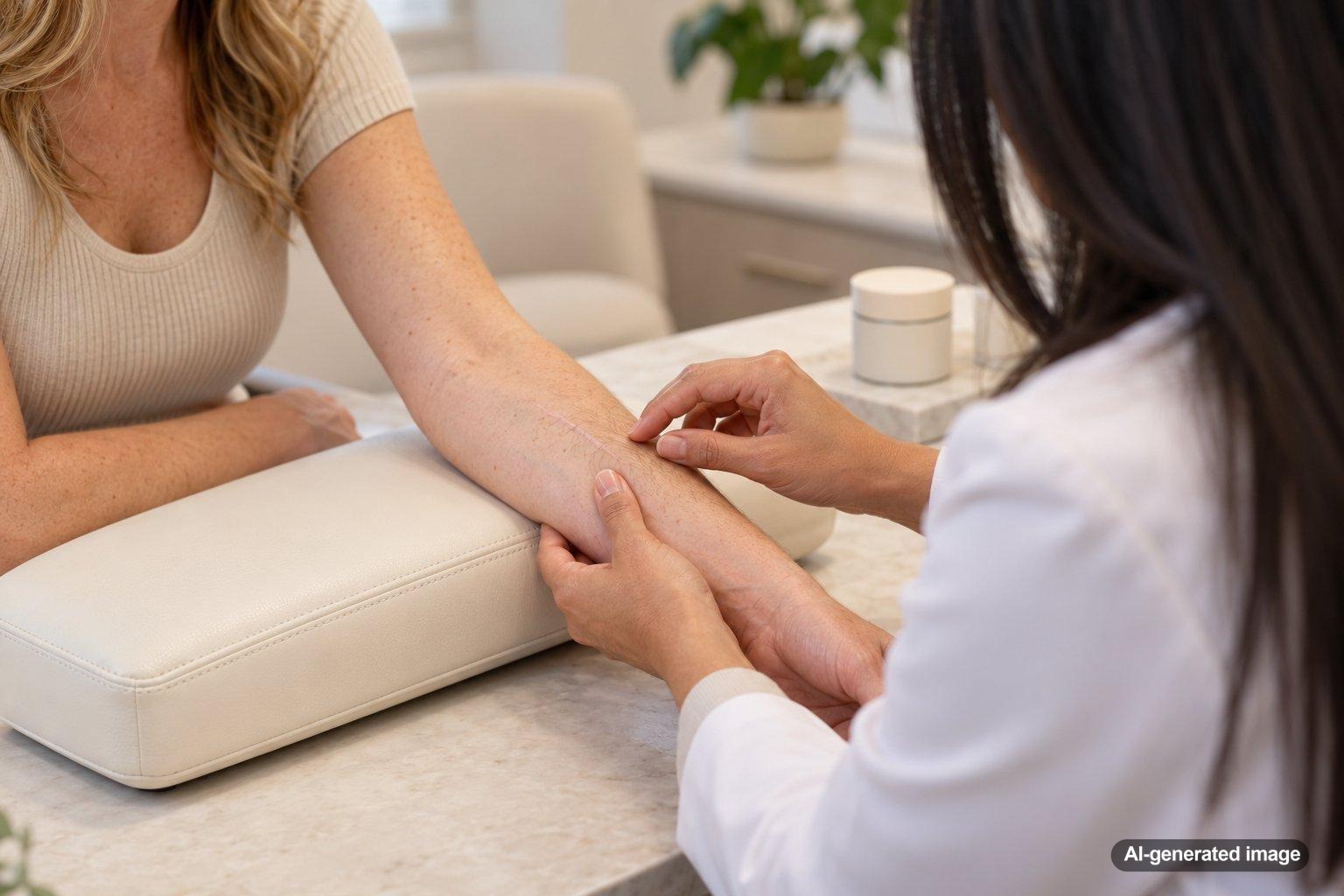
Noticing darker or thicker hair around a scar that has been there for years can be surprising. The skin may have healed long ago, yet a small patch of hair now seems more noticeable than the surrounding area. In some cases, this happens because a previous injury or ongoing local irritation has influenced how nearby hair follicles behave. Dermatologists sometimes describe this pattern as acquired localized hypertrichosis.
Not every change in hair growth is directly caused by the scar itself. Normal differences between follicles, friction, medications, and changes in the surrounding skin can also contribute. Understanding where the hair is growing, how quickly it has changed, and whether the scar looks different can help determine whether the finding needs a closer examination.
Quick Answer: Why Does Hair Grow Darker Around a Scar?
- Previous skin injury may influence nearby follicles. Local changes associated with healing and inflammation can sometimes accompany increased hair growth.
- Localized hypertrichosis is one possibility. This describes increased hair growth in a specific area, sometimes following irritation or trauma.
- Fine hairs may become more noticeable. Hair can vary in thickness, pigmentation, and length between neighboring follicles.
- Friction or certain topical products may contribute. Repeated rubbing and some medications can affect hair growth in limited areas.
- Changes in the scar itself deserve attention. A dermatologist can evaluate unusual hair growth alongside any new changes in the underlying skin.
How Can an Old Injury Affect Hair Follicles?
Hair follicles are living structures embedded in the skin. Their activity depends on signals from surrounding cells, local circulation, and the normal hair growth cycle. When skin experiences an injury, the healing process changes the local tissue environment.
In certain circumstances, increased hair growth has been observed after trauma, inflammation, burns, or prolonged pressure. Researchers have proposed that local inflammatory signals and changes in blood flow may influence follicle activity. However, the precise explanation is not established for every case.
An important distinction is that hair growing near a scar is not necessarily growing from the scar tissue itself. Dense scar tissue may have fewer functioning follicles, particularly after deeper injuries. Hair appearing along the border may originate from follicles that remained intact in the surrounding skin.
Because scars differ in depth, location, and the way they formed, their relationship with nearby hair growth can vary considerably.
What Is Acquired Localized Hypertrichosis?
Hypertrichosis means hair growth that is greater than expected for a particular area of the body. When this develops later in life and is limited to one region, it is called acquired localized hypertrichosis.
The affected patch may contain longer, denser, or more deeply pigmented hairs. Sometimes the difference is subtle, involving only a small cluster of follicles. In other cases, the area becomes visibly different from neighboring skin.
Localized hypertrichosis has been associated with previous skin injury, repeated rubbing, pressure, and certain topical medications. It is not the same as hirsutism, which refers to a particular pattern of coarse hair growth associated with androgen activity.
Although localized hypertrichosis is one possible explanation for darker hair around an old scar, the appearance alone cannot establish the cause. A dermatologist can assess whether the pattern fits this condition or reflects another process.
Common Reasons Hair May Look Darker Around an Old Scar
Several factors may make hair near a healed injury appear different from hair elsewhere on the body.
- Previous inflammation or trauma: Changes in the local skin environment following an injury may be associated with increased follicle activity.
- Repeated friction: Clothing seams, straps, protective equipment, or habitual rubbing can irritate skin near a scar and may contribute to localized hair growth.
- Differences in hair type: Fine, lightly pigmented vellus hairs are less visible than thicker, darker terminal hairs. A change in the characteristics of nearby hairs can make the area stand out.
- Topical medications: Certain products, including some corticosteroids and hair-growth medications, have been associated with localized increases in hair growth.
- Contrast with scar pigmentation: A pale or unusually smooth scar may make adjacent dark hairs easier to notice, even when the follicles have not changed significantly.
- Normal follicle variation: Neighboring hair follicles do not always produce identical hairs. A small patch may gradually become more apparent over time.
These possibilities can overlap. The location of the scar, the original injury, recent product use, and the pattern of hair growth all provide useful context.
Does Darker Hair Mean the Scar Is Healing Again?
Not necessarily. Hair growth follows its own biological cycle, while scar remodeling involves changes in collagen and other components of the skin. These processes are related to the same tissue environment but are not interchangeable.
A scar that has remained stable for years does not automatically become active again because nearby hairs appear darker. Likewise, increased hair growth is not a reliable measure of how well a scar healed.
If the scar has also developed new thickness, firmness, discoloration, tenderness, or other visible changes, it is worth having the skin examined rather than assuming the hair growth explains everything.
What Can You Do at Home?
If the skin appears otherwise unchanged and the hair growth is not causing discomfort, a gentle approach is reasonable while deciding whether to seek an evaluation.
- Observe the pattern. An occasional photograph under consistent lighting can help document whether the patch is changing.
- Reduce unnecessary friction. Avoid repeatedly rubbing, scratching, or picking at the scar and surrounding skin.
- Keep skincare simple. Use a mild cleanser and moisturizer appropriate for your skin, particularly if the area is sensitive.
- Protect exposed scars from sunlight. Sun protection can help limit additional pigmentation differences in previously injured skin.
- Be cautious with hair removal. Trimming may be less irritating than waxing or plucking over delicate tissue. Avoid aggressive methods on skin that is irritated, raised, or not fully healed.
- Review products used on the area. If the change began after starting a topical medication, discuss the observation with the prescribing clinician rather than discontinuing treatment independently.
There is no need to aggressively exfoliate a scar or use strong cosmetic products simply because nearby hair appears darker. Irritating the skin may create additional concerns without addressing the underlying reason for the change.
Professional Evaluation and Treatment Options
A dermatologist can examine the scar, assess the surrounding follicles, and review the timing of the change. The evaluation may include questions about the original injury, medication use, friction, and whether similar hair growth is appearing elsewhere.
If the finding is consistent with localized hypertrichosis and the skin is otherwise healthy, treatment may not be necessary. Some people prefer to leave the hair alone, while others want to reduce its visibility for cosmetic reasons.
Options may include careful trimming, conventional hair removal, or professionally guided procedures. Laser hair removal and electrolysis can provide longer-lasting hair reduction in selected circumstances, but effectiveness and potential side effects vary.
Scar tissue requires particular consideration because its texture, pigmentation, sensitivity, and follicle distribution may differ from unaffected skin. A dermatologist can help determine whether a procedure is appropriate for the specific area.
At Waverly DermSpa, we offer Excel HR Laser Hair Removal and can help you understand whether it may be appropriate.
When Should You See a Dermatologist?
A small, stable patch of darker hair is not necessarily an urgent concern. Still, professional evaluation is appropriate when a change is unexplained, persistent, or accompanied by changes in the skin.
Consider scheduling an appointment if you notice:
- Rapidly increasing hair growth around a previously stable scar.
- New discoloration, thickening, or a developing lump within or beside the scar.
- Persistent redness, swelling, tenderness, or warmth.
- Bleeding, crusting, an open area, or a sore that does not heal.
- New hair growth appearing in several unrelated areas without an obvious explanation.
- Hair changes that begin after a new medication or alongside other unexplained symptoms.
In Fort Lauderdale, where year-round sun exposure is common and many residents and seasonal visitors spend substantial time outdoors, it is particularly useful to pay attention to visible changes in previously injured skin. Hair growth alone cannot tell you whether a scar or nearby lesion is harmless.
Dr. Maryann Mikhail, MD, can evaluate the appearance of a scar and help determine whether observation, further assessment, or a treatment discussion is appropriate.
Frequently Asked Questions
Can a scar cause hair to grow thicker?
Some skin injuries are associated with increased hair growth in nearby areas. This may reflect localized changes affecting surviving follicles rather than new hair growing directly from dense scar tissue. Not every scar produces this effect.
Why is the hair darker only on one side of my scar?
Hair follicles can respond differently across a small area of skin. Variation in follicle density, pigmentation, friction, and the original injury may contribute. An examination can help clarify an unusual or changing pattern.
Will the darker hair eventually return to normal?
It depends on the cause. Some localized hair changes diminish after an associated irritation or exposure resolves, while others may persist. There is no reliable timeline that applies to every person.
Is it safe to shave hair growing around a scar?
Shaving may be an option when the skin is fully healed and smooth enough to avoid injury. Raised, sensitive, or irregular scars can be easier to nick or irritate. Trimming or discussing alternatives with a clinician may be preferable.
Can laser hair removal be performed near scar tissue?
Laser treatment may be considered for selected patients, but the condition of the scar, skin tone, hair pigmentation, and risk of irritation or pigment changes require assessment. Suitability should be determined by an experienced clinician.
Does darker hair around a scar mean something serious?
Not necessarily. Localized hair growth can occur for several reasons, including prior irritation or trauma. However, new or unexplained changes in the scar itself should be assessed rather than attributed to hair growth alone.
Ready to get help?
Schedule an appointment or send a message and our team will get back to you.
Prefer to call? 954-666-3736
Disclaimer
This article is for educational purposes and is not medical advice. For diagnosis and personalized treatment, please book an appointment with a board-certified dermatologist.
Sources & further reading
- Cleveland Clinic – Hypertrichosis (Werewolf Syndrome): What It Is & Treatment
- DermNet – Hypertrichosis
- Cleveland Clinic – Scarring (Cicatricial) Alopecia: What It Looks Like & Treatment
