

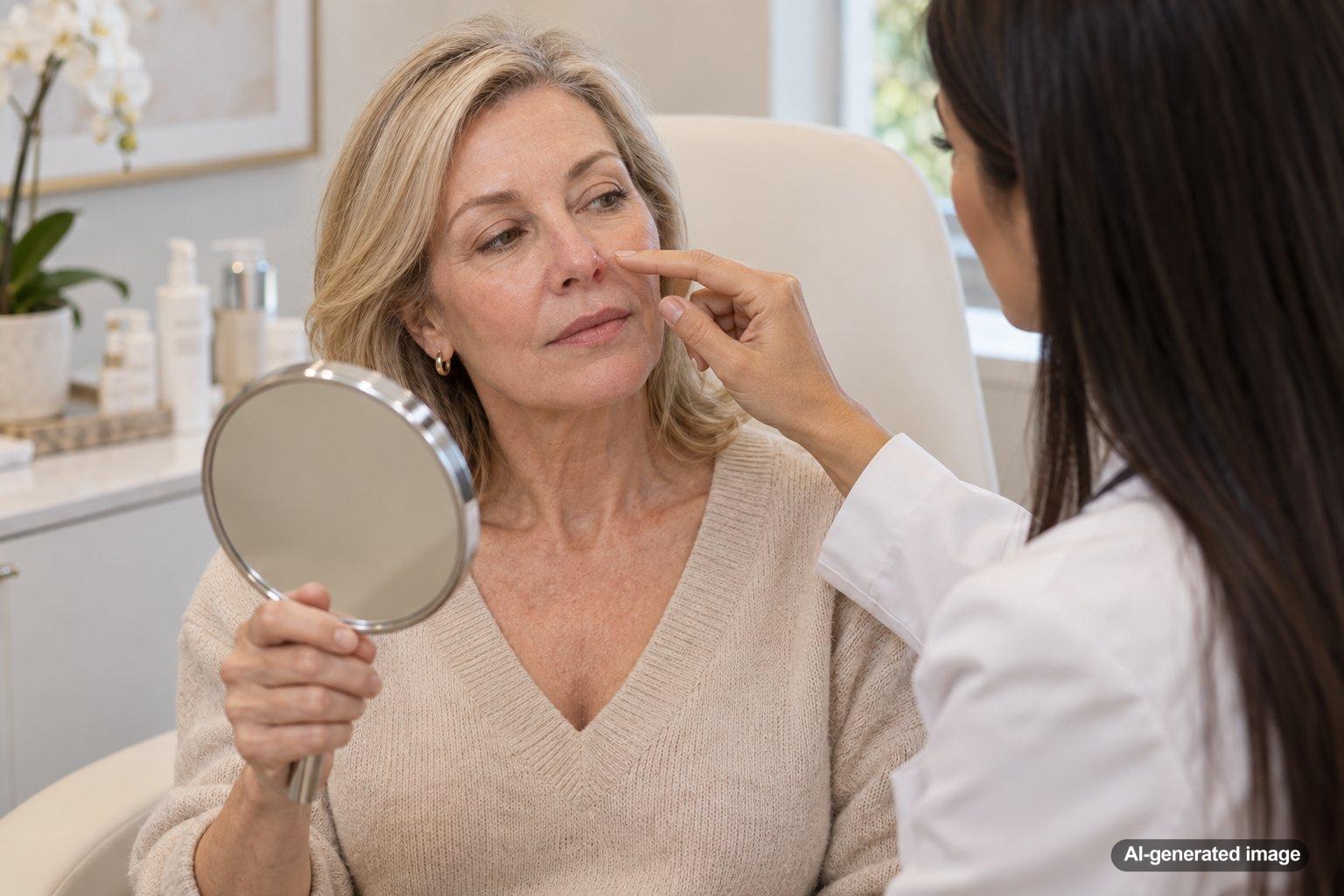
Noticing that one nostril edge looks consistently redder than the other can be surprisingly distracting, especially when the difference remains visible even when the rest of your complexion looks calm. One-sided redness around the nostril opening often develops because that particular area experiences more friction, moisture, dryness, or exposure to an irritating product. However, persistent redness can also be associated with inflammatory skin conditions, visible superficial blood vessels, or irritation involving the skin just inside the nose.
The most useful clues are where the color appears, whether the skin feels dry or tender, and whether there are additional changes such as flaking, crusting, bumps, or bleeding. A dermatologist can help distinguish a relatively straightforward skin barrier problem from a condition that requires a different approach. The fact that only one side is affected is helpful information, but it does not establish a diagnosis by itself.
Quick Answer: Why Is One Nostril Edge Redder?
- Uneven friction: Repeated wiping, blowing, rubbing, or touching one side of the nose can irritate its delicate outer edge.
- Dryness or moisture exposure: Dry air, nasal drainage, and repeated contact with tissues can disrupt the skin barrier around one nostril more than the other.
- Contact dermatitis: Skincare products, fragrances, topical medications, or other substances may irritate the skin or trigger an allergic reaction.
- Inflammation or visible vessels: Rosacea, seborrheic dermatitis, or a prominent superficial blood vessel may contribute to persistent color differences.
- Irritation or infection near the nasal opening: Tenderness, crusting, sores, or swelling can suggest a problem involving the nasal vestibule that warrants professional evaluation.
If the difference is mild and the skin is otherwise comfortable, observing potential triggers and simplifying skincare may be reasonable. Redness that persists, worsens, bleeds, or develops a distinct lesion should be examined rather than repeatedly treated as ordinary dryness.
What Does Redness Along the Nostril Edge Actually Mean?
The nostril edge is a small but anatomically varied area. It includes the external skin surrounding the opening, the curved crease where the nostril meets the face, and the transition toward the more delicate tissue just inside the nose. These nearby surfaces do not all respond to irritation in the same way.
External facial skin contains a protective barrier that limits water loss and helps reduce exposure to irritants. When this barrier becomes disrupted, the area may appear pink or red, feel tight, or develop fine scaling. The entrance to the nostril can also become irritated through repeated mechanical contact and exposure to nasal secretions.
A difference in color does not necessarily indicate that the nostrils themselves are structurally abnormal. Small variations in skin thickness, vascular visibility, exposure, and individual habits may make a reaction more noticeable on one side.
It is also important to distinguish redness of the flat skin from a discrete red bump, sore, or persistent scaly patch. Those findings may call for a different examination and should not automatically be grouped with generalized skin sensitivity.
Common Reasons One Nostril Edge Stays Red
Repeated wiping or blowing on one side
Even a subtle habit can create an uneven pattern of irritation. Someone may consistently press a tissue against the same nostril, rub one side during allergy symptoms, or touch a particular nasal crease without noticing.
This repeated friction can disturb the outer skin barrier and make superficial inflammation more visible. Seasonal allergies, colds, and chronic nasal drainage may contribute because they increase the frequency of wiping.
In Fort Lauderdale, outdoor allergens, warm conditions, and frequent transitions into air-conditioned spaces may influence how often someone experiences nasal symptoms or skin dryness. These environmental factors do not establish a cause, but they can be useful details when reviewing recurring irritation.
Dry or irritated skin around the nasal crease
The curved skin where the nostril meets the cheek can be particularly susceptible to accumulated cleanser, repeated rubbing, and changes in moisture. Dryness may present as a faint red outline, tightness, or fine flakes.
One side may become more noticeable because of differences in wiping habits, skincare application, or localized irritation. Applying additional exfoliating products to improve the appearance can sometimes make the sensitivity worse.
Contact dermatitis from skincare or other products
Contact dermatitis occurs when the skin reacts to an irritating substance or develops an allergic response to something it encounters. Around the nostril edge, potential exposures include cleansers, fragranced products, exfoliating acids, retinoids, cosmetics, and certain topical preparations.
Some reactions develop relatively quickly, while others become noticeable with repeated exposure. The skin may sting, itch, peel, or appear more inflamed after a product is applied.
A product does not need to be applied directly to the nostril to reach that area. Cleansing, sweating, or touching the face can transfer small amounts of product into the nasal crease.
Seborrheic dermatitis
Seborrheic dermatitis is an inflammatory skin condition that commonly affects oil-producing areas, including the folds alongside the nose. It may cause redness or discoloration with flaky, sometimes greasy-looking scale.
Although both sides can be affected, the visible intensity does not always need to match perfectly. Similar flaking around the eyebrows, scalp, or ears can provide useful context.
Because seborrheic dermatitis can resemble other inflammatory conditions, persistent or recurrent symptoms are worth discussing with a dermatologist.
Rosacea and superficial blood vessels
Rosacea can produce persistent facial redness, flushing, sensitivity, and visible small blood vessels, particularly across the central face. The nose and surrounding cheeks are common areas of involvement.
Rosacea is not usually identified from a single red nostril edge alone. However, a person who also experiences flushing, stinging with skincare products, or visible facial vessels may benefit from an evaluation for this condition.
Sometimes a small superficial blood vessel contributes to a localized area of persistent color without the scaling or tenderness associated with an irritated skin barrier. A dermatologist can examine the pattern and determine whether vascular changes are contributing.
Nasal vestibulitis or localized infection
The nasal vestibule is the area immediately inside the nostril entrance. It contains hair follicles and can become inflamed or infected, sometimes following frequent nose blowing, picking, or plucking nasal hairs.
Nasal vestibulitis may produce tenderness, swelling, pimples or sores, crusting, or bleeding near the opening. These findings deserve medical attention because an infection may require clinician-directed treatment and can occasionally spread.
Redness without pain, crusting, or other symptoms is not enough to identify an infection. Conversely, a painful bump or spreading inflammation should not be assumed to be a cosmetic concern.
How to Recognize Different Patterns of Nostril Redness
The appearance and associated sensations can help clarify what needs to be assessed. These patterns are clues rather than reliable ways to diagnose the condition at home.
- Redness with fine peeling: May suggest barrier irritation, dryness, or dermatitis.
- Redness with greasy-looking flakes: Can be associated with seborrheic dermatitis, especially when similar changes occur around the eyebrows or scalp.
- Redness with flushing or visible vessels: May raise the possibility of rosacea or localized vascular prominence.
- Redness with a tender bump or yellowish crust: Can occur with nasal vestibulitis or another localized infection and warrants assessment.
- Redness with a persistent sore, bleeding, or a changing growth: Requires evaluation to rule out conditions that should not be managed as simple irritation.
Location is particularly important. A red patch on the external nasal crease may have different causes from a painful sore immediately inside the nostril.
Why Might the Redness Affect Only One Side?
The right and left sides of the face do not necessarily experience identical conditions throughout the day. Small differences in behavior and exposure can create noticeable asymmetry.
For example, someone may habitually wipe one nostril more firmly, sleep with one side of the face against a pillow, or experience more frequent drainage from one nostril. A particular spot may also be more exposed to irritating skincare products or have a more prominent superficial blood vessel.
Asymmetry can also occur with inflammatory conditions and localized infections. However, the one-sided pattern becomes more clinically important when the change remains confined to the same precise area, progressively worsens, or is accompanied by bleeding, ulceration, pain, or a growing lesion.
Persistent asymmetry is therefore a reason to pay attention to the details, not a reason to assume either a harmless or a serious diagnosis.
What You Can Do at Home for Mild Nostril Edge Irritation
When the redness is mild, the skin is intact, and there are no concerning associated symptoms, a conservative approach may help minimize additional irritation while you observe the area.
Keep cleansing gentle
Use a mild, fragrance-free facial cleanser on the surrounding external skin and avoid vigorous rubbing. Lukewarm water is generally preferable to very hot water when the skin feels sensitive.
Pat the area dry with a soft towel rather than repeatedly dragging fabric across the nostril edge.
Temporarily simplify skincare
If the redness appears after starting or increasing an exfoliating acid, retinoid, fragranced product, or other potentially irritating cosmetic, consider avoiding that product on the affected external skin until the cause is clearer.
A simple, fragrance-free moisturizer formulated for sensitive facial skin may help support the external skin barrier. Avoid placing ordinary facial products deep inside the nostril unless specifically directed by a clinician.
Reduce unnecessary friction
During periods of nasal drainage, gentle blotting may be less irritating than repeated forceful wiping. Avoid picking at flakes, crusts, or bumps.
Do not squeeze tender lesions near the nostril or attempt to remove an ingrown hair or suspected infected bump with sharp instruments.
Protect the surrounding facial skin from the sun
Sun exposure can aggravate some facial inflammatory conditions, including rosacea. A broad-spectrum SPF 30 or higher sunscreen that your skin tolerates can be part of a gentle routine for exposed external facial skin.
If sunscreen consistently stings the affected area, a dermatologist can help identify more suitable options. Do not apply sunscreen inside the nasal passage.
Observe the pattern without repeatedly manipulating it
A few photographs taken under similar lighting conditions can help document whether the area is stable or changing. Note whether redness becomes more visible after wiping, cleansing, sun exposure, or applying a particular product.
Avoid trying multiple medicated creams at once. In particular, do not apply prescription-strength steroids, antibiotics, antifungals, or other medicated products around or inside the nostril without appropriate clinical guidance. The treatment depends on the actual cause, and some products may worsen certain facial conditions.
What Can a Dermatologist Do About Persistent Redness?
A dermatologist can examine whether the color difference comes from surface inflammation, scaling, vascular changes, a localized lesion, or involvement of the nasal vestibule. The examination may include questions about symptom duration, nasal drainage, product exposures, bleeding, tenderness, and previous treatments.
Professional options depend on the findings and may include:
- Skin barrier guidance: Identifying irritating products or habits and recommending an appropriate gentle skincare routine.
- Inflammatory skin condition management: Considering diagnosis-specific topical or other therapies for conditions such as contact dermatitis, seborrheic dermatitis, or rosacea.
- Infection assessment: Evaluating painful, crusted, or swollen areas and determining whether prescription treatment or additional medical care is necessary.
- Vascular treatment discussions: Assessing whether a persistent visible vessel or vascular redness might be appropriate for an office-based treatment after other causes have been considered.
- Further examination of a focal lesion: Evaluating persistent bleeding, ulceration, scaling, or growth and discussing whether additional testing, including a biopsy, is indicated.
For some types of confirmed superficial vascular redness, laser-based treatments may be considered. However, a laser is not the appropriate starting point for an unexplained painful, infected, crusted, or otherwise suspicious area.
At Waverly DermSpa, we offer Excel V+ and can help you understand whether it may be appropriate.
When Should You See a Dermatologist?
Arrange a dermatology evaluation when redness remains unexplained, repeatedly returns to exactly the same spot, or does not improve with a reasonable period of gentle care. Earlier evaluation is appropriate when additional symptoms develop.
Changes that deserve particular attention include:
- A persistent sore, ulcer, or area that bleeds without an obvious explanation.
- A growing bump, thickened spot, or scaly patch that does not resolve.
- Recurring crusting or tenderness near the nostril opening.
- Increasing redness accompanied by discomfort or swelling.
- A localized change that steadily becomes more noticeable or develops a new appearance.
- Redness associated with persistent nasal symptoms that may require evaluation by another appropriate medical specialist.
A nonhealing or changing lesion on the nose deserves examination because certain skin cancers can resemble benign inflammatory changes. This does not mean that ordinary nostril redness is likely to be skin cancer; it means that persistent focal lesions should not be dismissed without an assessment.
Seek urgent medical evaluation for rapidly spreading redness, significant pain, substantial swelling, or fever. Severe painful swelling at the nasal tip, particularly with a boil, warrants emergency assessment. Severe headache, vision changes, or symptoms of significant illness in association with nasal infection also require urgent attention.
Frequently Asked Questions
Is it normal for one nostril to look slightly redder than the other?
A mild difference in color can occur because of uneven friction, dryness, local blood vessel visibility, or other everyday factors. However, a new or persistent change cannot be classified as normal based on appearance alone. Associated symptoms and changes over time are important.
Can allergies make just one nostril edge red?
Allergies can contribute indirectly through nasal drainage, frequent wiping, and irritation. If one nostril is rubbed more often, the surrounding skin may appear redder. Persistent redness without obvious irritation may have another explanation.
Could redness around one nostril be rosacea?
Rosacea can affect the nose and central face, producing flushing, lasting redness, sensitivity, and visible vessels. A single red nostril edge is not sufficient to diagnose rosacea. A dermatologist can assess whether other characteristic findings are present.
Does a red nostril edge mean there is an infection?
Not necessarily. Simple irritation and inflammatory skin conditions can also cause redness. Pain, swelling, sores, pimples, crusting, or bleeding around the nasal opening may raise concern for an infection such as nasal vestibulitis and should be evaluated by a healthcare professional.
Should I put hydrocortisone cream on the red area?
It is better not to start a medicated steroid treatment on unexplained facial or nostril redness without professional guidance. Steroids can be inappropriate for some causes of redness, and products intended for external skin should not automatically be used inside the nose. A clinician can determine whether a medication is suitable.
Can a dermatologist treat a permanently visible red vessel near the nostril?
Some superficial facial blood vessels can be evaluated for vascular laser treatment. Suitability depends on the vessel, the surrounding skin, and whether another condition is contributing to the color. An examination should come before deciding on a procedure.
Ready to get help?
Schedule an appointment or send a message and our team will get back to you.
Prefer to call? 954-666-3736
Disclaimer
This article is for educational purposes and is not medical advice. For diagnosis and personalized treatment, please book an appointment with a board-certified dermatologist.
Sources & Further Reading
- American Academy of Dermatology (AAD) – Rosacea: Signs and symptoms
- Cleveland Clinic – Nasal Vestibulitis: Symptoms, Treatment & Outlook
- American Academy of Dermatology (AAD) – Rosacea: Overview
