

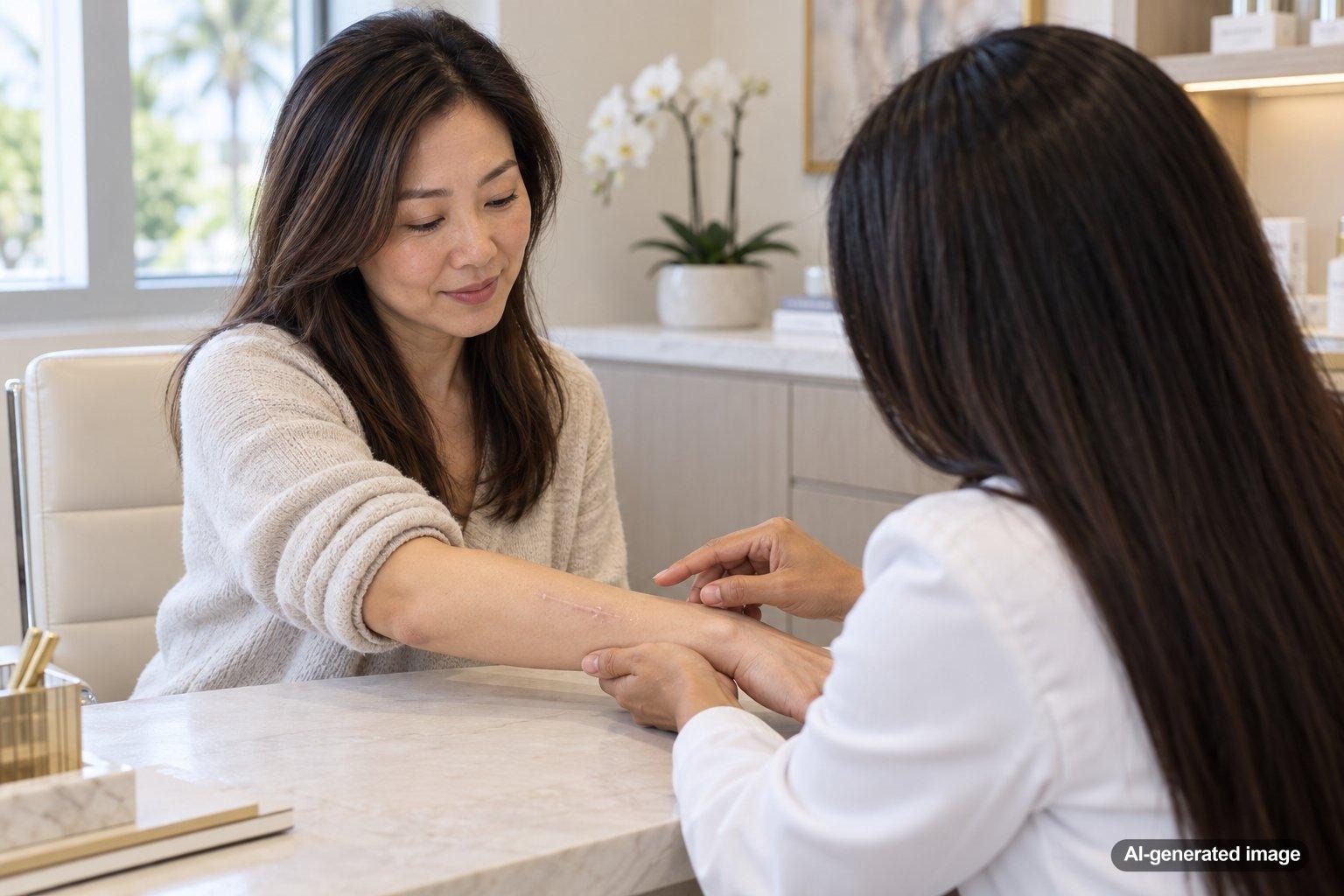
Noticing tiny white bumps along the edge of a scar can be surprising, especially when the original injury seems to have healed. The surrounding skin may look smooth while a few small, pale, raised spots appear directly on the scar or just beside it. Although these bumps can be harmless, their appearance does not always explain what they are.
One possible cause is secondary milia, which are small keratin-filled cysts that can develop after skin injury or during the repair process. Other possibilities include clogged hair follicles, tiny epidermoid cysts, or localized changes in scar tissue. Understanding the differences can help you avoid irritating the area and recognize when a professional evaluation is appropriate.
Quick Answer: Why Do White Bumps Form Along a Scar?
- Secondary milia: Tiny cysts containing keratin can appear where skin has been injured or repaired.
- Changes in skin structure: Healing can alter the surface of the skin and its normal openings.
- Blocked follicles: Small acne-like bumps may develop near a scar where hair follicles remain present.
- Scar tissue changes: Raised or uneven scar tissue can create small bumps that resemble cysts.
- Other skin conditions: Persistent, inflamed, growing, or unusual bumps deserve examination rather than an assumption that they are part of normal healing.
What Are Those Tiny White Bumps?
One common explanation for small, firm, pearly-white bumps near an injury is milia. A single bump is called a milium. Unlike a typical acne whitehead, a milium is a small cyst containing keratin, a structural protein naturally present in skin.
Milia may occur spontaneously on otherwise healthy skin, particularly around the eyes and cheeks. When they develop after an injury, burn, blistering condition, or skin-resurfacing procedure, they are often called secondary or traumatic milia.
These bumps may appear individually or in small groups. They are often smooth, round, and relatively firm, without the redness or tenderness associated with an inflamed pimple. However, appearance alone cannot establish a diagnosis, particularly when a bump develops on a changing scar.
Why Can Scar Healing Lead to Milia?
Skin healing involves rebuilding the protective outer layer while deeper tissues reorganize and form scar tissue. This process can temporarily change the normal architecture of the skin, including structures associated with hair follicles, sweat ducts, and the epidermis.
Secondary milia can develop when keratin becomes retained within small cyst-like structures during skin repair. The result may be a visible white or yellowish bump near the healed injury.
This phenomenon can occur after different kinds of skin damage. It is not necessarily a sign that the original wound was treated incorrectly or that the scar is healing poorly.
Common Reasons White Bumps Appear Around Scars
- Previous cuts or abrasions: Skin that has regenerated after an injury may develop small keratin cysts.
- Surgical incisions: Small bumps near an incision may represent milia, retained suture material, or other localized healing changes.
- Burns or blistering injuries: These can alter the outer skin layer in ways associated with secondary milia.
- Skin procedures: Treatments that intentionally injure or resurface the skin may occasionally be followed by small cysts during recovery.
- Follicular blockage: Hair follicles adjacent to a scar may develop plugs that resemble white bumps.
- Localized irritation: Friction, picking, or inappropriate skincare products may complicate the appearance of healing skin.
The timing, location, texture, and symptoms associated with a bump can provide useful clues. A dermatologist may also consider whether the scar followed surgery, trauma, a burn, or a cosmetic procedure.
Are Scar Milia Different From Whiteheads?
They can look similar, but milia and acne whiteheads develop differently. Whiteheads are closed comedones associated with blocked follicles and a buildup of oil and skin cells. Milia are small keratin-filled cysts that are not considered a form of acne.
A typical milium may feel like a tiny firm bead beneath the skin. A whitehead may occur with other acne lesions and can sometimes become inflamed. Neither characteristic is completely reliable for identifying a bump without an examination.
It is particularly important not to assume that a bump along a surgical scar is acne. Depending on its appearance and history, a clinician may need to rule out a reaction to retained suture material or another localized process.
What Can You Safely Do at Home?
If a scar is completely healed and the bumps are not causing symptoms, gentle skin care may be a reasonable starting point while you monitor the area. The goal is to protect the skin rather than force the bumps to disappear.
- Avoid squeezing or piercing: Milia do not behave like ordinary pimples, and attempting extraction can cause irritation, infection, or additional scarring.
- Cleanse gently: Use a mild cleanser and avoid aggressive rubbing or scrubbing.
- Moisturize appropriately: Choose a product suited to your skin and any postoperative instructions you have received.
- Protect exposed scars from sunlight: Sun protection may help limit unwanted discoloration as scar tissue matures.
- Follow wound-care directions: If the scar is recent, prioritize instructions from the clinician who treated the injury.
- Observe changes: A dated photograph can help document whether bumps remain stable, increase in number, or change in appearance.
Avoid applying strong exfoliating acids, retinoids, or abrasive products to a fresh or incompletely healed scar unless your treating clinician specifically recommends them. Skin that is still recovering may be more vulnerable to irritation.
Can a Dermatologist Remove White Bumps on a Scar?
If a dermatologist confirms that the bumps are milia, treatment may not be necessary. Some milia resolve without intervention, while others persist and may be considered for removal if they are bothersome.
Professional options can include carefully opening and extracting individual milia with appropriate sterile instruments. In selected cases, a dermatologist may discuss topical treatments or other procedures, depending on the number of lesions, their location, and the condition of the surrounding skin.
Scar tissue deserves special consideration because unnecessary trauma may affect its texture or appearance. The appropriate approach depends on whether the area is fully healed and whether the bumps are truly milia rather than another type of lesion.
If the bumps are associated with a recent surgical procedure, the clinician who performed that procedure may also need to evaluate the area before any treatment is considered.
When Should You See a Dermatologist?
Small, stable, painless bumps may not be urgent, but certain changes deserve attention. Arrange an evaluation if you notice:
- Increasing redness, warmth, swelling, or tenderness around the scar.
- Drainage, pus, an unpleasant odor, or reopening of the wound.
- A bump that enlarges, bleeds, develops a crust, or repeatedly breaks down.
- New pigmentation, unusual color changes, or an irregular growth.
- Persistent bumps that are uncomfortable or difficult to identify.
- A new bump near a scar from a previous skin cancer removal.
Spreading redness, fever, or rapidly worsening pain warrants prompt medical attention, especially after surgery. Changes within or near a previous skin cancer treatment site should also be assessed rather than attributed to scar tissue without examination.
At Waverly DermSpa in Fort Lauderdale, Dr. Maryann Mikhail, MD, can evaluate changes in scar appearance and help determine whether observation, treatment, or additional examination is appropriate.
Frequently Asked Questions
Are little white bumps on a scar a normal part of healing?
They can occur during or after skin repair, particularly when secondary milia develop. However, not every white bump is a milium, and a new or changing lesion may need assessment to clarify its cause.
Will milia along a scar disappear on their own?
Some milia gradually resolve without treatment, while others remain visible for longer periods. The course varies depending on the type of lesion and individual skin characteristics. A dermatologist can help determine whether observation is reasonable.
Can I pop a white bump on my scar?
It is best not to squeeze, puncture, or scrape bumps on scar tissue. These actions may injure the skin and introduce bacteria. Professional evaluation is preferable if a bump is persistent or bothersome.
Can white bumps appear months after a scar has formed?
Yes. Secondary milia can become noticeable after the initial injury has healed. Timing alone does not confirm the diagnosis, so a new bump should be evaluated if its appearance or behavior raises concern.
Do white bumps mean a surgical scar is infected?
Not necessarily. Milia are not infections. However, redness, increasing pain, warmth, swelling, or drainage may indicate a different problem that requires medical assessment.
Can scar treatments make the bumps worse?
Some resurfacing procedures can be associated with secondary milia during healing. Irritating treatments or home extraction attempts may also create additional skin injury. A dermatologist can help determine which approaches are appropriate for a particular scar.
Understanding Changes in Your Scar
Little white bumps around a scar are often associated with relatively minor changes in the healing skin, including secondary milia. Still, scars can develop several kinds of bumps, and distinguishing them matters when deciding whether treatment is needed.
Gentle care, attention to new symptoms, and an individualized evaluation offer a thoughtful approach. Whether you live in Fort Lauderdale year-round or are visiting South Florida seasonally, a dermatologist can help clarify unfamiliar skin changes without unnecessary treatment.
Ready to get help?
Schedule an appointment or send a message and our team will get back to you.
Prefer to call? 954-666-3736
Disclaimer
This article is for educational purposes and is not medical advice. For diagnosis and personalized treatment, please book an appointment with a board-certified dermatologist.
Sources & Further Reading
- DermNet – Milium
- Cleveland Clinic – Milia (Milk Spots): Causes & Treatment
- DermNet – Cutaneous Cysts and Pseudocysts
