

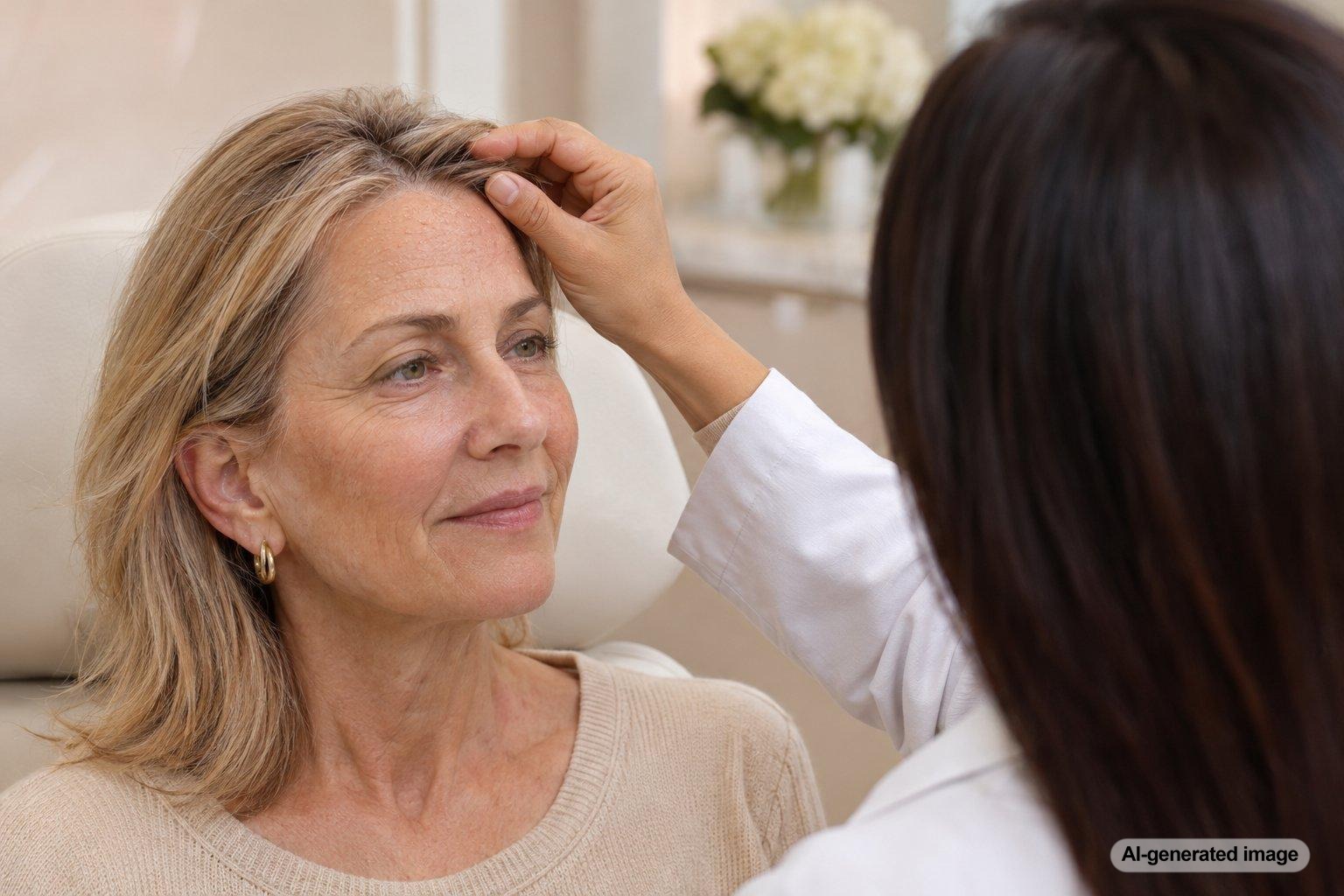
Tiny, nearly identical bumps across the forehead can appear seemingly overnight or develop so gradually that you first notice them in certain lighting. Unlike a typical pimple, these bumps may have little redness, no obvious white center, and a texture that feels rougher than the surrounding skin. Their uniform appearance can make it difficult to determine what is happening beneath the surface.
Several conditions can create this pattern. Common possibilities include closed comedones, which are clogged pores, irritation from skincare or hair products, and inflammation around hair follicles. In some cases, a yeast-associated condition called Malassezia folliculitis may be involved. The appearance alone is not enough to establish a diagnosis, but associated symptoms and recent changes in routine can provide useful clues.
Quick Answer: Why Do Tiny Uniform Bumps Appear on the Forehead?
- Clogged pores: Closed comedones can produce small, flesh-colored bumps that make the forehead feel uneven.
- Hair and skincare products: Oils, styling products, and other formulations may contribute to clogged pores, particularly near the hairline.
- Folliculitis: Inflammation involving hair follicles can create similarly sized bumps, sometimes accompanied by itching.
- Heat and sweat: Humidity, perspiration, and occlusion may aggravate certain follicular conditions.
- Irritation: Harsh exfoliation or a poorly tolerated product may contribute to roughness, redness, and small raised areas.
What Are These Small Forehead Bumps?
The forehead contains numerous oil-producing glands and hair follicles. When oil and dead skin cells accumulate inside a pore, a small raised lesion called a closed comedo can develop. These bumps may appear skin-colored or slightly lighter than the surrounding complexion. They often create an uneven surface without the prominent inflammation associated with larger pimples.
However, not every small bump represents acne. Some eruptions begin within hair follicles, while others reflect irritation or a reaction to something touching the skin. Two conditions can look similar from a distance even though their underlying mechanisms and appropriate treatments differ.
Dermatologists assess the individual bumps, their distribution, whether they itch or hurt, and whether blackheads or other acne lesions are present. These details can help distinguish ordinary acne from other causes of follicular inflammation.
Common Causes of Tiny, Uniform Forehead Bumps
Closed Comedones and Congested Pores
Closed comedones form when excess oil and dead skin cells accumulate within a pore whose opening remains closed. They may be particularly noticeable when light strikes the forehead from the side. Some people develop these bumps alongside blackheads or occasional inflamed pimples.
Skin type, hormonal influences, and the products applied to the face may affect the tendency toward clogged pores. Because closed comedones are not necessarily inflamed, they can persist without becoming red or tender.
Hair Products and Acne Cosmetica
Hair oils, pomades, conditioners, styling creams, and certain leave-in products can transfer onto the forehead. When a formulation contributes to pore blockage, small bumps may develop near the hairline or extend across the upper forehead. This pattern is sometimes called acne cosmetica.
Consider whether the bumps appeared after changing a styling product or beginning a more intensive haircare routine. Product residue on pillowcases, hats, and headbands can also increase contact with the skin. A product does not need to feel particularly greasy to be poorly suited to someone’s individual skin.
Malassezia Folliculitis
Malassezia is a group of yeasts that normally live on human skin. Under certain circumstances, these organisms can be associated with inflammation within hair follicles. Malassezia folliculitis may produce clusters of small, remarkably similar bumps, sometimes with tiny pustules.
Itching can be an important clue, particularly when the bumps appear in a uniform pattern without typical blackheads. Heat, humidity, sweating, and occlusive products may contribute to the conditions in which this problem develops. The forehead and hairline can be involved, although the chest and upper back are also common locations.
Malassezia folliculitis is sometimes described informally as fungal acne, but it is not the same condition as conventional acne. Other types of folliculitis can look similar, so a dermatologist should evaluate persistent or suspicious eruptions rather than assuming that uniform bumps have a particular infectious cause.
Skin Irritation and Barrier Disruption
Frequent exfoliation, aggressive cleansing, or combining several strong skincare ingredients may leave the forehead irritated. Some individuals notice a rough texture accompanied by tightness, dryness, stinging, or redness.
Irritated skin does not always develop obvious peeling. Subtle inflammation and surface roughness can occasionally resemble clusters of small blemishes. In this situation, adding more exfoliating products may increase discomfort rather than improve the appearance of the skin.
Why Do the Bumps Sometimes Look Almost Identical?
When bumps are approximately the same size and shape, dermatologists may describe the eruption as monomorphic. This pattern can be useful when considering follicular conditions, including Malassezia folliculitis, but it is not diagnostic on its own.
Closed comedones may also appear relatively uniform, especially when numerous pores become congested over the same period. Differences in itching, visible pore plugs, surrounding inflammation, and the presence of other acne lesions provide additional context.
Photos taken under consistent lighting may help document whether the bumps are changing. However, magnifying mirrors and repeated close inspection can make normal skin texture seem more concerning than it is. The goal is to identify meaningful changes, not to expect a completely texture-free forehead.
What Can You Do at Home?
When small forehead bumps develop without significant pain or other concerning symptoms, a simple, gentle routine is a reasonable starting point while determining whether professional evaluation is needed.
- Cleanse gently: Use a mild facial cleanser and lukewarm water rather than abrasive scrubs or repeated washing.
- Review product changes: Consider whether a new sunscreen, moisturizer, serum, or hair product was introduced before the bumps appeared.
- Keep styling products away from the forehead: Apply hair oils and leave-in products carefully, particularly around the hairline.
- Choose suitable moisturizers: Lightweight products labeled non-comedogenic may be helpful for skin prone to clogged pores.
- Remove sweat and residue gently: After exercise or prolonged sweating, cleanse when practical without excessive rubbing.
- Avoid picking: Squeezing tiny bumps can increase inflammation and may contribute to discoloration or scarring.
- Simplify an irritating routine: Temporarily reducing unnecessary exfoliating steps may help limit additional irritation.
It is tempting to experiment with multiple acne treatments when forehead texture becomes noticeable. However, different causes may require different approaches. A product intended to address clogged pores may not be appropriate for folliculitis or irritated skin. Avoid repeatedly adding strong ingredients when the diagnosis is uncertain.
How Can a Dermatologist Evaluate Forehead Bumps?
A dermatologist can examine the size, shape, location, and distribution of the bumps while considering symptoms and recent product exposure. The evaluation may include questions about itching, sweating, medications, and whether similar lesions appear on the chest, back, or scalp.
When conventional acne is suspected, professional options may include topical treatments that help address clogged pores and inflammation. If folliculitis is suspected, the clinician may consider additional examination or testing to clarify the cause. Treatment for a yeast-associated condition differs from treatment for ordinary acne, which is why identifying the underlying process matters.
For irritation-related texture, the priority may be reducing exposure to triggering products and supporting the skin barrier. A dermatologist can also help determine when office-based treatments are appropriate and when a simpler routine is preferable.
At Waverly DermSpa, we offer Chemical Peels and can help you understand whether they may be appropriate. Such treatments are not suitable for every cause of forehead bumps and should be considered only after the condition has been evaluated.
When Should You See a Dermatologist?
Consider scheduling an evaluation if the bumps persist, recur frequently, spread, or remain unexplained despite reasonable adjustments to your routine. Persistent itching, tenderness, or repeated pustules can also warrant assessment.
Seek prompt medical attention for rapidly spreading redness, increasing warmth or swelling, significant pain, fever, or other signs of a potentially more serious skin infection. These symptoms should not be managed by repeatedly applying cosmetic products.
A professional evaluation is especially helpful when forehead bumps resemble acne but do not respond as expected to ordinary skincare. The correct diagnosis can prevent unnecessary product experimentation and help establish a more appropriate plan.
Frequently Asked Questions
Are tiny forehead bumps always acne?
No. Closed comedones are one common explanation, but folliculitis, irritation, and product-related reactions can create similar-looking bumps. Appearance alone cannot reliably determine the cause.
Can forehead bumps be caused by fungal acne?
Some uniform forehead eruptions may be associated with Malassezia folliculitis, often called fungal acne. Itching and similarly sized follicular bumps can raise suspicion, but other conditions may look similar. A dermatologist can assess whether this diagnosis is appropriate.
Why do the bumps become more noticeable after sweating?
Sweat, heat, friction, and occlusion can aggravate some follicular conditions. Perspiration can also interact with products already on the skin. This pattern offers a clue but does not identify a specific diagnosis.
Should I exfoliate to remove small forehead bumps?
Exfoliating ingredients may be useful for certain types of clogged pores, but aggressive exfoliation can worsen irritation. If the bumps itch, sting, or appear inflamed, determining their cause before introducing stronger products is particularly important.
Can hair products cause bumps even if they never touch my face directly?
Yes. Styling products can migrate from the hair onto nearby skin or transfer through pillowcases, hats, and other surfaces. Bumps concentrated along the hairline may justify reviewing the products used in that area.
Will small forehead bumps disappear on their own?
Some product-related or temporary irritation patterns may improve after a trigger is removed. Other conditions can persist or recur without targeted care. The course varies with the underlying cause, so persistent or worsening bumps deserve professional assessment.
Ready to get help?
Schedule an appointment or send a message and our team will get back to you.
Prefer to call? 954-666-3736
Disclaimer
This article is for educational purposes and is not medical advice. For diagnosis and personalized treatment, please book an appointment with a board-certified dermatologist.
Sources & Further Reading
- American Academy of Dermatology (AAD) – How to treat different types of acne
- DermNet – Malassezia folliculitis
- American Academy of Dermatology (AAD) – Are your hair care products causing breakouts?
