

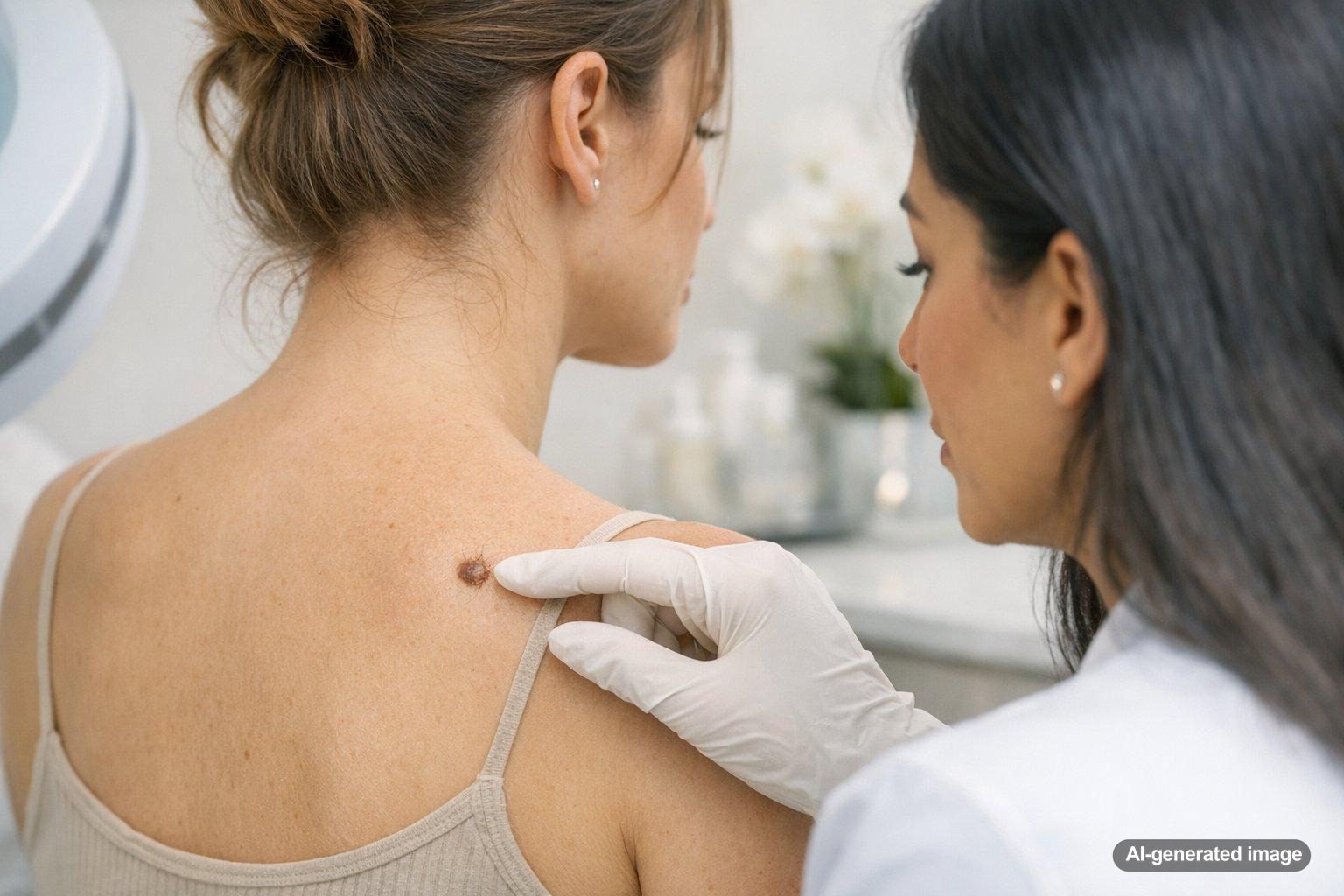
A hair growing from a mole can look surprising, but it is often a simple sign that the mole formed around a normal hair follicle. In many cases, the follicle keeps working, so a strand of hair can grow through the pigmented spot just as it would through nearby skin.
Hair alone does not prove that a mole is healthy, and it does not prove that anything is wrong. The more important question is whether the mole is changing, bleeding, itching, becoming painful, developing uneven color, or looking noticeably different from your other moles.
Quick answer
- Some moles grow hair because they contain or sit over active hair follicles.
- A hairy mole is often benign, but the hair itself is not a safety test.
- It is usually okay to trim hair at the skin surface if the mole is not irritated.
- A dermatologist should evaluate any mole that is new, changing, bleeding, itching, painful, or different from your other spots.
What a hairy mole usually means
A mole, also called a nevus, is a collection of pigment-producing cells in the skin. If that cluster develops in an area where hair follicles are present, the follicle may continue to produce hair. That is why some raised or flat moles can have one or more hairs growing from them.
The hair may be darker, coarser, or more noticeable than surrounding hair because the mole contains extra pigment and may make the area stand out visually. The presence of hair does not automatically make a mole concerning, and many common moles can have hair.
Common reasons a mole may have hair
- The mole sits over a follicle: Hair can grow through the mole if the follicle underneath remains active.
- The area is naturally hair-bearing: Moles on the face, scalp, chest, arms, legs, or back may be more likely to show hair because those areas commonly have follicles.
- The mole is slightly raised: Raised moles can make a normal hair easier to see or feel.
- Hormonal changes can affect hair growth: Hair texture and visibility can shift over time, even when the mole itself is stable.
- Pigment can make the hair more noticeable: Darker color around the follicle may draw attention to a hair that might otherwise be overlooked.
Can you remove hair from a mole?
Many people prefer to manage the hair for comfort or cosmetic reasons. Conservative options include trimming the hair carefully with clean scissors or using a small facial hair trimmer without scraping the surface of the mole. Try not to repeatedly pick, dig, or irritate the area, especially if the mole becomes tender or inflamed.
Tweezing may be tolerated by some people, but it can irritate the follicle or the mole surface. If a mole is frequently bothered by shaving, waxing, clothing, jewelry, or grooming, a dermatologist can examine it and talk through safer options.
Professional options
If the mole is stable and the main concern is appearance or repeated irritation, a dermatologist can evaluate whether removal is appropriate. Common medical approaches may include shave removal or surgical excision, depending on the mole’s size, depth, location, and clinical features. When a mole is removed, it may be examined under a microscope when clinically appropriate.
If the mole has any concerning features, cosmetic removal should not be the first step. The priority is a dermatology evaluation so your clinician can decide whether a biopsy or another medical approach is needed.
When to see a dermatologist
Schedule a mole check if a mole with or without hair starts to change. It is worth being evaluated if you notice:
- Asymmetry, uneven borders, or multiple colors
- Growth, darkening, crusting, bleeding, itching, or pain
- A new mole in adulthood or a spot that looks unlike your other moles
- A mole that is repeatedly irritated by shaving, clothing, or grooming
- A personal or family history of melanoma or atypical moles
People who spend time in South Florida, including Fort Lauderdale residents, seasonal visitors, and international travelers, may also benefit from routine skin checks because ongoing sun exposure can make regular monitoring especially important.
FAQ
Does hair growing from a mole mean it cannot be melanoma?
No. Hair can be seen in many benign moles, but hair is not a reliable way to rule anything in or out. A changing or unusual mole should be checked by a dermatologist.
Is it bad to pluck hair from a mole?
Plucking does not usually change what a mole is, but it can irritate the follicle or skin surface. If plucking causes pain, bleeding, swelling, or repeated inflammation, it is better to stop and ask a dermatologist for guidance.
Can laser hair removal be used over a mole?
Laser treatment directly over pigmented lesions is a medical decision and should not be assumed to be appropriate. A dermatologist can evaluate the mole first and help you understand safer options.
Should a hairy mole be removed?
Not always. Some people choose removal because the mole is irritated or cosmetically bothersome, but removal decisions should be based on a clinical exam, the mole’s features, your history, and your goals.
What should I do if the mole changes after I remove the hair?
Stop irritating the area and book a dermatology appointment, especially if the mole bleeds, crusts, grows, changes color, or does not settle down after minor grooming irritation.
Ready to get help?
Schedule an appointment or send a message and our team will get back to you.
Prefer to call? 954-666-3736
Disclaimer
This article is for educational purposes and is not medical advice. For diagnosis and personalized treatment, please book an appointment with a board-certified dermatologist.
Sources & further reading
- American Academy of Dermatology (AAD) – Moles: Signs and symptoms
- American Academy of Dermatology (AAD) – What to look for: ABCDEs of melanoma
- The Skin Cancer Foundation – Melanoma Warning Signs and Images
