

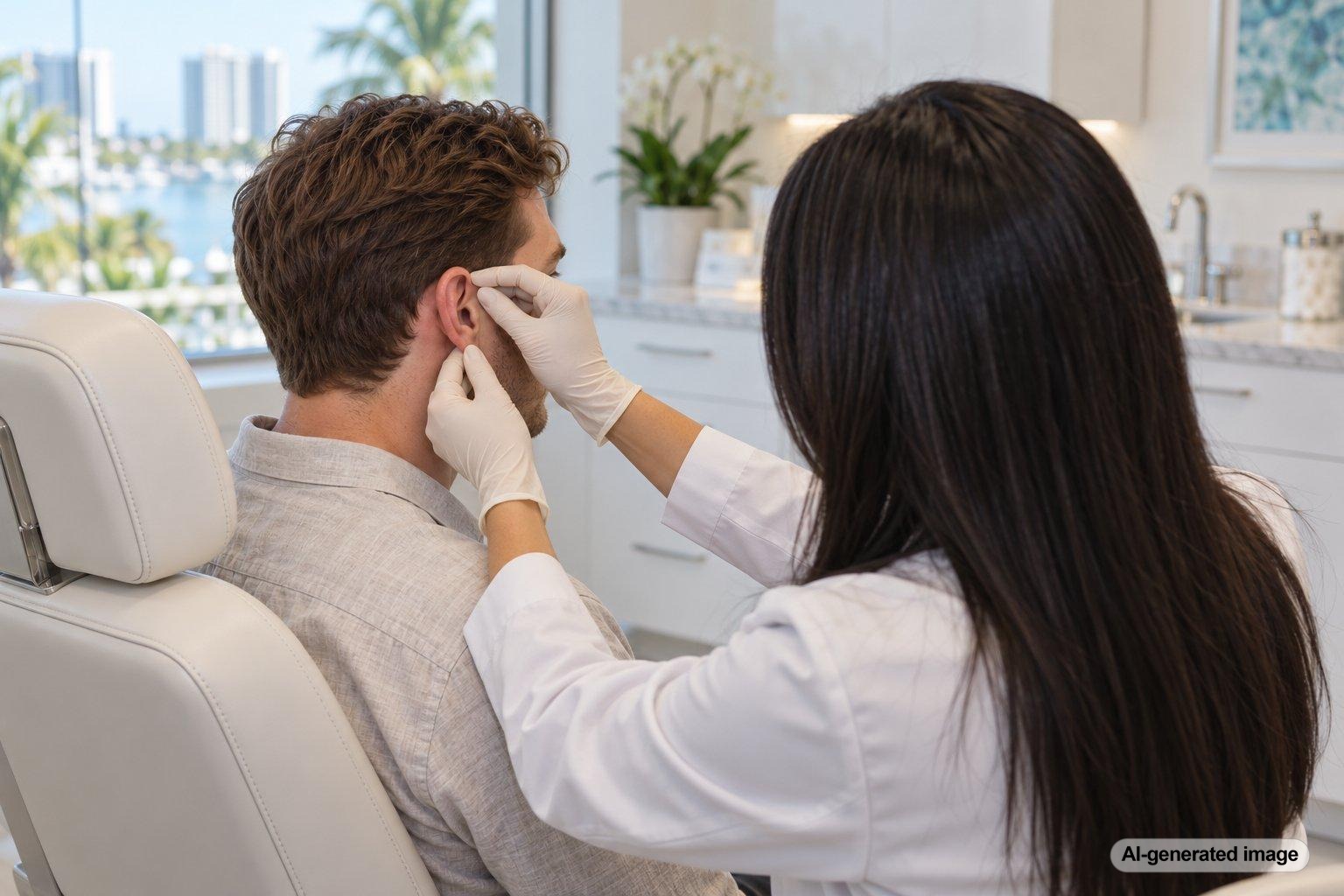
Blackheads inside the fold of your ear can be surprisingly persistent. You might notice a tiny dark dot while looking in the mirror, feel a small bump when washing your face, or discover several clogged pores in an area you rarely examine. Although blackheads are usually associated with the nose, chin, and forehead, they can also develop in the curved surfaces of the outer ear.
The most common explanation is straightforward: the skin inside your ear folds contains oil-producing glands and hair follicles, just like the skin on your face. When oil and dead skin cells accumulate inside a follicle, a blackhead can form. The ear’s unusual shape can make these clogged pores harder to notice and more difficult to clean gently. However, not every dark spot in the ear is a blackhead, and persistent or changing spots deserve professional evaluation.
Quick Answer: Why Blackheads Form Inside Ear Folds
- Oil and dead skin cells collect in pores. The outer ear contains follicles that can develop the same type of blockage seen in facial acne.
- Ear folds create hard-to-reach surfaces. Curved areas can retain oil, residue, and debris that may contribute to clogged pores.
- Hair and skincare products may contribute. Conditioner, styling products, sunscreen, and moisturizers can leave residue around the ear.
- Some people naturally develop more clogged pores. Skin type, oil production, and individual acne tendencies can influence where blackheads appear.
- Squeezing is not the safest solution. The delicate contours of the ear can make aggressive extraction uncomfortable and potentially damaging.
What Exactly Is a Blackhead in the Ear?
A blackhead is a type of acne lesion called an open comedone. It develops when a hair follicle becomes filled with a mixture of sebum, the skin’s natural oil, and accumulated skin cells. Unlike a closed comedone, which remains covered by a thin layer of skin, an open comedone has an opening at the skin’s surface.
The dark appearance comes from chemical changes, including oxidation of material within the exposed pore. It does not mean the spot is filled with dirt or that the ear is unclean.
The outer ear, also called the auricle or pinna, has several folds and recessed areas. One prominent depression near the entrance to the ear canal is called the concha. Blackheads may appear in this area or along other accessible folds of the external ear.
Importantly, a blackhead on the visible outer ear is different from a problem deeper inside the ear canal. The canal has sensitive structures, and attempting to inspect or treat a suspected blackhead deep inside it is not recommended.
Why Ear Folds Are Especially Prone to Clogged Pores
Several factors may explain why a blackhead develops in this particular location, even when the rest of your face looks relatively clear.
Natural Oil Production
The outer ear contains sebaceous glands that produce sebum. This oil helps protect and lubricate the skin, but it can contribute to comedones when it becomes trapped with dead skin cells inside follicles. People with naturally oily or acne-prone skin may notice clogged pores around the ears as well as on the face.
The Shape of the Ear
The ridges and depressions of the ear make it different from relatively flat facial skin. Some areas receive less attention during routine cleansing, allowing residue to remain on the surface. This does not mean that washing more aggressively will prevent blackheads. Gentle, consistent care is generally preferable to repeated scrubbing.
Hair Products and Conditioner
Shampoo, conditioner, leave-in treatments, hair oils, and styling products can come into contact with the outer ear. Some formulations may contribute to clogged pores in susceptible individuals, particularly when residue remains against the skin.
If you frequently notice blackheads near the hairline or behind the ears, consider whether your hair-care routine could be contributing.
Earbuds, Headphones, and Accessories
Devices that contact the outer ear can create friction and hold oil, sweat, or product residue against the skin. The relationship between these devices and blackheads varies, but regular cleaning of items that touch your ears is a reasonable skincare habit.
Choose properly fitting accessories and avoid unnecessary pressure against irritated areas.
Individual Skin Characteristics
Some people are simply more prone to comedonal acne. Hormonal influences, sebum production, follicular characteristics, and skincare habits can all contribute. A recurring blackhead in the same ear fold does not necessarily indicate a serious underlying problem.
Is the Dark Spot Really a Blackhead?
A typical blackhead looks like a small dark opening in a pore. It may feel slightly raised or appear nearly flat. It usually does not cause significant pain, although the surrounding skin can become irritated if the area is repeatedly squeezed or picked.
Not every dark spot or bump on the ear is a comedone. Other possibilities include an enlarged pore, a small cyst, an accumulation of surface debris, or a pigmented skin lesion. These can sometimes look similar without a close examination.
A spot that is growing, bleeding, changing color or shape, developing an irregular outline, or repeatedly forming a sore should be evaluated by a dermatologist rather than treated as an ordinary blackhead. This is particularly important when the spot does not resemble your usual clogged pores.
How to Care for Blackheads in the Outer Ear at Home
Conservative skincare may help reduce residue and support healthier skin around the visible outer ear. The goal is to clean the area without damaging its delicate contours.
Wash the Accessible Outer Ear Gently
During your usual cleansing routine, gently wash the visible external folds with a mild, fragrance-free cleanser and lukewarm water. Use clean fingertips or a soft cloth without rubbing firmly. Rinse away cleanser and dry the area carefully.
Avoid directing water or cleanser into the ear canal. There is no need to insert cotton swabs or cleaning tools to reach a dark spot.
Rinse Away Hair Product Residue
After shampooing or conditioning, gently rinse the accessible outer ear to remove remaining product. If you use heavy styling creams or oils, pay attention to where they contact your skin.
Switching to lighter or noncomedogenic products may be worth considering if clogged pores repeatedly appear around your ears and hairline.
Avoid Picking and Squeezing
It can be tempting to press on a visible blackhead, particularly if it appears close to the skin’s surface. However, the ear’s folds provide little room for controlled pressure. Fingernails and improvised extraction tools can damage the skin, increase irritation, and leave marks.
Repeated squeezing may also push material deeper or make an otherwise uncomplicated pore more uncomfortable.
Be Cautious With Acne Products
Salicylic acid and topical retinoids are commonly used for comedonal acne on appropriate skin surfaces. However, the ear’s anatomy makes application more complicated than applying a product to the forehead or chin.
Do not put acne treatments into the ear canal. Strong exfoliating acids, alcohol-based preparations, and harsh spot treatments can irritate sensitive skin. Before treating a suspected blackhead in an ear fold, ask a dermatologist whether a particular product and application method are appropriate for that location.
If you have broken or irritated skin, avoid experimenting with active ingredients until the area has been assessed or has recovered.
Why Ear Blackheads Sometimes Keep Coming Back
Removing material from a pore does not necessarily change the follicle’s tendency to collect sebum and skin cells. Some pores repeatedly develop comedones, especially when they are naturally enlarged or located in areas where residue accumulates.
A blackhead that appears to return in exactly the same place may reflect a persistent follicular opening. However, a recurring bump may also represent something other than a typical blackhead.
If the same spot repeatedly fills, becomes tender, or changes in appearance, a dermatologist can examine it and help determine whether routine comedonal care is sufficient.
Can a Dermatologist Remove Blackheads From the Ear?
A dermatologist can examine a suspected ear blackhead and determine whether extraction or another approach makes sense. Professional comedone extraction involves specialized techniques designed to release material while limiting unnecessary pressure on surrounding skin.
The location matters. Blackheads on accessible parts of the outer ear may be approached differently from bumps close to the ear canal. Some lesions are not appropriate for extraction at all.
For people with recurring clogged pores, professional guidance may also include adjustments to cleansing habits, acne skincare, or appropriately selected topical treatments. An aesthetician may assist with suitable nonmedical skincare maintenance or gentle extraction in appropriate areas, while a dermatologist should evaluate uncertain, persistent, or concerning lesions.
Procedures and skincare recommendations are individualized. Not every small blackhead requires professional removal, and results can vary depending on the underlying follicle and skin characteristics.
When Should You See a Dermatologist?
Many small, stable blackheads on the visible outer ear are not urgent. Still, certain symptoms make professional assessment especially worthwhile.
- The spot becomes painful, swollen, unusually warm, or increasingly red.
- There is spontaneous drainage, bleeding, crusting, or an open sore.
- The bump grows or repeatedly returns despite gentle care.
- The dark area changes shape, color, or border.
- You cannot tell whether it is a clogged pore or another type of skin lesion.
- The spot is located inside the ear canal rather than on the accessible outer ear.
- You notice hearing changes or significant ear discomfort along with the bump.
A dermatologist can assess visible outer-ear skin changes. Symptoms involving the ear canal or hearing may require evaluation by an ear, nose, and throat specialist. Significant pain, rapidly worsening swelling, or sudden hearing changes warrant prompt medical attention.
Frequently Asked Questions About Ear Blackheads
Why do I get blackheads in my ears but not on my face?
Oil production, follicle size, residue exposure, and skin-care habits can vary by location. The outer ear’s folds can also make cleansing less straightforward. Having a few blackheads in the ears does not mean you need to have noticeable facial acne.
Are blackheads inside the ear caused by poor hygiene?
Not necessarily. Blackheads form when sebum and skin cells accumulate in follicles, and their dark color is not simply trapped dirt. Gentle cleansing can help remove surface residue, but excessive washing or scrubbing may irritate the skin.
Can I use a blackhead extractor inside my ear?
At-home extraction tools are not recommended for the ear’s narrow, curved surfaces. It is easy to apply pressure incorrectly or injure the surrounding skin. Never insert extraction tools into the ear canal. A dermatologist can determine whether a visible lesion is suitable for professional extraction.
Will an ear blackhead eventually disappear on its own?
Some clogged pores may resolve without treatment, while others remain visible or recur. The course varies by the individual pore and its underlying characteristics. Avoid repeatedly squeezing a persistent spot in an effort to make it disappear.
Can salicylic acid help blackheads in the ear fold?
Salicylic acid can help manage comedonal acne in suitable locations, but it is not automatically appropriate for every part of the ear. Its use near the ear canal requires caution. A dermatologist can advise whether a specific preparation is suitable for the accessible outer-ear skin.
Should I worry about a single large blackhead in my ear?
A single prominent dark pore is not automatically dangerous, but appearance alone cannot establish what it is. If it is unusually large, changing, painful, bleeding, or repeatedly developing a bump, professional examination can clarify the cause and appropriate next steps.
A Gentle Approach to Clearer Ear Skin
Blackheads inside the folds of the ear often develop for the same reasons they appear elsewhere: oil and dead skin cells collect within a follicle. The ear’s curved anatomy, contact with hair products, and individual skin characteristics may make the area more susceptible.
Gentle external cleansing, careful rinsing, and avoiding aggressive extraction are sensible starting points. If a spot keeps returning or its appearance is uncertain, a dermatologist can help distinguish an ordinary clogged pore from a condition that needs different care.
At Waverly DermSpa in Fort Lauderdale, Dr. Maryann Mikhail, MD, can evaluate concerns involving the skin of the outer ear and help you understand appropriate next steps. This can be especially helpful if you have noticed a new spot while traveling or spending part of the year in South Florida and would prefer a professional assessment rather than attempting removal yourself.
Ready to get help?
Schedule an appointment or send a message and our team will get back to you.
Prefer to call? 954-666-3736
Disclaimer
This article is for educational purposes and is not medical advice. For diagnosis and personalized treatment, please book an appointment with a board-certified dermatologist.
