

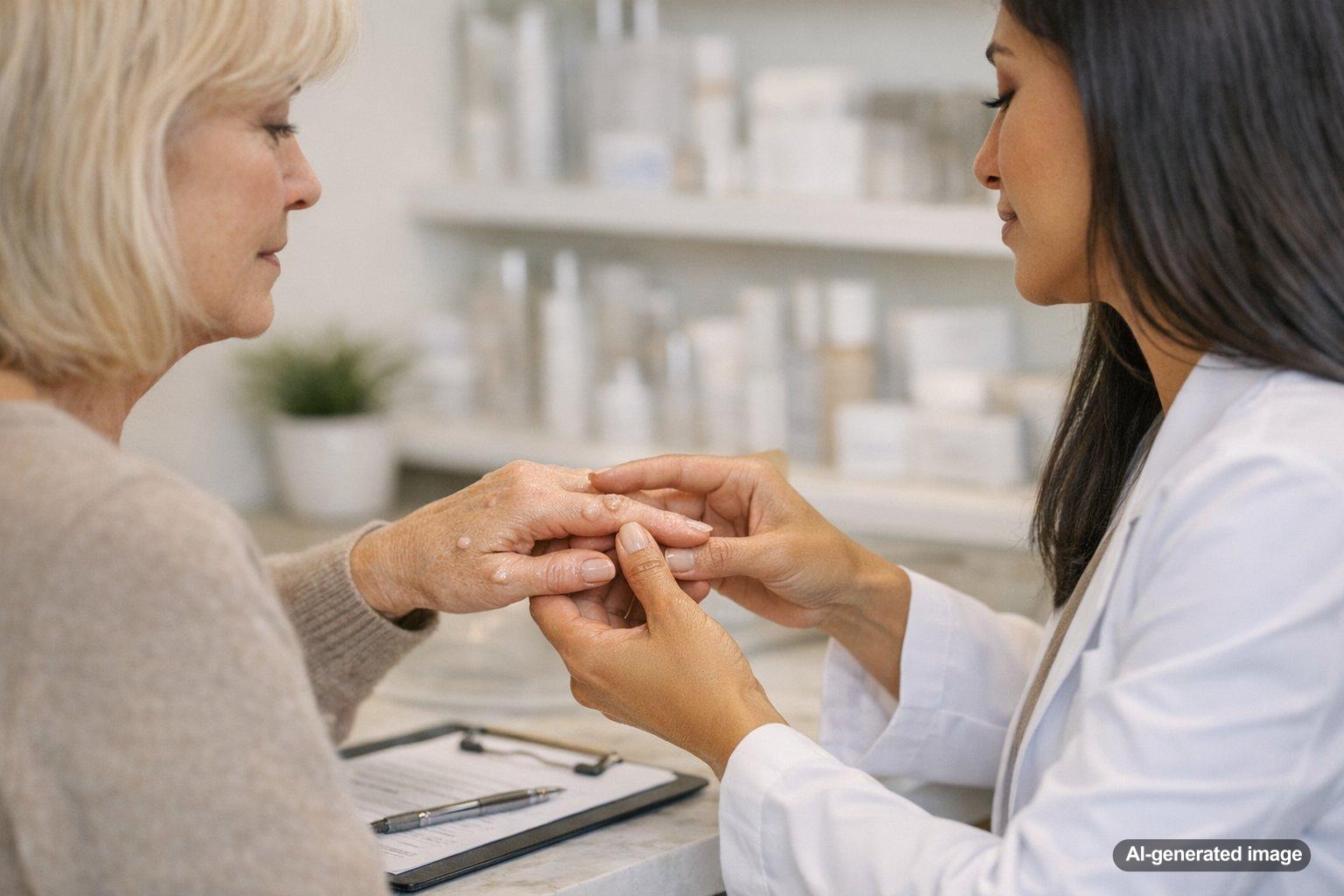
Yes, a dermatologist can evaluate warts on the hands and talk with you about treatment options. Hand warts are common, and while many are harmless, they can be frustrating when they catch on jewelry, feel rough, spread around the fingers, or make you feel self-conscious in close-up situations.
The right next step depends on what the growth looks like, where it is located, how long it has been there, whether it is changing, and whether you have tried anything at home. A calm, careful exam can help confirm whether it appears consistent with a wart or whether another skin growth should be considered.
Quick answer
- Hand warts can often be treated, but the best option depends on the size, location, number of growths, and your skin history.
- Common options may include at-home salicylic acid for select small warts, in-office freezing, prescription therapies, or other dermatologist-directed care.
- Warts are related to certain types of human papillomavirus, also called HPV, and can spread through contact or small breaks in the skin.
- A dermatologist should evaluate growths that hurt, bleed, change quickly, appear near the nail, spread, or do not respond to conservative care.
What hand warts are
Common warts are skin growths that can develop when certain HPV types infect the upper layer of skin. On the hands, they often appear as rough, raised bumps on the fingers, knuckles, or around the nails. Some have tiny dark dots, which are often clotted blood vessels rather than dirt.
Because different skin growths can look similar, it is worth having a dermatologist look at anything that is new, changing, painful, bleeding, or uncertain. That is especially true if the spot does not behave the way a typical wart usually does.
Common causes or triggers
Hand warts can be associated with everyday skin contact and tiny openings in the skin barrier. They are not a sign that someone is unclean, and they are not something to feel embarrassed about.
- Small cuts, hangnails, or irritated skin around the fingers
- Nail biting, cuticle picking, or frequent picking at rough skin
- Sharing towels, nail tools, gloves, or other items that touch affected skin
- Touching or picking at an existing wart, which may spread the virus to nearby skin
- A weakened immune system, which can make some warts more persistent
What you can do at home
If you have one or a few small growths that seem consistent with common warts, conservative home care may help while you arrange an evaluation. Keep the guidance simple and gentle: avoid picking, keep the area covered when practical, wash hands after touching the area, and do not share nail clippers, files, or towels.
Some people use over-the-counter salicylic acid products for small common warts on thicker hand skin. These products should be used exactly as labeled and are not appropriate for every location or every person. Avoid using wart removers on the face, genitals, irritated skin, infected-looking skin, or a growth that has not been reasonably identified.
Professional options
In the office, a dermatologist can examine the area and recommend a plan that fits the wart’s location and your comfort level. Common professional options may include cryotherapy, prescription-strength topical medication, carefully applied in-office treatments, or other dermatologist-directed approaches.
Warts around or under the nails can be more stubborn and may need a more careful plan to protect the nail unit. If a growth looks unusual or does not respond as expected, your clinician may discuss whether a biopsy or another diagnostic step is appropriate.
When to see a dermatologist
It is worth booking a visit if you are unsure whether the growth is a wart, if it is spreading, or if it is affecting your hands in daily life. You should also seek care if the area hurts, bleeds, burns, itches, grows quickly, looks like an open sore, appears around the nail, or keeps coming back after treatment.
People who have many warts, a weakened immune system, diabetes, circulation concerns, or a history of unusual skin growths should be especially cautious about self-treating without a professional evaluation.
FAQ
Are hand warts contagious?
They can be. Warts can spread from one area of skin to another and, in some situations, from person to person. Covering the area, avoiding picking, and not sharing nail tools or towels may help reduce spread.
Will a wart on my hand go away on its own?
Some warts fade without treatment, but timing can vary widely. If the wart is bothersome, spreading, painful, or persistent, a dermatologist can help you review options.
Should I cut off a wart myself?
No. Cutting, digging, or scraping at a wart can irritate the skin, increase the chance of spreading, and make it harder to tell what is going on. A dermatologist can evaluate it more safely.
Can warts grow near the nails?
Yes. Warts can develop around or under fingernails. These areas can be more delicate, so professional evaluation is a good idea before trying aggressive home treatment.
What if I am not sure it is a wart?
If you are unsure, it is worth getting checked. Several skin growths can resemble one another, and a dermatologist can help determine what the spot appears to be and what steps make sense.
Ready to get help?
Schedule an appointment or send a message and our team will get back to you.
Prefer to call? 954-666-3736
Disclaimer: This article is for educational purposes and is not medical advice. For diagnosis and personalized treatment, please book an appointment with a board-certified dermatologist.
Sources & further reading
- American Academy of Dermatology (AAD) – Warts: Diagnosis and treatment
- American Academy of Dermatology (AAD) – Warts: FAQs
- Mayo Clinic – Common warts: Symptoms and causes
- MedlinePlus (NIH) – Warts
