

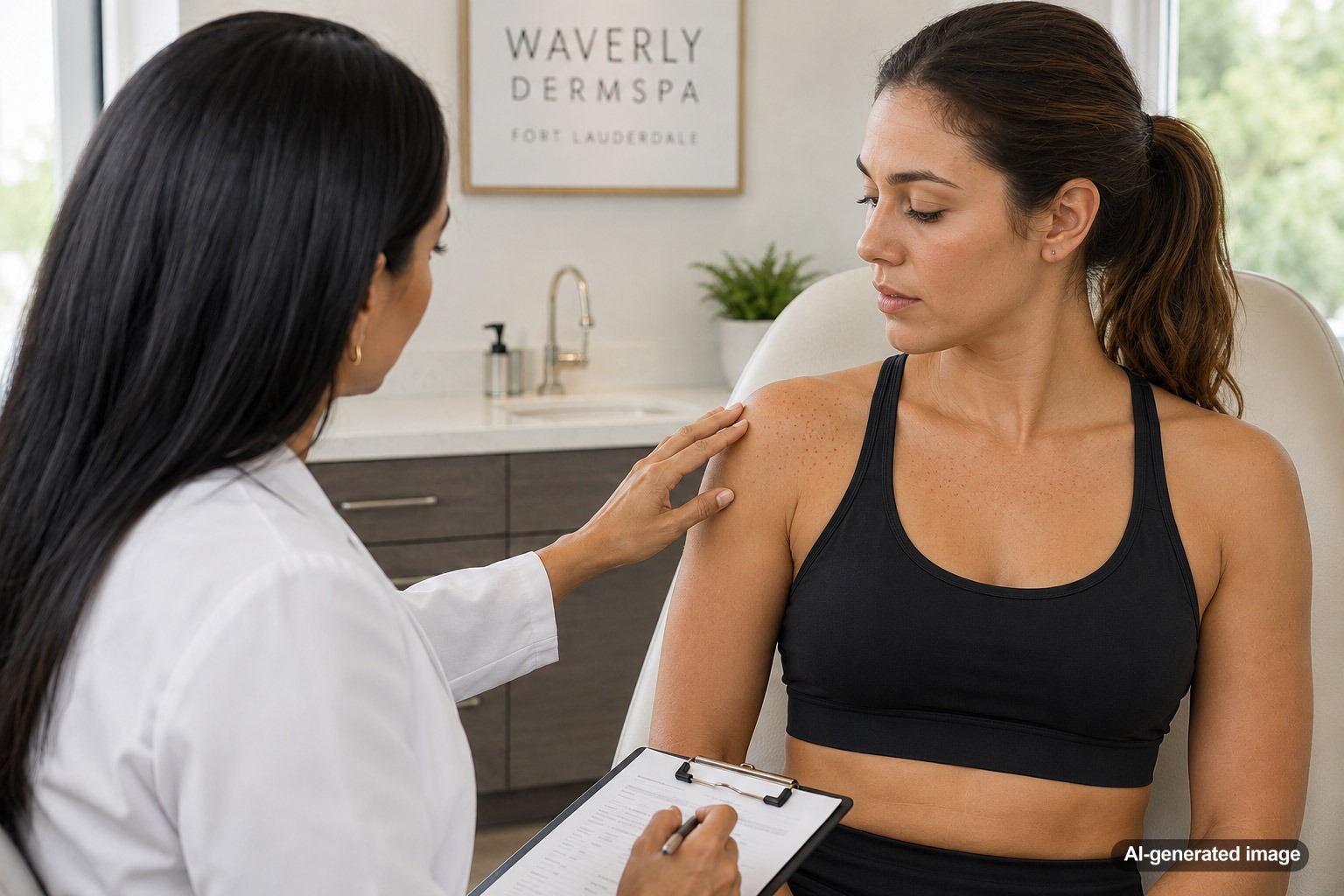
Tiny red dots that appear where a tight sports bra presses against your skin can have several possible explanations. Pressure, friction, trapped sweat, heat, and irritation from fabric or laundry products can all contribute. In some cases, very small flat red or purple spots may also reflect tiny blood vessels under the skin that have leaked after significant pressure or strain.
The appearance alone usually isn’t enough to identify the cause. Where the spots occur, whether they itch or hurt, whether they blanch when pressed, and how long they last can all help a dermatologist understand what may be happening.
Quick answer
- A very tight sports bra can create pressure and friction that irritate the skin.
- Sweat and heat trapped beneath snug fabric may contribute to redness or small bumps.
- Fabric, elastic, dyes, detergents, or fragrance products may trigger irritation in sensitive skin.
- Flat pinpoint red or purple spots that don’t fade when pressed may have a different cause than a typical friction rash.
- Persistent, spreading, painful, unexplained, or recurrent spots are worth having evaluated.
Why can a tight sports bra leave red dots?
Sports bras are designed to reduce movement, so they often fit more snugly than everyday clothing. During exercise, that close contact combines with repeated motion, warmth, and perspiration. The result can be temporary redness or irritation along the band, straps, neckline, or areas where seams rub.
A bra that is especially tight may also place concentrated pressure on small areas of skin. If the dots are pinpoint-sized and flat rather than raised or itchy, a clinician may consider whether superficial blood vessels were affected by pressure. That is different from diagnosing the spots based on appearance alone, which isn’t reliable without an examination.
Common triggers to consider
- Friction: Repetitive rubbing during running, cycling, strength training, or other movement can irritate the skin barrier.
- Pressure: A band, strap, seam, or clasp that digs into the skin may leave localized marks or redness.
- Sweat and heat: Moisture trapped beneath close-fitting fabric can make skin more vulnerable to irritation.
- Fabric or elastic: Certain synthetic materials, elastic components, or finishes may bother sensitive skin.
- Laundry products: Fragrance, detergent residue, or fabric softener can sometimes contribute to irritation.
- Chafing: Longer workouts and repetitive motion can create clusters of small red areas where fabric repeatedly moves against skin.
How can you tell irritation from pinpoint bleeding under the skin?
They can look similar at first glance. Friction or contact irritation often appears as broader redness, tenderness, itching, roughness, or small raised bumps. Tiny areas of bleeding beneath the skin may look more like distinct flat red, reddish-brown, or purple pinpoints.
One practical observation is whether the spots temporarily lighten when gentle pressure is applied. Many forms of surface redness can fade or blanch with pressure, while blood that has leaked beneath the skin generally does not. This isn’t a diagnostic test, however, and unexplained non-blanching spots should be assessed in context by a medical professional.
What can you do at home?
If the area seems mildly irritated and you otherwise feel well, conservative changes may help reduce further friction while you observe the skin.
- Take a break from the sports bra that seems to trigger the problem.
- Check the fit, especially around the underband, straps, seams, and arm openings.
- Choose smooth, breathable fabrics that don’t bunch or rub.
- Change out of damp workout clothing soon after exercising.
- Wash the area gently and avoid aggressive scrubbing.
- Consider fragrance-free laundry and skincare products if your skin is easily irritated.
- Avoid repeatedly scratching or rubbing the spots while they settle.
If the same pattern returns every time you wear one particular bra, the garment’s fit, fabric, elastic, or construction may be contributing.
When should you see a dermatologist?
Consider getting the area checked if the dots keep returning, do not improve after you stop wearing the tight garment, spread beyond areas of direct pressure, or are accompanied by significant itching, pain, swelling, blistering, or skin breakdown.
It is also important to seek medical evaluation for unexplained pinpoint red or purple spots that do not blanch, particularly if they appear in multiple areas or occur along with unusual bruising, bleeding, fever, feeling unwell, or other new symptoms. Those findings can have causes unrelated to a sports bra and deserve appropriate assessment.
A dermatologist can examine the pattern closely and help distinguish simple mechanical irritation from contact reactions, inflammatory skin conditions, or other causes that may require a different approach.
FAQ
Can a sports bra be too tight even if it feels supportive?
Yes. Support should not require painful compression, deep indentations, persistent marks, numbness, or significant rubbing. A sports bra can feel secure while still placing excessive pressure on certain areas.
Why do the dots show up after exercise instead of while I am exercising?
Heat, moisture, friction, and pressure accumulate throughout a workout, and skin changes may become more noticeable once you remove the garment and inspect the area.
Could sweat alone cause the red dots?
Sweat can contribute to irritation by keeping the skin moist and increasing friction, but the pattern may also involve pressure, heat, fabric, or product sensitivity. A dermatologist can help evaluate recurrent episodes.
Should I stop exercising until the spots disappear?
Not necessarily. If the spots appear related to a particular garment and you otherwise feel well, changing the bra or reducing friction may be enough. If exercise itself seems associated with recurrent unexplained spots, pain, bleeding, or other symptoms, getting medical guidance is appropriate.
What if the spots do not fade when I press on them?
Non-blanching pinpoint spots may represent blood beneath the skin rather than simple surface redness. That does not identify the cause by itself. If the spots are unexplained, widespread, recurrent, or accompanied by other symptoms, seek medical evaluation.
Ready to get help?
Schedule an appointment or send a message and our team will get back to you.
Prefer to call? 954-666-3736
This article is for educational purposes and is not medical advice. For diagnosis and personalized treatment, please book an appointment with a board-certified dermatologist.
