

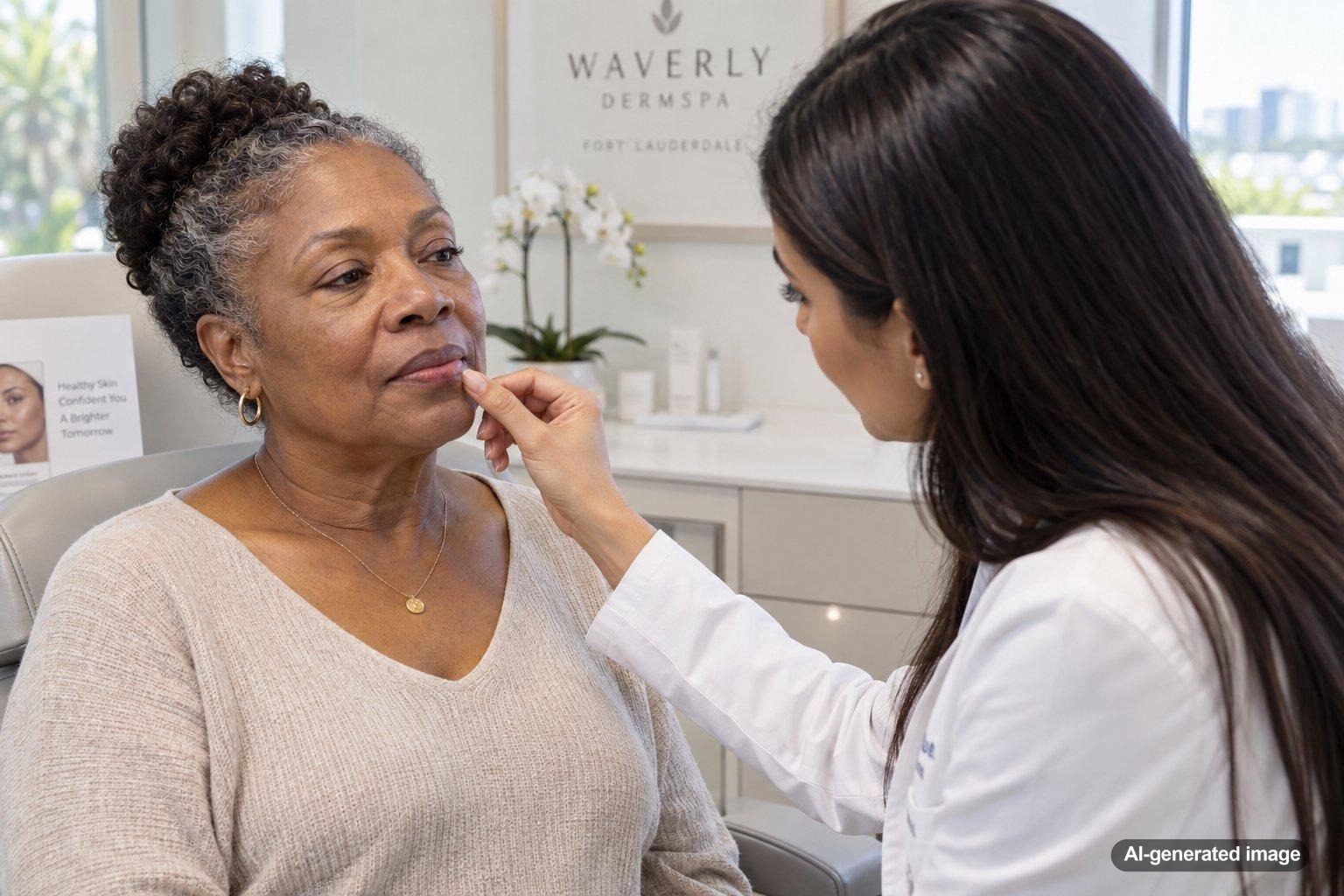
A tiny blue bump on your lip can be surprising, especially if you don’t remember injuring the area. Several different things can create a blue, purple, or translucent spot on the lip. One common possibility is a venous lake, which is a small area of dilated blood vessels that often appears on the lower lip. A mucocele, or mucus-filled cyst, can also look bluish, particularly when it develops inside the lip after minor trauma such as accidental biting.
Appearance alone is not enough to identify every lip bump. Its location, texture, duration, and whether it changes or bleeds can all matter. A dermatologist can examine the area and help determine whether it is a common benign growth or something that deserves additional evaluation.
Quick answer
- A soft blue or purple spot on the lower lip may be a venous lake.
- A smooth, sometimes bluish bump inside the lip may be a mucocele related to a blocked or injured salivary duct.
- Other vascular or pigmented lesions can sometimes look similar.
- A bump that is new, changing, repeatedly bleeding, painful, ulcerated, or persistent is worth having examined.
What can cause a tiny blue bump on the lip?
Blue coloration usually means that blood, fluid, or pigment beneath the surface is affecting how the area looks. Several conditions can create this appearance, and they cannot always be distinguished reliably without an in-person examination.
Venous lake
A venous lake is a small, soft blue or purple spot caused by a dilated superficial vein. These commonly occur on the lower lip and may flatten or become less blue when gentle pressure temporarily moves blood out of the vessel. Venous lakes are generally harmless, although a dermatologist should confirm the diagnosis if the appearance is uncertain.
Mucocele
A mucocele is a mucus-filled cyst that commonly develops on the inner lower lip. It can appear clear, translucent, or bluish and often follows minor trauma, such as biting the lip. Many are painless. If a bump keeps returning, becomes large, or interferes with eating or speaking, a clinician can evaluate it.
Other vascular or pigmented spots
Other blood vessel growths and pigmented lesions can sometimes have a blue, purple, or dark appearance. Because different lesions may resemble one another, it is better not to rely on color alone when trying to identify a persistent lip bump.
What should you notice about the bump?
A few simple observations can help your dermatologist understand what is happening. Consider when you first noticed the spot, whether it is on the outer lip or inside the mouth, and whether it has stayed stable or changed over time.
- Color: Note whether it is blue, purple, red, brown, or translucent.
- Texture: Notice whether it feels soft, firm, smooth, or crusted.
- Changes: Pay attention to growth, darkening, repeated bleeding, or changes in shape.
- Symptoms: Mention tenderness, burning, itching, ulceration, or discomfort.
- Recent trauma: Lip biting or another minor injury can be relevant.
What can you do at home?
Avoid squeezing, puncturing, cutting, or repeatedly pressing on a lip bump. Trying to drain or remove a lesion yourself can irritate the tissue, cause bleeding, or introduce infection. If you think repeated lip biting is contributing, reducing that habit may also help prevent additional irritation.
You can take a clear photo in consistent lighting and compare the area over time. This can make subtle changes easier to recognize. Sun protection for the lips, including an appropriate lip product with SPF and shade when practical, is also a useful general habit for exposed lip skin.
What professional options are available?
Treatment depends entirely on what the lesion turns out to be. A dermatologist may be able to identify a typical venous lake or other common lesion during an examination. In selected cases, additional evaluation or a biopsy may be recommended when the diagnosis is uncertain.
If a confirmed venous lake is bothersome cosmetically or repeatedly irritated, professional treatment options can include vascular laser or other procedures that target or remove the affected vessel. Mucoceles that persist or repeatedly return may also be treated by an appropriate medical or dental professional. Your clinician can help you decide whether treatment is necessary and which approach makes sense for the specific lesion.
When should you see a dermatologist?
Consider scheduling an evaluation if the bump is new and unexplained, persists, grows, changes color or shape, repeatedly bleeds, becomes painful, develops an open sore, or simply looks different from other spots you have. An examination is also reasonable whenever you are uncertain about a pigmented or vascular-looking lesion on the lip.
A dermatologist can examine the lesion closely and determine whether observation is appropriate or whether additional testing should be considered.
FAQ
Is a blue bump on the lower lip always a venous lake?
No. A venous lake is one possible cause, but mucoceles and other vascular or pigmented lesions can also appear blue. An in-person examination is the most reliable way to identify an unfamiliar lip lesion.
Can a venous lake go away on its own?
Venous lakes can remain stable for long periods and generally do not require treatment when they are not causing problems. A dermatologist can confirm whether a spot has the typical features of a venous lake.
Can biting my lip cause a blue bump?
Yes. Minor trauma such as lip biting can contribute to a mucocele, particularly on the inner lower lip. It can also cause temporary bruising or swelling.
Should I pop a blue bump on my lip?
No. Avoid puncturing or squeezing an unidentified lip bump. Doing so can cause bleeding, irritation, infection, or scarring and may make the area harder to evaluate.
What if the bump keeps bleeding?
Repeated bleeding is a reason to have the area examined rather than continuing to monitor it on your own. A dermatologist can look for the source of the bleeding and recommend appropriate next steps.
Ready to get help?
Schedule an appointment or send a message and our team will get back to you.
Prefer to call? 954-666-3736
This article is for educational purposes and is not medical advice. For diagnosis and personalized treatment, please book an appointment with a board-certified dermatologist.
