

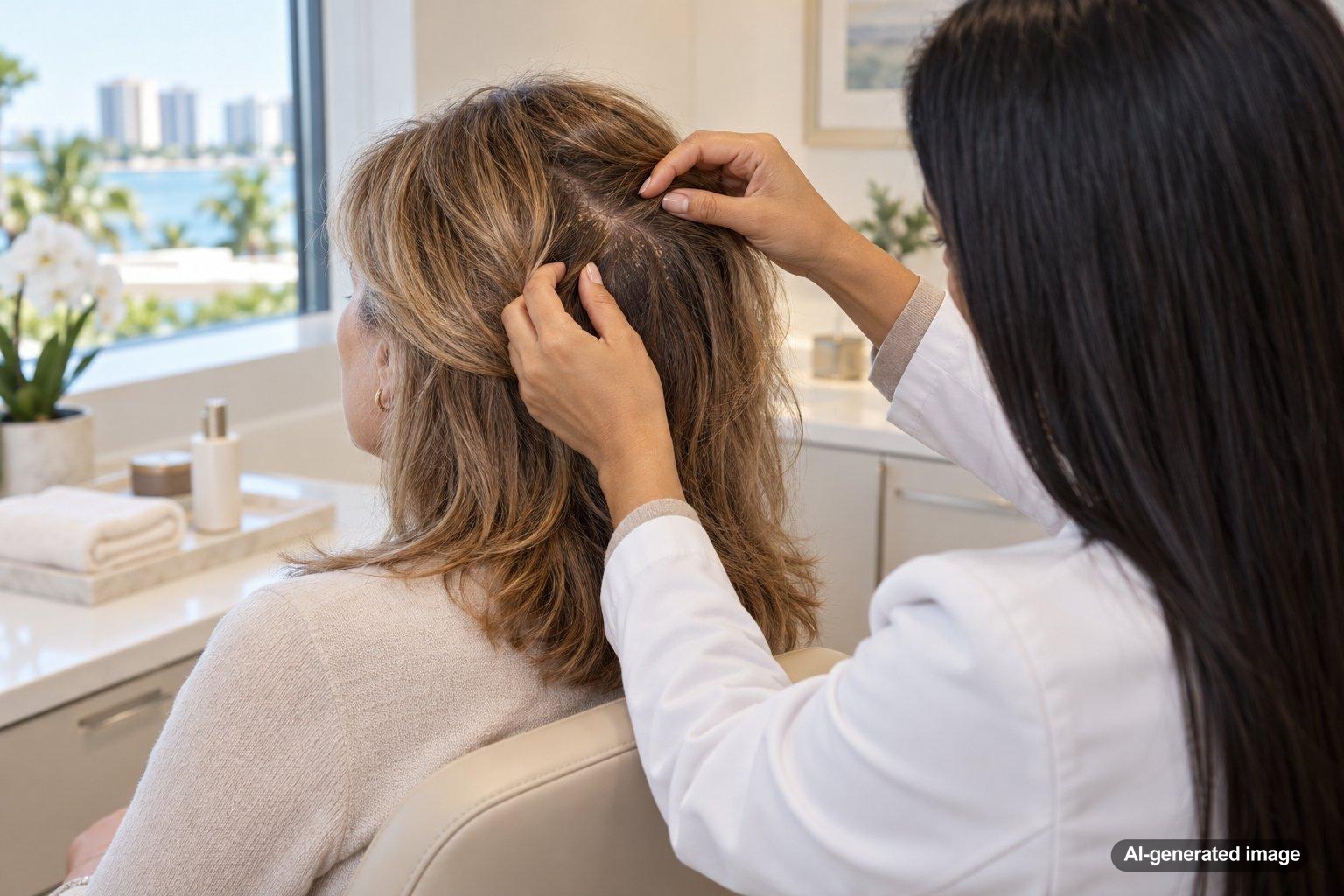
Finding a patch of sticky yellow scale on your scalp can be confusing, especially when the rest of your scalp looks and feels normal. The material may seem oily, cling to individual hairs, or return to exactly the same place after shampooing. Sometimes the skin underneath feels itchy or tender. Other times, the buildup is noticeable only when you part your hair or run your fingers over the area.
One possible explanation is seborrheic dermatitis, an inflammatory scalp condition that can produce greasy, yellowish flakes. However, a localized patch can also be associated with psoriasis, irritation from hair products, or certain infections. The color and texture alone cannot establish the cause. Understanding what the scale actually represents, why it may remain concentrated in one spot, and which changes deserve professional attention can help you approach the problem without unnecessary irritation.
Quick Answer: Why Does One Spot on My Scalp Have Sticky Yellow Scale?
- Seborrheic dermatitis is a common possibility. It can create oily, yellow or white scale that adheres to the scalp and hair.
- Inflammation does not have to affect your entire scalp. Some scalp conditions appear in isolated patches rather than spreading evenly.
- Other conditions can look similar. Psoriasis, contact dermatitis, and certain infections may also produce localized scaling or crusting.
- Sticky scale is different from ordinary product buildup. Scale forms from accumulated skin cells, while styling products leave residue on the hair and scalp. Both can sometimes occur together.
- Persistent or worsening patches deserve evaluation. Pain, drainage, spreading redness, or hair loss are especially important reasons to seek medical attention.
What Is Sticky Yellow Scalp Scale?
Scalp scale consists primarily of accumulated skin cells that have separated from the surface but have not fallen away normally. Depending on the underlying condition, these cells may collect in thin flakes, thicker plaques, or material that adheres closely to the skin.
The scalp naturally produces sebum, an oily substance that helps support the skin barrier and lubricate the hair. When excess skin cells mix with sebum, the resulting scale may appear yellowish, greasy, or sticky rather than dry and powdery.
Inflammation can change how quickly skin cells accumulate and how readily they separate. This helps explain why a scaly area may return even after the visible material has been washed away.
It is also important to distinguish scale from crust. Scale generally represents accumulated surface skin cells. Crust can form when fluid, blood, or other discharge dries on the skin. Yellow crust that develops over an open, painful, or draining area may suggest a different problem from uncomplicated greasy scaling.
These distinctions are not always obvious without examining the scalp. A dermatologist can assess the skin beneath the material instead of relying on its color alone.
Common Causes of Sticky Yellow Scale in One Area of the Scalp
Several conditions can create a similar appearance. Their accompanying symptoms, distribution, and changes over time often provide more useful clues than the scale itself.
- Seborrheic dermatitis: This inflammatory condition frequently affects oil-rich areas, including the scalp, eyebrows, and skin around the nose. Its scale may be yellow, greasy, and relatively adherent. Itching and redness can occur, although some people experience little discomfort. The condition can affect a limited area rather than the entire scalp.
- Scalp psoriasis: Psoriasis can produce thicker, more sharply defined scaly patches. The scale is often described as silvery or whitish, but its appearance may vary, especially when oil, irritation, or overlapping seborrheic dermatitis is present. Some people also notice psoriasis on the elbows, knees, or nails.
- Contact dermatitis: Hair dye, fragrances, styling products, adhesives, and other substances can irritate the scalp or trigger an allergic reaction. Affected skin may itch, burn, flake, or occasionally ooze and develop crust. A patch may correspond to where a product was concentrated or repeatedly applied.
- Scalp infections: Certain bacterial or fungal infections can cause scaling, crusting, inflamed bumps, or patches of hair loss. These conditions require different management from ordinary dandruff. Tenderness, pustules, broken hairs, or drainage make an examination particularly important.
- Product residue combined with scalp irritation: Dry shampoo, heavy conditioners, oils, and styling preparations can accumulate near the roots. Residue may make existing flakes more adhesive or noticeable. However, persistent inflammation or true skin scale should not automatically be attributed to inadequate washing.
Why Does the Yellow Scale Keep Appearing in Exactly the Same Spot?
A recurring patch often reflects a local skin process rather than a problem affecting every part of the scalp equally. An area of inflammation may remain active even when surrounding skin appears healthy.
With seborrheic dermatitis, for example, the scalp’s inflammatory response to factors involving skin oils and naturally occurring Malassezia yeast may vary across different areas. The condition is not simply a sign of poor hygiene, and washing away the visible flakes does not necessarily eliminate the inflammation beneath them.
Localized psoriasis can also remain concentrated in a particular area. Similarly, contact with a specific hair accessory, cosmetic product, or repeated source of friction may contribute to irritation in a limited location.
Sometimes a patch becomes more noticeable because it is repeatedly scratched or picked. This can aggravate the skin and create additional crusting, making the area appear more persistent.
The fact that the patch returns in one place is worth mentioning during a dermatology appointment. Its location, borders, and underlying skin changes may help distinguish among possible explanations.
How Can You Tell Greasy Scalp Scale From Ordinary Dandruff?
Dandruff is generally considered a mild form of scalp scaling that is often associated with seborrheic dermatitis. The two are related, but they do not always look identical.
Ordinary dandruff commonly produces loose white or pale flakes that fall onto the hair or clothing. More inflamed seborrheic dermatitis may produce adherent, greasy, yellowish scale over skin that appears pink, red, darker, or lighter than the surrounding scalp.
A thick, sharply bordered plaque might raise consideration of psoriasis, while a moist area with drainage or honey-colored crust may suggest a different process that requires assessment.
No single visual feature can reliably identify the condition. A dermatologist may examine the patch closely, assess the hair follicles, and look for changes elsewhere on the skin.
What Can You Do at Home Without Irritating the Area?
When a localized patch is not painful, draining, or accompanied by other concerning symptoms, gentle scalp care may help limit unnecessary irritation while you determine whether professional evaluation is needed.
- Wash the scalp gently. Use a shampoo suitable for your scalp and hair type. Massage with your fingertips rather than scraping with your nails.
- Avoid forcibly removing attached scale. Picking or aggressive brushing may injure the underlying skin and lead to additional irritation or crusting.
- Consider an appropriate anti-dandruff shampoo. Products containing ingredients such as ketoconazole or selenium sulfide are commonly used for dandruff and seborrheic dermatitis. Follow package instructions, account for your hair type, and ask a dermatologist which option is appropriate if the diagnosis is uncertain.
- Rinse products thoroughly. Shampoo, conditioner, and styling products left on the scalp can contribute to irritation in some people.
- Temporarily simplify your hair routine. If the patch appeared after a new product, consider avoiding that product until the cause has been assessed.
- Avoid harsh home remedies. Undiluted essential oils, abrasive scalp scrubs, and irritating household ingredients can worsen an already inflamed area.
- Observe changes without repeatedly touching the patch. Note whether it becomes larger, more uncomfortable, moist, or associated with broken or thinning hair.
Medicated shampoos are not suitable for every cause of scalp scaling. If a patch is unusually tender, has an open surface, produces discharge, or is associated with hair loss, medical evaluation is more appropriate than repeatedly experimenting with new products.
Professional Options for Persistent Yellow Scalp Scale
A dermatologist can examine the affected area and determine whether its appearance is more consistent with seborrheic dermatitis, psoriasis, contact dermatitis, infection, or another scalp condition.
Evaluation may include a review of your hair care routine, symptoms, recent product changes, and medical history. A close examination can help reveal whether the material is greasy scale, a thicker inflammatory plaque, or crust related to an irritated or draining area.
Additional testing is not always necessary. When an infection is suspected or the diagnosis remains uncertain, a clinician may consider appropriate sampling or other diagnostic steps.
Treatment depends on the cause. For seborrheic dermatitis, common options include medicated antifungal shampoos and prescription scalp preparations that address inflammation. Psoriasis may require a different anti-inflammatory approach. Suspected contact allergies may call for identifying and avoiding a trigger, while infections require evaluation for condition-specific treatment.
The texture of the hair, frequency of washing, sensitivity of the scalp, and location of the patch can all influence which formulation is practical. Your dermatologist can help select an approach that fits the diagnosis and your routine.
When Should You See a Dermatologist for Yellow Scalp Scale?
A recurring patch that remains in one location, does not improve with gentle care, or repeatedly returns after washing is a reasonable reason to schedule a dermatology appointment.
Seek prompt medical evaluation if you notice any of the following:
- Pain, warmth, swelling, or increasing tenderness in or around the affected area.
- Oozing, pus, bleeding, or a new moist crust rather than dry or greasy flakes.
- Rapidly spreading redness or discoloration surrounding the patch.
- Localized hair loss, broken hairs, or visible changes in hair density near the scaling.
- Thickening, cracking, or persistent inflammation despite careful scalp care.
- Fever or feeling unwell along with a painful or spreading scalp eruption.
Rapidly worsening symptoms, especially spreading inflammation accompanied by fever or significant pain, warrant urgent medical assessment rather than waiting for a routine cosmetic or scalp-care appointment.
Even without these warning signs, a patch that consistently returns deserves attention if you do not know what is causing it. Early evaluation can help avoid treating the wrong condition or unintentionally aggravating sensitive skin.
Frequently Asked Questions
Is sticky yellow scalp scale always seborrheic dermatitis?
No. Seborrheic dermatitis is a recognizable cause of greasy yellow scale, but psoriasis, contact dermatitis, and certain infections can produce overlapping symptoms. The appearance of the underlying skin and any associated tenderness, drainage, or hair changes are important considerations.
Why is only one part of my scalp affected?
Inflammatory scalp conditions do not necessarily develop evenly. A localized patch may reflect inflammation in that particular area, a concentrated contact exposure, or another condition with a limited distribution. A recurring single spot does not identify the diagnosis by itself.
Can sticky yellow scale cause hair loss?
Some scalp conditions associated with scaling can also be accompanied by shedding or hair breakage. Hair loss is not a defining feature of uncomplicated seborrheic dermatitis, so a scaly patch with noticeable thinning, broken hairs, or a bald area should be examined by a dermatologist.
Should I scrape the yellow flakes off my scalp?
Forcefully scraping attached scale is not recommended. It can irritate the skin, cause small injuries, and potentially worsen crusting. Gentle shampooing is preferable, and a dermatologist can recommend appropriate products if the material remains firmly attached.
Can washing my hair more often make the patch disappear?
Appropriate shampooing may help reduce excess oil and loose flakes, particularly when seborrheic dermatitis is involved. However, simply increasing washing frequency may not address inflammation, and overly aggressive cleansing can cause additional irritation. Washing needs vary with hair type, scalp sensitivity, and the underlying condition.
Is yellow crust on the scalp a sign of infection?
Not necessarily. Greasy yellow scale can occur with noninfectious inflammatory conditions. However, yellow crust accompanied by drainage, pustules, pain, swelling, or spreading redness may indicate an infection or another problem requiring examination. Color alone is not enough to make that distinction.
Ready to get help?
Schedule an appointment or send a message and our team will get back to you.
Prefer to call? 954-666-3736
Disclaimer
This article is for educational purposes and is not medical advice. For diagnosis and personalized treatment, please book an appointment with a board-certified dermatologist.
Sources & Further Reading
- DermNet – Seborrhoeic dermatitis
- American Academy of Dermatology (AAD) – Seborrheic dermatitis: Diagnosis and treatment
- DermNet – Diagnosis of scalp rashes
- American Academy of Dermatology (AAD) – Seborrheic dermatitis: Self-care
