

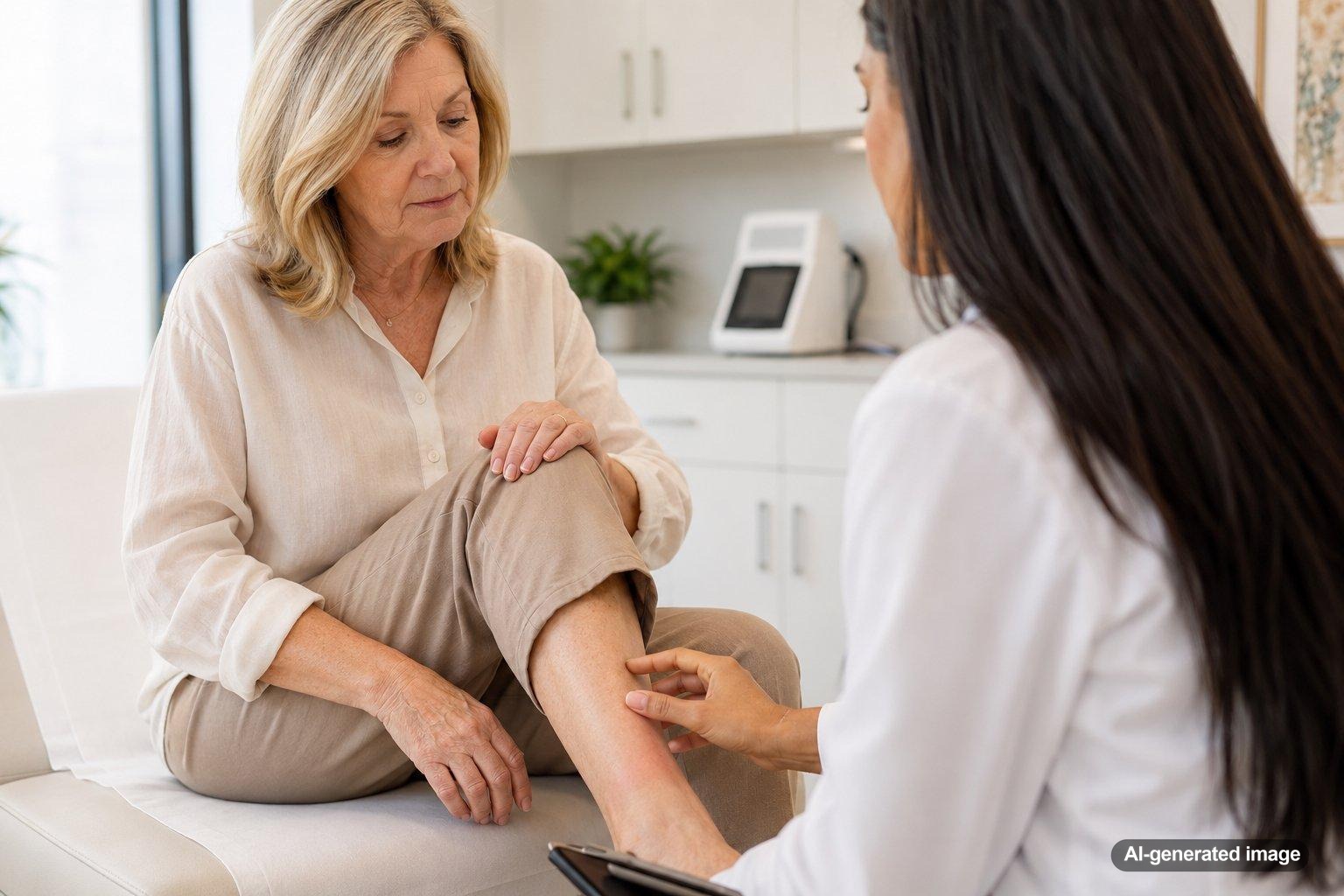
If your ankles become itchy, red, dry, or irritated right where your socks sit, the socks themselves may be contributing to the problem. The reaction can be related to friction, trapped sweat, detergent residue, dyes, fabric treatments, or materials in elastic components. In some people, this pattern can also be associated with contact dermatitis or another form of eczema.
The location of the rash can offer a useful clue, especially when irritation repeatedly follows the upper edge of a sock or appears after wearing a particular pair. Still, several skin conditions can look similar, so a persistent or worsening rash is worth having evaluated rather than assuming the sock is the only cause.
Quick answer
- Friction and pressure from a snug sock cuff can irritate sensitive skin.
- Sweat and heat trapped beneath socks can increase irritation, especially in warm or humid conditions.
- Textile dyes, finishing chemicals, elastic, or rubber-related ingredients may trigger contact dermatitis in susceptible people.
- Laundry products such as fragranced detergent or fabric softener can leave residues that bother sensitive skin.
- A rash that keeps returning, spreads, becomes painful, or does not improve should be evaluated by a dermatologist.
What may be happening to the skin around your ankles?
The skin beneath a sock is exposed to a combination of fabric contact, pressure, rubbing, warmth, and moisture. When the skin barrier becomes irritated, you may notice itching, redness, dryness, scaling, burning, or tenderness. Contact dermatitis is one possible explanation. It develops when the skin is irritated by a substance or develops an allergic reaction to something touching it.
Clothing-related contact dermatitis is not always caused by the basic fabric fiber itself. Chemical additives used during textile manufacturing, including certain dyes and finishing agents, can sometimes be responsible. Elastic components may also contain materials that cause allergic contact dermatitis in susceptible people.
Common causes and triggers
- A tight elastic cuff: Repeated pressure and rubbing at the same line around the ankle may aggravate the skin.
- Sweating: Moisture held against the skin can make friction more irritating and may worsen existing dermatitis.
- Fabric dyes and finishing agents: Chemicals used to color or process textiles may cause contact reactions in some people.
- Elastic or rubber-related materials: Chemicals used in certain rubber components can be contact allergens.
- Laundry detergent or fabric softener: Fragrances and other residues may bother sensitive or eczema-prone skin.
- Dry or sensitive skin: A weakened skin barrier can make ordinary rubbing and exposure to products feel much more irritating.
- A change in socks or laundry products: A new fabric blend, dye, detergent, or product formulation can introduce a trigger you have not encountered before.
What can you do at home?
Start by reducing obvious sources of irritation. Consider switching temporarily to loose-fitting, breathable socks without a tight cuff and avoiding the specific pair that seems to trigger the reaction. Washing new socks before wearing them may help remove some manufacturing residues and excess dye.
Using a fragrance-free laundry detergent and skipping fragranced fabric softener may also be helpful if your skin is sensitive. Keep the area comfortably dry, change out of damp socks, and avoid scratching because repeated scratching can further damage irritated skin. A simple fragrance-free moisturizer can support the skin barrier when the area feels dry.
Cool, damp compresses may feel soothing when skin is itchy. If you are considering an over-the-counter medicated product, especially when the cause of the rash is uncertain, a dermatologist or other clinician can help you decide what is appropriate for your situation.
How a dermatologist can help
If the rash keeps returning in the same location, a dermatologist can examine its pattern and consider whether contact dermatitis, eczema, another inflammatory condition, or a different skin problem may be involved. The evaluation may include a detailed review of your socks, shoes, laundry products, skincare products, occupational exposures, and other possible triggers.
When allergic contact dermatitis is suspected, your dermatologist may discuss patch testing, which is used to look for delayed allergic reactions to specific substances. Treatment options depend on what the examination suggests and may include avoiding identified triggers, supporting the skin barrier, and using appropriate topical therapies when indicated.
When should you see a dermatologist?
Consider making an appointment if the rash is recurring, persistent, spreading, or uncomfortable enough to interfere with sleep or normal activities. Evaluation is also important when the skin becomes significantly swollen, blistered, cracked, painful, or difficult to manage with simple changes in socks and skincare.
Seek prompt medical attention if you develop signs that could suggest infection, such as increasing warmth, rapidly worsening redness, pus or drainage, significant tenderness, or fever. A dermatologist can evaluate the rash directly rather than relying only on its location or appearance.
FAQ
Can I suddenly become allergic to socks I have worn before?
Yes, a contact allergy can sometimes develop after previous exposures without a noticeable reaction. Product formulations and textile components can also change, so a familiar-looking sock may not necessarily contain exactly the same materials as an older version.
Why is the rash only where the sock elastic touches my ankle?
A sharply localized pattern can suggest that pressure, friction, trapped moisture, or something within the elastic area is contributing. That pattern alone cannot establish a diagnosis, but it is useful information to share with a dermatologist.
Could laundry detergent be causing the itching?
It is possible. Fragrances and other laundry-product residues can irritate sensitive skin or contribute to contact dermatitis in some people. Trying a fragrance-free detergent and thoroughly rinsing clothing may help reduce exposure while you watch for patterns.
Are cotton socks always better for sensitive skin?
Not necessarily. Breathability and comfort can matter, but reactions may involve dyes, textile treatments, elastic components, detergent residue, friction, or moisture rather than the primary fiber alone. A soft, loose-fitting, well-rinsed sock may be more useful than focusing on a single fiber label.
Should I keep wearing the socks to see if the rash comes back?
Repeatedly exposing already irritated skin to a suspected trigger may make symptoms harder to settle. It is generally more practical to avoid the suspected pair for now and note whether the skin improves. If the pattern keeps returning or the cause remains unclear, a dermatologist can evaluate it.
Ready to get help?
Schedule an appointment or send a message and our team will get back to you.
Prefer to call? 954-666-3736
This article is for educational purposes and is not medical advice. For diagnosis and personalized treatment, please book an appointment with a board-certified dermatologist.
Sources & further reading
- American Academy of Dermatology (AAD) – Eczema types: Contact dermatitis tips for managing
- Mayo Clinic – Contact dermatitis – Symptoms and causes
- DermNet – Textile contact dermatitis
