

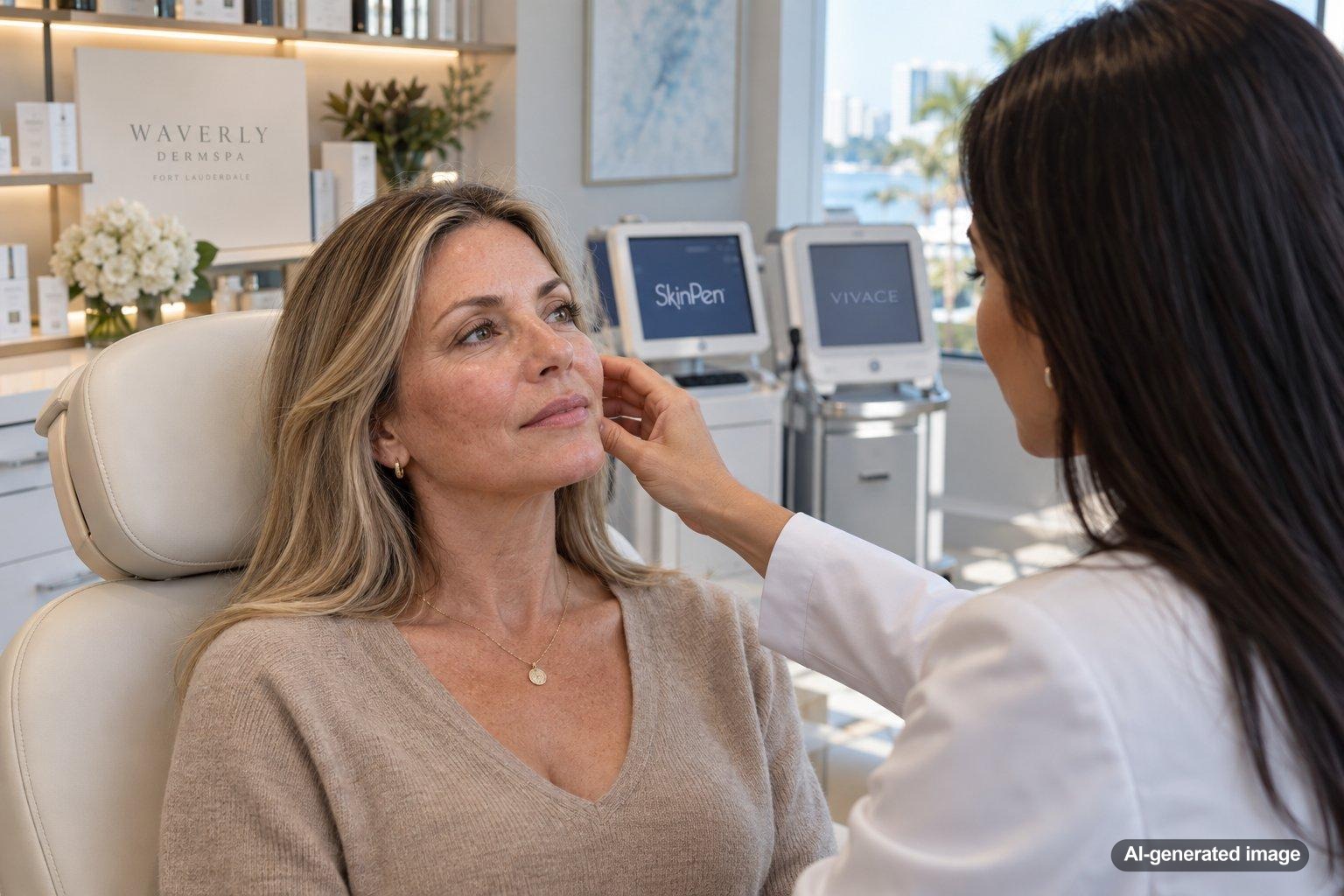
Mild acne scarring can look different from one person to another. Some people have shallow depressions that become more noticeable in side lighting, while others are mainly bothered by uneven texture left behind after breakouts. SkinPen and Vivace are two microneedling-based options that may be considered for improving texture, but they do not work in exactly the same way.
SkinPen uses mechanical microneedling alone, while Vivace combines microneedling with radiofrequency energy. Neither option is automatically the right choice for every person with mild acne scarring. Scar type, skin tone, sensitivity, active acne, treatment goals, tolerance for recovery, and sun exposure all matter, particularly in South Florida where strong year-round ultraviolet exposure can complicate post-procedure skin care.
Quick answer
- SkinPen is a mechanical microneedling treatment that creates controlled microchannels without adding radiofrequency heat.
- Vivace combines microneedling with radiofrequency energy delivered through the treatment tips.
- Both approaches may be considered for acne-related texture, but their energy delivery, treatment experience, and risk considerations differ.
- For mild scarring, the more intensive option is not automatically the more appropriate option. Scar pattern and skin characteristics should guide treatment selection.
- In South Florida, careful sun avoidance and consistent sunscreen use are especially important after procedures that temporarily make skin more vulnerable.
| Feature | SkinPen | Vivace |
|---|---|---|
| Treatment type | Mechanical microneedling | Radiofrequency microneedling |
| Energy added | No radiofrequency energy | Uses radiofrequency energy in addition to needles |
| Common discussion point | Texture and collagen remodeling with a comparatively straightforward microneedling approach | Texture treatment with the addition of controlled energy delivery |
| Treatment planning | Depth and treatment pattern are adjusted to the area and skin | Needle settings and radiofrequency parameters both require individualized selection |
How SkinPen works
SkinPen is a powered microneedling device. Its needles repeatedly enter and exit the skin to create controlled microscopic injuries. The healing response that follows can support collagen remodeling, which is why microneedling is used for selected types of acne scarring and uneven texture.
The U.S. Food and Drug Administration has authorized SkinPen for improving the appearance of facial acne scars in adults age 22 and older. The treatment does not use radiofrequency, laser, or light energy. That distinction can matter for patients who want a microneedling treatment without an added heat-based component.
SkinPen is not necessarily limited to only the most superficial scars, but scar architecture matters. Deep ice-pick scars, sharply edged scars, tethered rolling scars, active inflammatory acne, and pigment concerns may require a different strategy or a combination approach. A dermatologist can evaluate which feature is contributing most to the texture you see.
How Vivace is different
Vivace belongs to the radiofrequency microneedling category. The needles enter the skin while radiofrequency energy is delivered through the treatment system. This means the procedure combines the mechanical effect of microneedling with controlled energy delivered below the surface.
That additional energy changes treatment planning. Settings must account for factors such as the treatment area, skin characteristics, scar pattern, and the depth at which energy is delivered. The FDA has noted that radiofrequency microneedling devices work differently from conventional microneedling devices and can carry different risks.
In 2025, the FDA issued a safety communication regarding reports of serious complications associated with certain uses of radiofrequency microneedling. This does not mean every RF microneedling procedure causes a complication, but it reinforces the importance of appropriate patient selection, proper device use, and treatment by a qualified professional.
Which approach may make sense for mild acne scarring?
For genuinely mild acne scarring, treatment planning often starts by determining what the word “mild” actually represents on the skin. A handful of shallow depressions may call for a different approach than widespread rough texture, enlarged pores, persistent discoloration, or scars that are attached to deeper tissue.
SkinPen may be considered when the goal is straightforward microneedling-based collagen remodeling without radiofrequency energy. Vivace may enter the discussion when a clinician believes RF microneedling is appropriate for the specific texture pattern and treatment goals. Adding energy does not automatically make a procedure more suitable for a mild concern.
A useful consultation therefore focuses less on which device sounds more advanced and more on what type of scar is present, how the skin responds to inflammation, and whether other treatments would address the concern more directly.
Skin tone and pigment changes matter
Post-inflammatory hyperpigmentation can be as bothersome as the scar texture itself, particularly in people whose skin readily develops dark marks after irritation. Microneedling can be used across a wide range of skin tones, but careful technique and aftercare are still important.
Because Vivace adds radiofrequency energy, treatment settings require additional consideration. Anyone with a history of prolonged discoloration after procedures, burns, irritation, or acne should mention that history during consultation. It is also helpful to separate true depressed scarring from flat brown or red acne marks because they may respond to different treatment strategies.
Why South Florida sun exposure changes the conversation
Living in Fort Lauderdale can make post-procedure sun precautions particularly important. Strong ultraviolet exposure is not limited to summer, and routine activities such as driving, walking between buildings, eating outside, or spending time near the water can add meaningful exposure.
The American Academy of Dermatology recommends daily broad-spectrum, water-resistant sunscreen with SPF 30 or higher after acne scar treatment and emphasizes avoiding excessive sun while treated skin heals. Your clinician may provide more specific instructions based on the procedure performed and how your skin looks afterward.
If you are planning a beach vacation, boating, outdoor sports, or extended pool time, mention those plans before scheduling treatment. Timing a procedure around unavoidable sun exposure can be just as important as choosing between devices.
What recovery can feel like
After microneedling, temporary redness, warmth, sensitivity, swelling, or a sunburn-like feeling can occur. Some people notice that the skin feels dry or tight as it settles. Recovery varies depending on the procedure, settings, treatment area, and individual skin response.
Radiofrequency microneedling adds an energy component, so its aftercare plan should be followed specifically rather than assuming it is identical to conventional microneedling recovery. Avoid judging either treatment by social media descriptions of “zero downtime.” Even relatively mild visible recovery can matter if you have an event, travel, professional photography, or significant outdoor plans immediately afterward.
What about active acne?
Scar treatment and active acne treatment are related but different goals. If inflamed, painful, or pus-filled breakouts are still occurring in the treatment area, a dermatologist may recommend addressing active acne before performing microneedling over that skin.
This approach can also help prevent a cycle in which new scars continue to form while older scars are being treated. During consultation, it is useful to discuss both the existing scars and how frequently you are still breaking out.
Can either treatment completely remove acne scars?
No procedure should be expected to erase every acne scar. Acne scars vary in depth, shape, location, and attachment to deeper tissue. Microneedling-based treatments may help soften the appearance of selected scars, but outcomes vary and multiple approaches are sometimes considered for different scar types on the same face.
A realistic treatment plan should identify which scars are likely to respond, which may need another technique, and whether the main goal is smoother texture, softer shadowing, more even tone, or a combination of improvements.
Frequently asked questions
Is SkinPen less intense than Vivace?
They use different technologies, so “less intense” is not always a useful comparison. SkinPen uses mechanical microneedling without radiofrequency energy. Vivace combines microneedling with RF energy. Treatment settings can vary considerably with either procedure.
Is Vivace automatically better because it uses radiofrequency?
No. Additional technology does not make one procedure universally more appropriate. Mild scars, deeper scars, pigmentation, skin sensitivity, scar type, and personal treatment goals can all influence the choice.
Can SkinPen help mild acne scars?
SkinPen is FDA authorized to improve the appearance of facial acne scars in adults age 22 and older. Individual response varies, and a dermatologist can determine whether the scars being treated are a good match for microneedling.
Can I have microneedling right before a South Florida beach weekend?
That timing may be inconvenient because treated skin requires careful sun protection. If substantial sun exposure is expected, discuss scheduling with your clinician before treatment rather than assuming sunscreen alone will make immediate outdoor plans appropriate.
How do I know whether my acne scars are mild?
Scar severity cannot always be judged accurately from a bathroom mirror or photograph. Lighting, scar depth, skin tension, pigmentation, and scar shape can change how prominent scars appear. An in-person examination can help distinguish shallow scars from scars that may require a different approach.
Can SkinPen and other scar treatments be combined?
Combination treatment is sometimes considered because one person can have several scar types at once. The sequence and timing should be individualized rather than layering procedures without a clear reason.
At Waverly DermSpa, we offer SkinPen and can help you understand whether it may be appropriate.
Ready to get help?
Schedule an appointment or send a message and our team will get back to you.
Prefer to call? 954-666-3736
This article is for educational purposes and is not medical advice. For diagnosis and personalized treatment, please book an appointment with a board-certified dermatologist.
Sources & further reading
- U.S. Food and Drug Administration (FDA) – Microneedling Devices
- American Academy of Dermatology (AAD) – Acne scars: Consultation and treatment
