

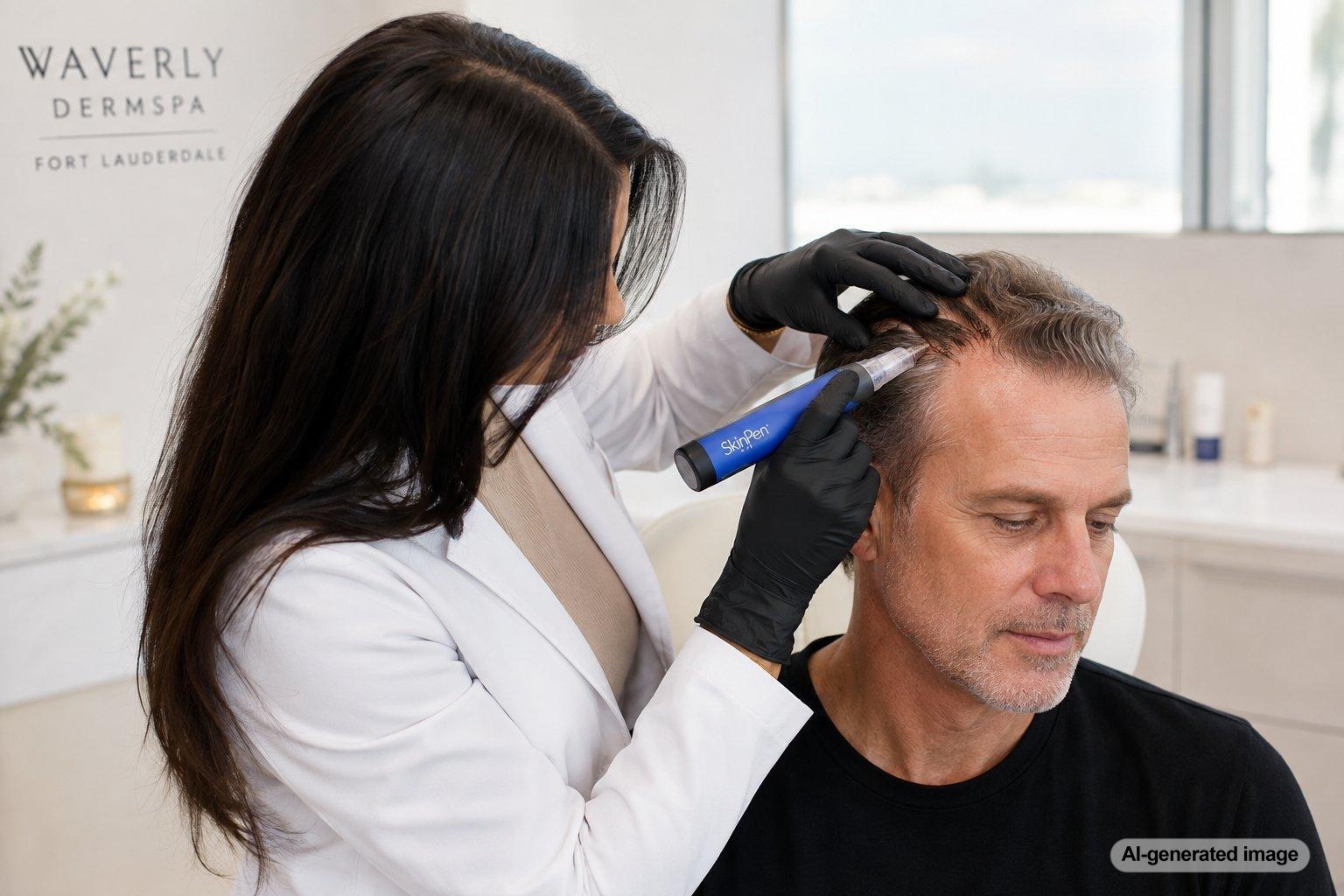
A surgical scar along the scalp or hairline can remain noticeable even after the incision has fully healed. Differences in color, texture, thickness, or the way hair grows around the scar may all affect how visible it looks. Microneedling with a device such as SkinPen may be discussed as one option for improving certain aspects of a mature scar, but the scalp and hairline require careful evaluation before treatment.
SkinPen is an FDA-cleared microneedling device for specific indications, including facial acne scars and neck wrinkles in certain adult populations. Treatment of a surgical scar on the scalp or hairline is outside those cleared indications, so a dermatologist should assess whether microneedling is appropriate for the individual scar and location.
Quick answer
- Microneedling creates controlled microscopic injuries that stimulate a skin remodeling response.
- Some mature surgical scars may become less noticeable in texture after professional microneedling, but results vary.
- Scalp and hairline scars need special attention because of hair follicles, scar thickness, prior surgery, and the possibility of hair loss within or around the scar.
- SkinPen’s FDA-cleared indications do not specifically include surgical scars of the scalp or hairline.
- A dermatologist can determine whether microneedling, another scar treatment, or no procedure is the better approach.
What SkinPen microneedling does
SkinPen is a motorized microneedling device that uses a sterile cartridge containing small needles. During treatment, the needles create controlled microchannels in the skin. This controlled injury can encourage a remodeling response involving collagen and other components of the skin’s support structure.
Microneedling is used in dermatology and aesthetic medicine for selected concerns involving texture and scarring. Cleveland Clinic notes that microneedling may be used to improve the appearance of certain scars, while the FDA emphasizes that medical microneedling devices have specific authorized uses and should be performed by appropriately trained healthcare professionals.
Why scalp and hairline scars are different
A scar on the scalp is not exactly the same as a scar on the cheek, abdomen, or another relatively hairless area. Several features can influence treatment planning.
- Hair follicles: Hair-bearing skin contains follicles that may be present beside the scar but absent inside scar tissue.
- Scar depth: Surgical scars can extend through multiple layers of tissue, so the visible surface does not always show the full extent of the scar.
- Scar type: A flat, mature scar may require a different approach from a thick, raised, depressed, widened, or tightly contracted scar.
- Hair density: The visibility of the scar may depend as much on surrounding hair density and direction as on the scar itself.
- Previous procedures: Hair transplantation, scalp surgery, skin cancer surgery, cosmetic procedures, trauma repair, or other operations can affect the anatomy of the area.
When microneedling may be considered
A dermatologist may consider professional microneedling when a surgical incision is completely healed and the main concern involves uneven texture or the appearance of a mature scar. The decision depends on the scar’s location, thickness, age, color, surrounding skin, medical history, and the reason the surgery was performed.
Microneedling does not replace missing hair follicles. If the main concern is a hairless line caused by follicle destruction within the scar, improving skin texture may not fully address the cosmetic concern. In those situations, evaluation may include discussion of other approaches depending on the scar and surrounding scalp.
When SkinPen may not be the right approach
Not every scalp or hairline scar should be microneedled. Treatment may need to be postponed or avoided when the area is not fully healed, when there are signs of infection or significant inflammation, or when the scar has characteristics that call for a different type of treatment.
A history of raised or keloid-type scarring is also important to discuss. Cleveland Clinic recommends speaking with a healthcare provider before microneedling if you have a tendency to form keloids or certain active skin conditions. The dermatologist should also know about medications, prior procedures, and any unexplained changes occurring in or around the scar.
What you can do at home
Conservative scar care is generally more appropriate than trying to microneedle a surgical scalp scar yourself. Helpful steps may include protecting exposed scars from excessive sun, using gentle hair and skin products around sensitive areas, and avoiding picking or repeated friction over the scar.
Do not use an at-home needling tool over a surgical scar without professional guidance. Medical microneedling can reach living tissue, blood vessels, and other structures beneath the surface. The FDA recommends choosing a healthcare provider who is trained to perform microneedling and discussing the potential benefits and risks before treatment.
Professional options for scalp and hairline scars
Scar treatment is highly individualized. Depending on what makes the scar noticeable, a dermatologist may discuss professional microneedling, laser-based treatments, injections for certain raised scars, surgical scar revision, pigment-focused approaches, or strategies related to hair restoration. Sometimes a combination approach is considered rather than relying on one procedure alone.
For microneedling specifically, temporary redness, swelling, tightness, peeling, bruising, or pinpoint bleeding can occur. Less common complications can include changes in pigmentation or infection. The expected response can also be influenced by scar characteristics and treatment depth.
At Waverly DermSpa, we offer SkinPen and can help you understand whether it may be appropriate.
When to see a dermatologist
A dermatologist should evaluate a scalp or hairline scar before cosmetic treatment if it is painful, persistently itchy, thickening, rapidly changing, draining, bleeding unexpectedly, inflamed, or associated with new hair loss. An evaluation is also appropriate when you are unsure whether a mark is simply a surgical scar or another skin condition.
If the scar resulted from treatment of a skin cancer or another medically significant condition, discuss cosmetic procedures with the treating physician or dermatologist before proceeding.
FAQ
Can SkinPen make a scalp surgical scar disappear?
No procedure can promise to make a surgical scar disappear. Microneedling may help improve certain aspects of scar texture in appropriately selected cases, but the degree of improvement varies.
Can SkinPen make hair grow inside a surgical scar?
Microneedling should not be assumed to restore hair follicles that were removed or destroyed during surgery or injury. If lack of hair is the primary concern, a dermatologist can evaluate the scar and surrounding scalp and discuss appropriate options.
How soon after scalp surgery can microneedling be performed?
There is no single timeline that applies to every surgical scar. The incision needs to be appropriately healed, and the surgeon or dermatologist should determine when, or whether, microneedling is suitable for that specific area.
Is SkinPen FDA-cleared specifically for scalp surgical scars?
No. The FDA lists authorized uses for medical microneedling devices in specific treatment areas and indications. SkinPen’s cleared indications include facial acne scars and neck wrinkles in specified adult populations, not surgical scars of the scalp or hairline. A clinician considering another treatment area should discuss that distinction with the patient.
Can microneedling be performed directly through hair?
Hair density, length, scalp anatomy, and the precise location of the scar can affect how a treatment is performed. A clinician needs direct access to and clear visualization of the treatment area, so preparation is individualized.
Ready to get help?
Schedule an appointment or send a message and our team will get back to you.
Prefer to call? 954-666-3736
This article is for educational purposes and is not medical advice. For diagnosis and personalized treatment, please book an appointment with a board-certified dermatologist.
Sources & further reading
- U.S. Food and Drug Administration (FDA) – Microneedling Devices
- Cleveland Clinic – Microneedling: What It Is, Uses, Benefits & Results
