

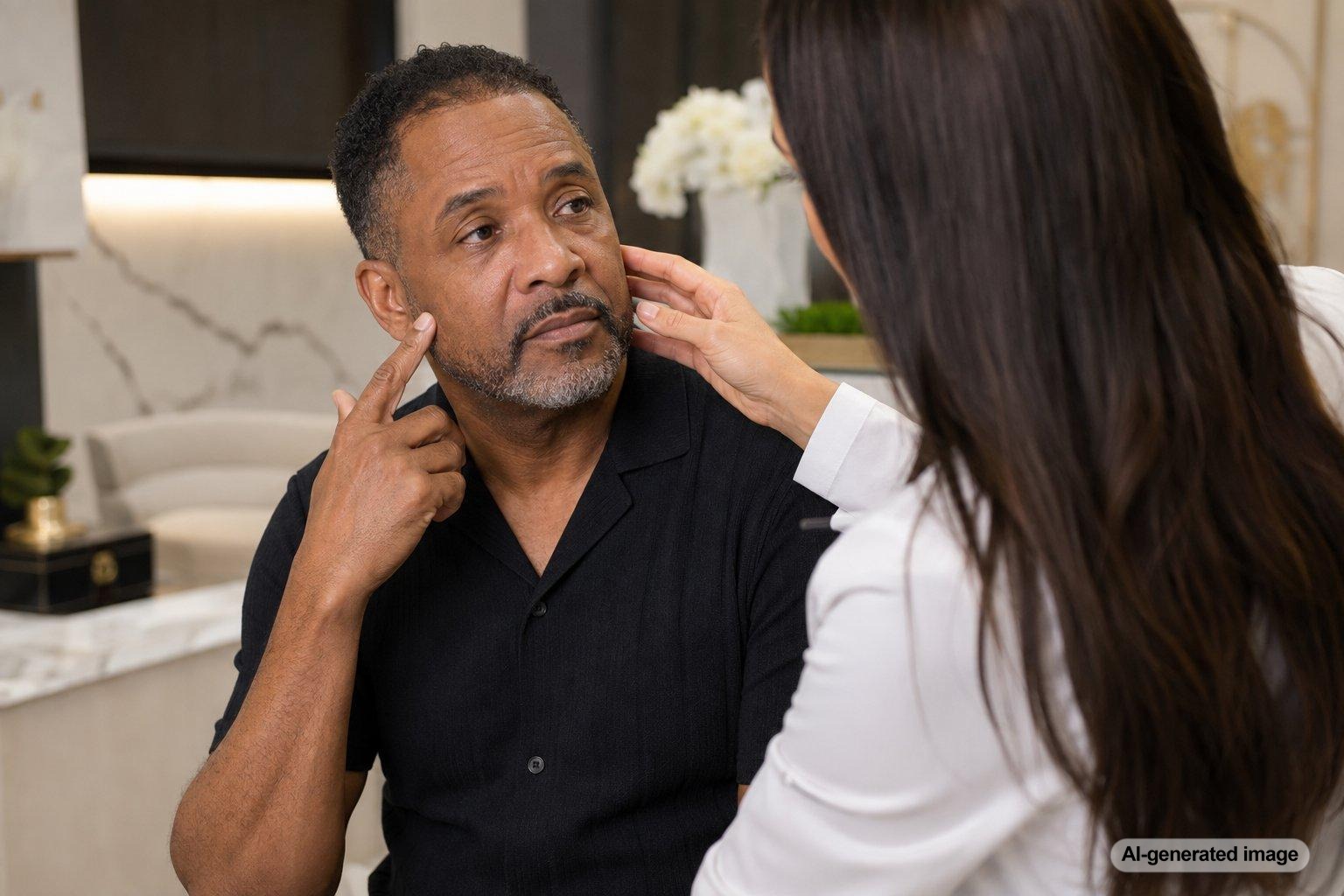
If one sideburn suddenly looks thinner, shorter, or nearly bare while the other side looks normal, the difference can be surprisingly noticeable. One-sided sideburn hair loss does not point to one specific diagnosis. Sometimes the explanation is mechanical, such as repeated rubbing, pulling, or breakage. In other cases, a dermatologist may consider inflammatory or autoimmune forms of hair loss, especially when the area looks smooth, sharply defined, or continues to expand.
The pattern matters. So do changes in the skin, the speed of the hair loss, your grooming habits, and whether hair is disappearing anywhere else.
Quick answer
- Repeated friction or pressure can affect one side more than the other, particularly when habits consistently involve the same side of the face or head.
- Traction and styling can thin hair around the temples and sideburns when hair is repeatedly pulled tightly.
- Hair breakage can make an area look sparse even when follicles are still producing hair.
- Alopecia areata can cause smooth, patchy hair loss on the head or face and may occasionally involve a localized area.
- Persistent, enlarging, inflamed, or unexplained hair loss is worth having evaluated by a dermatologist rather than trying to identify the cause from appearance alone.
Why can one sideburn thin while the other stays normal?
Hair loss is not always symmetrical. A localized trigger can repeatedly affect one side, or a hair-loss condition can begin in one small area before appearing anywhere else. That is why comparing the two sides can be useful, but the asymmetry itself does not identify the cause.
A dermatologist may look closely at whether hairs are missing from the root, broken at different lengths, miniaturized, or surrounded by redness or scale. Those clues can help separate mechanical damage from a medical hair-loss pattern.
Repeated friction or pressure
Think about what touches that sideburn every day. Repeated contact may create more stress on hair than you realize. The effect can be uneven if the same side is exposed over and over.
Possible sources of localized friction include helmet straps, mask loops, eyewear, headphones, occupational headgear, habitual rubbing, or another object that repeatedly presses against the same area. Even sleeping habits may be worth considering when the same region is consistently subjected to rubbing, although friction alone should not automatically be assumed to be the cause.
If the problem is mainly breakage, you may notice short hairs of different lengths rather than completely smooth bare skin.
Traction from hairstyles
Repeated pulling can cause a form of hair loss known as traction alopecia. Tight ponytails, braids, extensions, buns, and other styles that keep tension on the hairline can place stress on follicles. The temples and hairline are common places for traction to become noticeable.
One side may look worse if a style pulls unevenly, if extensions are anchored differently from side to side, or if you habitually secure or manipulate one side more than the other.
A useful practical rule is that a hairstyle should not hurt. If there is pulling, tenderness, or persistent tension around the thinning area, switch to a looser style and avoid repeatedly stressing the same section of hair. Long-standing traction can become more difficult to reverse, which is one reason early evaluation can matter.
Hair breakage versus true hair loss
Sometimes the follicle is still producing hair, but the hair shaft is snapping before it reaches its usual length. Chemical processing, excessive heat, aggressive brushing, repeated grooming, and friction can all contribute to fragile hair.
Breakage often leaves uneven short hairs or a rougher appearance. True follicular hair loss may instead create an area where hairs are absent or noticeably reduced from the skin surface. The distinction is not always easy to make without magnification, so persistent thinning deserves a professional look.
Could alopecia areata affect a sideburn?
It can. Alopecia areata is an autoimmune condition in which the immune system attacks hair follicles. It commonly produces smooth, round or oval patches of hair loss and can affect hair on the scalp, beard, or other parts of the body.
A patch near the temple or sideburn does not automatically mean alopecia areata. However, it may be considered when hair disappears relatively quickly and the underlying skin looks smooth rather than irritated or scarred. Some people also develop additional patches elsewhere, nail changes, or sensations such as tingling or itching around affected areas.
Because different types of hair loss can resemble one another, a dermatologist may use the pattern, examination findings, medical history, and occasionally additional testing to determine what is happening.
Other clues your dermatologist may look for
The appearance of the skin around the missing hair can provide important information. Mention any changes you have noticed, including:
- Redness or persistent irritation
- Flaking, scale, or crusting
- Itching, tenderness, burning, or pain
- Small bumps or pustules
- Shiny or unusually smooth skin
- Broken hairs of many different lengths
- A sharply outlined bald patch
- Loss of eyebrow, beard, scalp, or body hair elsewhere
These details do not establish a diagnosis on their own, but they can help your clinician narrow the possibilities.
What you can do at home while you monitor it
Until you know the cause, keep the routine around the area simple and gentle. Avoid repeatedly tugging, rubbing, or inspecting the hairs. Loosen hairstyles that create tension around the temples. Reduce unnecessary heat and harsh chemical processing, and handle the hair carefully when washing and styling.
You can also take a clear photo in consistent lighting every few weeks. Comparing photographs may be more useful than checking the mirror several times a day because small changes are easier to recognize over time.
Avoid starting multiple hair-growth products at once simply because one side looks thinner. Different causes of localized hair loss may require different approaches, and some treatments are best discussed with a dermatologist first.
Professional evaluation and treatment options
Treatment depends on what is causing the thinning. If repeated tension or friction is contributing, reducing that stress may be an important part of the plan. If inflammation, alopecia areata, or another medical form of hair loss is suspected, a dermatologist can discuss appropriate medical options after examining the area.
For some hair-loss concerns, office-based regenerative approaches may also be discussed after the diagnosis and condition of the follicles are evaluated. At Waverly DermSpa, we offer PRFM for Hair Loss and can help you understand whether it may be appropriate.
The important step is identifying the type of hair loss before choosing a treatment. The same approach is not appropriate for every thinning sideburn.
When to see a dermatologist
Consider scheduling an evaluation if the hair loss is clearly progressing, has developed without an obvious mechanical trigger, or has not improved after removing possible sources of tension and friction.
It is particularly worth getting checked when the patch is smooth and sharply defined, additional areas of hair are disappearing, or the skin becomes red, scaly, painful, scar-like, or otherwise different from the surrounding area. Sudden or unexplained patchy hair loss also deserves professional assessment.
FAQ
Can sleeping on one side make my sideburn disappear?
Repeated friction may contribute to breakage or localized stress in some situations, but sleep position alone should not be assumed to explain a persistent bald or thinning patch. If the hair continues to disappear, a dermatologist can help determine whether another type of hair loss is involved.
Can glasses cause sideburn hair loss?
Eyewear that repeatedly rubs or presses the same area could potentially contribute to local friction or breakage. Check whether the frame consistently contacts the thinning spot, but have persistent loss evaluated rather than assuming the glasses are the only cause.
Does a smooth bald patch mean alopecia areata?
Not necessarily. Alopecia areata can produce smooth patches, but several hair-loss conditions can have overlapping appearances. A dermatologist can evaluate the pattern and other clinical clues before determining the cause.
Can tight hairstyles thin the sideburns?
Yes. Repeated tension from tightly pulled hairstyles can contribute to traction alopecia, particularly around the hairline and temples. Loosening styles and reducing repeated pulling can help protect stressed follicles.
Will the sideburn hair grow back?
That depends on the cause, how long the process has been present, and whether the follicles remain capable of producing hair. Some forms of hair loss can improve, while others can become persistent. An examination offers more useful information than trying to predict regrowth from the appearance alone.
Ready to get help?
Schedule an appointment or send a message and our team will get back to you.
Prefer to call? 954-666-3736
Disclaimer
This article is for educational purposes and is not medical advice. For diagnosis and personalized treatment, please book an appointment with a board-certified dermatologist.
Sources & further reading
- American Academy of Dermatology (AAD) – Hair loss types: Alopecia areata signs and symptoms
- American Academy of Dermatology (AAD) – Hairstyles that pull can lead to hair loss
- National Institute of Arthritis and Musculoskeletal and Skin Diseases (NIAMS) – Alopecia Areata
