

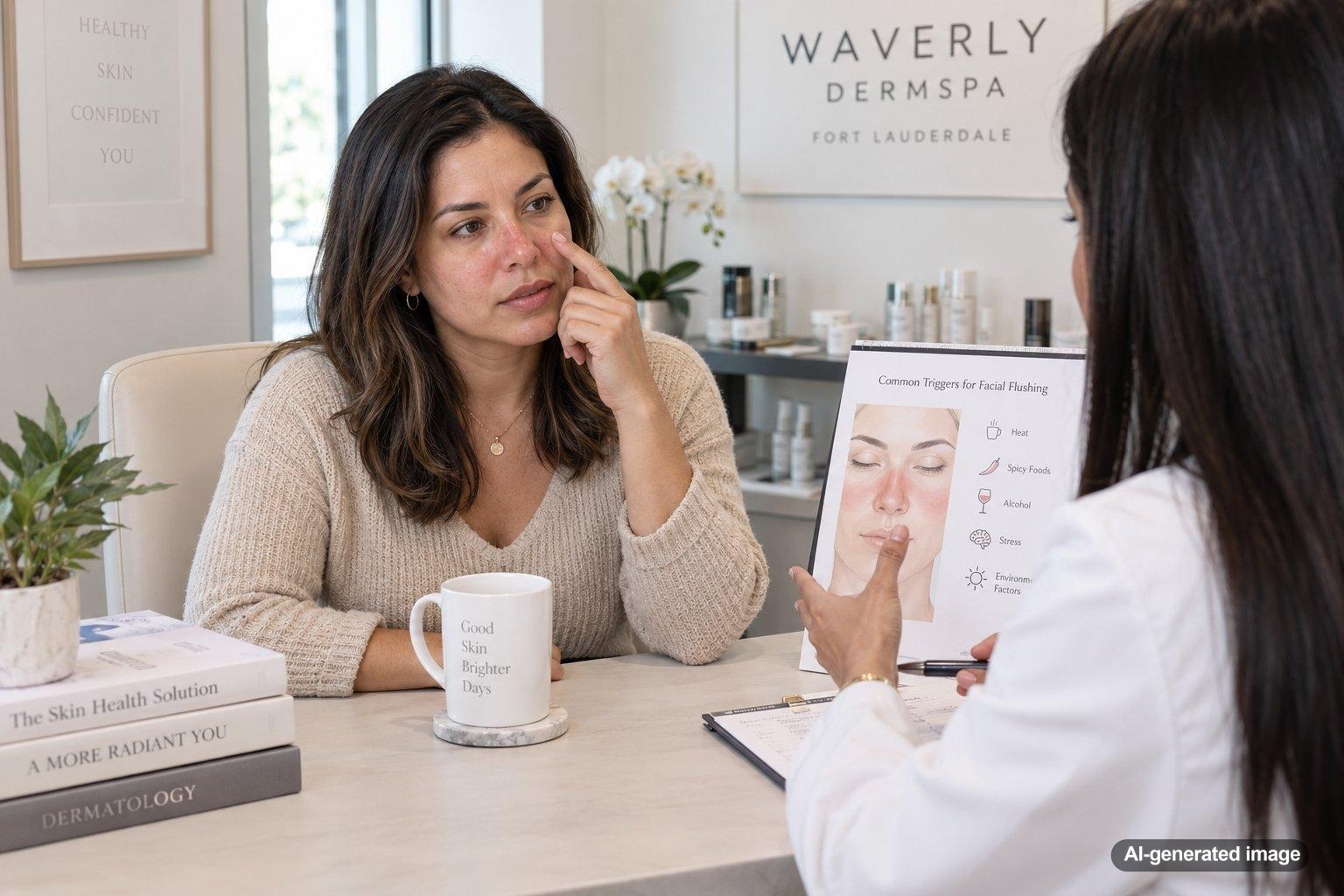
If the skin around your nose repeatedly becomes red after coffee, tea, soup, or another hot beverage, the heat itself may be contributing to temporary facial flushing. Warmth can increase blood flow near the skin’s surface, making redness more noticeable in areas that are already prone to sensitivity or visible blood vessels.
Recurrent flushing can also be associated with rosacea and other forms of facial irritation, so the pattern matters. A dermatologist can help distinguish a simple heat response from an underlying skin condition when the redness is frequent, persistent, uncomfortable, or changing.
Quick answer
- Hot beverages can increase facial warmth and temporarily widen blood vessels near the skin’s surface.
- The nose and nearby cheeks are common places for flushing to become noticeable.
- Rosacea can be associated with increased sensitivity to heat and hot drinks, but flushing after a beverage does not by itself establish a diagnosis.
- Allowing a drink to cool somewhat and tracking other triggers may help clarify your pattern.
- Redness that becomes persistent, painful, scaly, swollen, or accompanied by other symptoms is worth discussing with a dermatologist.
Why can a hot beverage make the skin around your nose red?
When your body is exposed to heat, small blood vessels near the surface of the skin can widen. This process, called vasodilation, increases visible blood flow and can create a flushed appearance. The central face, including the nose and surrounding cheeks, is an area where these changes may be especially easy to notice.
The temperature of the drink may be more important than the specific beverage for some people. Others notice that additional factors, such as caffeine, alcohol, spicy ingredients, room temperature, exercise, stress, or sun exposure, seem to amplify the reaction.
Could rosacea be involved?
Possibly, but recurrent redness after hot drinks is not enough to diagnose rosacea. Rosacea is a facial skin condition that can involve repeated flushing, longer-lasting redness, visible blood vessels, sensitivity, acne-like bumps, or eye symptoms. Hot beverages and heat are recognized triggers for some people who have rosacea.
A useful clue is whether redness is becoming easier to trigger, lasting longer than it used to, or appearing alongside burning, stinging, bumps, or visible small blood vessels. A dermatologist can evaluate the entire pattern rather than relying on one trigger alone.
Other factors that may contribute to redness around the nose
- General heat exposure: Hot weather, warm rooms, exercise, and hot showers may produce a similar flushing response.
- Skin sensitivity: Irritating cleansers, exfoliants, fragrances, or other products can make the area more reactive.
- Skin barrier disruption: Dryness and irritation may make redness and stinging more noticeable.
- Alcohol or spicy foods: These can contribute to facial flushing in some people.
- Other skin conditions: Redness near the nose can have several causes, including conditions that may also produce scaling, bumps, itching, or irritation.
What can you do at home?
Simple observations can often provide useful information. Try allowing very hot drinks to cool before drinking them and notice whether the response changes. You can also keep a brief record of when the redness occurs and whether it coincides with heat, alcohol, spicy foods, sun exposure, exercise, stress, or specific skincare products.
Keep skincare gentle while the area is reactive. A mild cleanser, fragrance-free moisturizer, and daily broad-spectrum sunscreen are generally sensible choices for sensitive facial skin. Avoid aggressively scrubbing or trying to remove redness with repeated exfoliation, since additional irritation may make the area look and feel worse.
What professional options are available?
Treatment depends on what is causing the redness. If a dermatologist identifies rosacea or another inflammatory condition, options may include adjustments to skincare, prescription topical or oral therapies, or selected in-office procedures. Persistent visible blood vessels and background redness may also be addressed with certain light or laser-based approaches in appropriately selected patients.
The right approach varies with your skin, symptoms, medical history, and the type of redness present, so an evaluation is more useful than choosing a treatment based only on appearance.
When should you see a dermatologist?
Consider an evaluation if the redness is occurring often, lasting progressively longer, or becoming noticeable even when you have not had a hot beverage. It is also worth getting checked if you develop persistent burning or stinging, swelling, acne-like bumps, scaling, visible blood vessels, eye irritation, or a significant change in the appearance of your skin.
Because several skin conditions can cause redness around the nose, an examination can help clarify the cause and guide a more individualized plan.
FAQ
Does redness after hot coffee mean I have rosacea?
No. Hot coffee can trigger temporary flushing for several reasons, including the temperature of the beverage. Rosacea is one possible explanation when flushing is recurrent or accompanied by other characteristic symptoms, but a dermatologist should evaluate the overall pattern before making a diagnosis.
Is caffeine responsible for the redness?
Not necessarily. For some people, beverage temperature appears to be an important factor. If you want to learn more about your own pattern, compare how your skin responds to the same type of beverage at different temperatures.
Why does the redness show up mostly around my nose?
The central face has many superficial blood vessels, and flushing can be particularly visible around the nose and cheeks. Local skin sensitivity or an underlying inflammatory condition may also influence where redness appears.
Can skincare products make this reaction worse?
They can. Products that irritate or dry the skin may increase sensitivity, stinging, or visible redness. Gentle skincare is often preferable when the area is reactive.
Should I stop drinking hot beverages completely?
Not necessarily. If temperature appears to be your trigger, allowing beverages to cool may be enough to reduce flushing. Individual triggers vary, so tracking your response can be more useful than automatically eliminating something you enjoy.
Ready to get help?
Schedule an appointment or send a message and our team will get back to you.
Prefer to call? 954-666-3736
This article is for educational purposes and is not medical advice. For diagnosis and personalized treatment, please book an appointment with a board-certified dermatologist.
Sources & further reading
- American Academy of Dermatology (AAD) – Triggers could be causing your rosacea flare-ups
- DermNet – What’s triggering my rosacea?
