

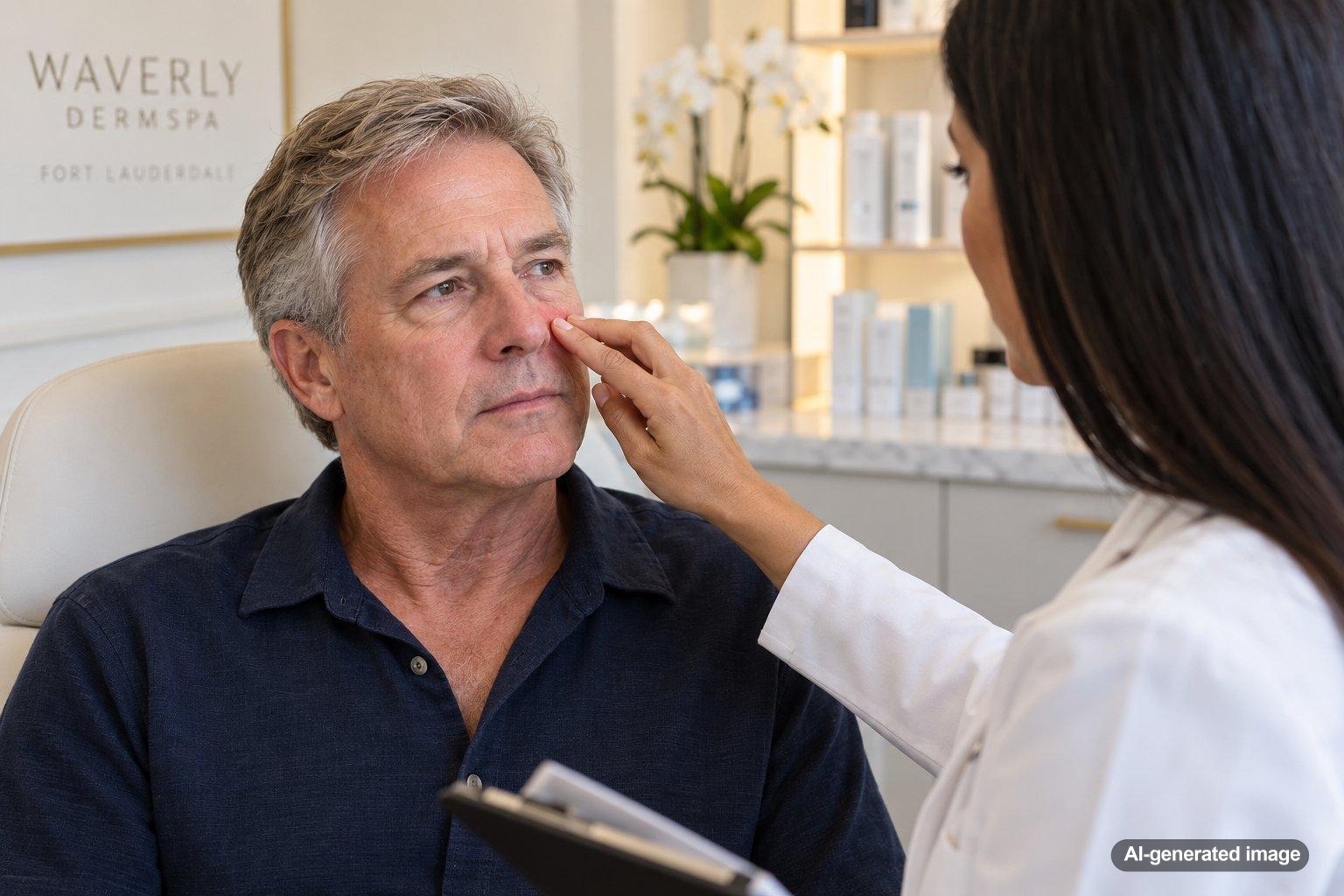
When one corner of your nose stays red, tender, or sore while the rest of the area looks normal, there are several possible explanations. Repeated friction, dryness, skincare products, a runny nose, inflammation, or a localized infection can all affect the delicate skin around a nostril. A persistent spot can occasionally need a closer look for other skin changes as well.
The location alone cannot identify the cause. What matters is how the area looks and feels, how long it has been present, whether it repeatedly improves and returns, and whether there is crusting, scaling, bleeding, drainage, swelling, or a distinct bump. A dermatologist can examine the area and determine what is most likely.
Quick answer
- Repeated wiping, blowing, rubbing, or picking can irritate one side of the nose and weaken the skin barrier.
- Skincare, cosmetics, sunscreen, cleansers, or topical medications may trigger irritant or allergic contact dermatitis.
- A sore or crusted spot near the nostril opening can sometimes be associated with nasal vestibulitis, a bacterial infection that requires medical evaluation.
- Inflammatory skin conditions can cause recurring redness, scaling, or sensitivity around the nose.
- A spot that does not heal, repeatedly bleeds, forms a persistent crust, or noticeably changes should be evaluated rather than repeatedly treated at home.
Why can redness stay in just one corner of the nose?
The corners and folds around the nostrils are exposed to moisture, mucus, skincare products, facial movement, tissues, fingers, masks, and environmental conditions throughout the day. Because the skin is thin and frequently disturbed, a small area can become irritated while nearby skin remains comfortable.
Sometimes the problem is primarily on the outer skin. In other cases, irritation or inflammation begins just inside the nostril and becomes noticeable at the edge. Looking at exactly where the redness begins can help a dermatologist narrow the possibilities.
Common causes and triggers
Repeated friction and a damaged skin barrier
Frequent nose blowing, wiping, rubbing, or picking can create a small cycle of irritation. This is especially common during allergy season, a cold, travel, or periods of dry indoor air. The skin may look pink or red and can feel raw, tight, or tender.
Contact dermatitis
Contact dermatitis can occur when the skin is irritated by a substance or develops an allergic reaction to something touching it. Around the nose, possible triggers can include cleansers, fragrances, cosmetics, sunscreen, acne products, topical medications, tissues with added ingredients, or other personal-care products. Symptoms vary but may include redness, dryness, scaling, itching, burning, tenderness, bumps, or occasionally blistering.
Dryness and environmental irritation
Air conditioning, low humidity, wind, sun exposure, and frequent washing can leave the nostril edges dry and more vulnerable to small cracks. This can be particularly noticeable after travel or during seasonal changes, including for people spending part of the year in South Florida and moving between different climates.
Nasal vestibulitis
Nasal vestibulitis is an infection near the opening of the nostril. It may be associated with soreness, redness, swelling, pimples or sores, bleeding, or yellow crusting. Repeated nose blowing, picking, or plucking nasal hairs can contribute. Because bacterial infections may need prescription treatment, a painful or crusted area inside the nostril is worth having evaluated rather than attempting to diagnose or treat on your own.
Inflammatory skin conditions
Several inflammatory skin conditions can affect the folds around the nose. Depending on the condition, there may be redness, flaking, itching, burning, small bumps, or sensitivity. The appearance can overlap considerably between conditions, so an examination is often more useful than trying to identify the cause from redness alone.
A persistent skin lesion
Most everyday irritation around the nose has a benign explanation, but a spot that consistently fails to heal deserves attention. Skin cancers can occur on the nose and may sometimes resemble a sore, scaly patch, pimple, crusted area, or small growth. A lesion that heals and returns, repeatedly bleeds, enlarges, or otherwise changes should be examined by a dermatologist.
What you can do at home
If the area appears mildly irritated and there are no concerning symptoms, simplifying your routine for a short period may help reduce additional irritation.
- Avoid rubbing, scratching, picking, or squeezing the area.
- Blot gently instead of repeatedly wiping when your nose is running.
- Temporarily stop new or potentially irritating products directly around the sore area.
- Use a gentle, fragrance-free cleanser and avoid aggressive scrubs or exfoliating acids on irritated skin.
- Keep your skincare routine simple while the skin barrier is sensitive.
- Avoid plucking hairs from inside the nostril, especially when the area is already inflamed.
- Do not repeatedly apply antibiotic, steroid, antifungal, or acne medications unless a clinician has recommended them for the specific problem.
If symptoms continue despite removing obvious irritants, the next step is usually an evaluation rather than cycling through more products.
What a dermatologist may look for
A dermatologist can assess whether the redness is primarily on the external skin, in the nostril opening, or both. The examination may consider the pattern of redness, scaling, crusting, tenderness, swelling, bumps, broken skin, bleeding, and any changes over time.
Professional options depend on the cause. A clinician may recommend barrier-supportive skincare for irritation, strategies for avoiding a suspected contact trigger, or prescription treatment when an inflammatory or infectious condition is identified. If a persistent lesion has features that warrant closer evaluation, the dermatologist can determine whether additional testing or a biopsy should be considered.
When should you see a dermatologist?
Schedule an evaluation when redness or soreness keeps returning, does not improve, or has no clear explanation. It is particularly important to get checked if you notice:
- A sore that does not heal or repeatedly heals and returns.
- Recurring bleeding or crusting without an obvious injury.
- A growing or changing bump, spot, or patch.
- Increasing pain, warmth, swelling, or redness.
- Pus, drainage, or significant yellow crusting.
- Redness that is spreading beyond the original area.
- A persistent sore or pimple just inside the nostril.
Fever, rapidly spreading facial redness or swelling, severe pain, severe headache, or vision symptoms warrant prompt medical attention. These symptoms should not be managed solely with skincare products.
FAQ
Why is only one side of my nose irritated?
Localized exposure often explains the asymmetry. You may wipe one side more often, sleep against that side, have irritation concentrated near one nostril, or have a small inflamed area that happens to be unilateral. The pattern alone does not establish a diagnosis.
Can skincare products make the corner of my nose red?
Yes. Cleansers, exfoliating acids, retinoids, acne treatments, fragrances, cosmetics, sunscreens, and other products can irritate sensitive skin or contribute to contact dermatitis. The nasal folds can be especially vulnerable because products may collect in the crease.
What does nasal vestibulitis feel like?
It can be associated with soreness, redness, swelling, crusting, bleeding, or pimple-like sores near the opening of the nostril. Those features can overlap with other problems, so a healthcare professional should evaluate suspected infection.
Should I put antibiotic ointment on a sore nostril?
It is better not to assume that every red or sore area is bacterial. Some topical products can themselves irritate skin or trigger contact reactions. A clinician can determine whether an antibiotic is appropriate and, if so, which type should be used.
Could a sore on the side of the nose be skin cancer?
Most irritation is not skin cancer, but some skin cancers can resemble a persistent sore, pimple, crusted area, scaly patch, or small growth. A dermatologist should examine a spot that does not heal, repeatedly returns, bleeds, grows, or noticeably changes.
How long should I watch a red spot before getting it checked?
There is no single timeline that applies to every skin problem. If the area is persistent, recurrent, worsening, painful, bleeding, crusting, or simply concerning to you, it is reasonable to have it evaluated rather than waiting for a particular number of days.
Ready to get help?
Schedule an appointment or send a message and our team will get back to you.
Prefer to call? 954-666-3736
This article is for educational purposes and is not medical advice. For diagnosis and personalized treatment, please book an appointment with a board-certified dermatologist.
Sources & further reading
- Cleveland Clinic – Nasal Vestibulitis: Symptoms, Treatment & Outlook
- Mayo Clinic – Contact dermatitis – Symptoms and causes
- American Academy of Dermatology (AAD) – Basal cell carcinoma: From symptoms to treatments
