

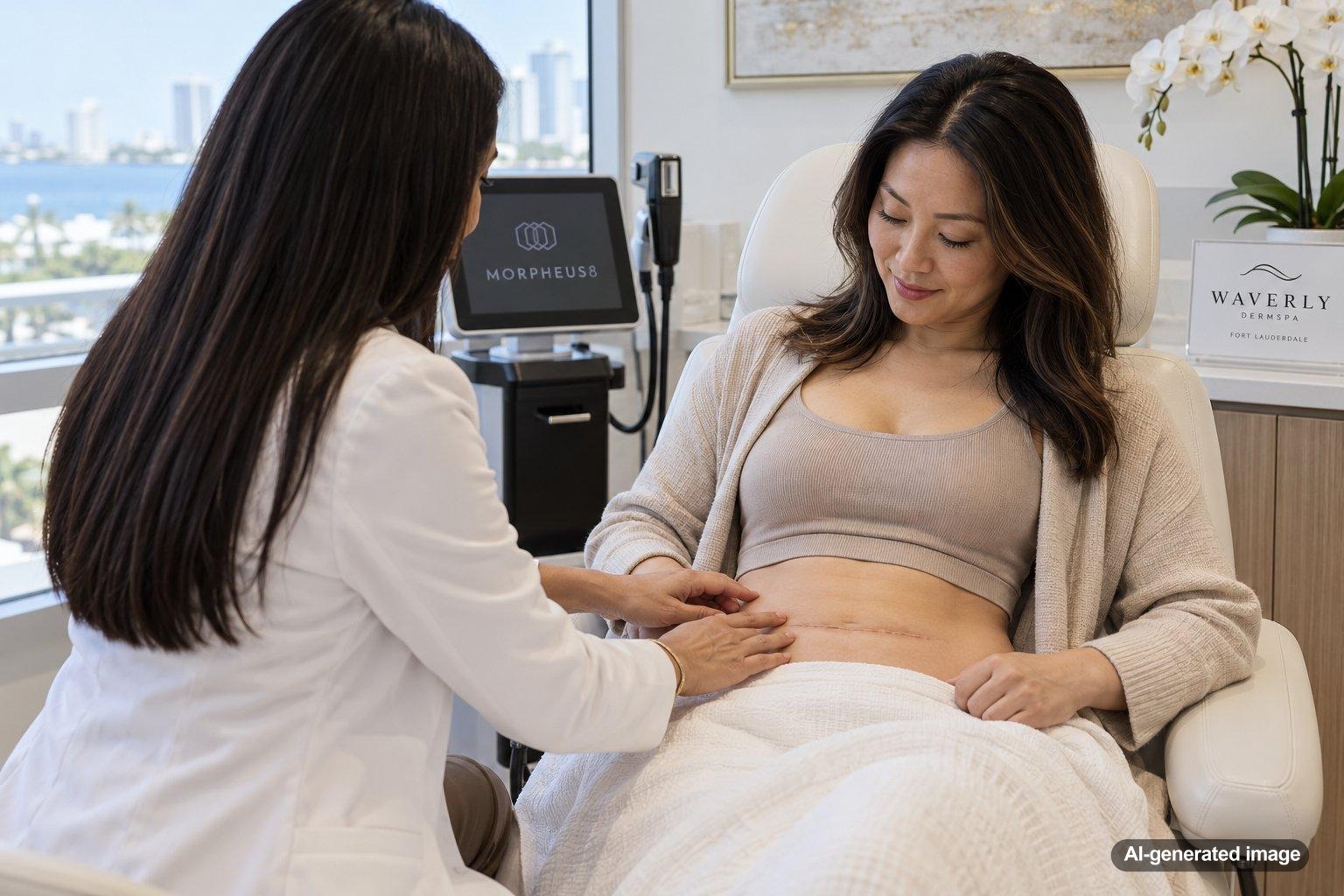
A tummy tuck can leave a long abdominal scar that continues to change as the skin heals and remodels. Even when a scar has healed normally, some people remain bothered by uneven texture, firmness, thickness, or a noticeable transition between the scar and surrounding skin. Morpheus8 is one office-based option that may be considered for selected, fully healed surgical scars.
The goal is not to erase a scar. Instead, treatment may be used to improve certain aspects of texture and blending. Whether Morpheus8 is appropriate depends on how the scar has healed, its age and characteristics, your skin, and your overall treatment goals.
Quick answer
- Morpheus8 combines microneedling with radiofrequency energy delivered below the skin surface.
- It may be considered for selected healed tummy tuck scars when texture or firmness is a concern.
- Results vary, and surgical scars generally cannot be made completely invisible.
- Treatment should be considered only after the surgical area has healed adequately and a qualified clinician has evaluated the scar.
- Some scars require a different approach or a combination of treatments.
What Morpheus8 is
Morpheus8 is a fractional radiofrequency microneedling treatment. Very small needles enter the skin while controlled radiofrequency energy is delivered at selected depths. This creates controlled treatment zones that encourage the skin’s normal remodeling response.
When used on a mature surgical scar, the objective may be to soften an uneven surface, improve the transition between scar tissue and surrounding skin, or address areas that feel firmer than the neighboring tissue. The exact treatment depth and settings are individualized rather than applied the same way to every scar.
How Morpheus8 may be used for a tummy tuck scar
A tummy tuck scar typically extends across the lower abdomen and may sit beneath the underwear or swimsuit line. Over time, a normally healing scar often becomes flatter and less noticeable, but the final appearance varies considerably from person to person.
If the incision is fully closed and the scar has matured enough for treatment, a clinician may evaluate whether fractional radiofrequency microneedling could be useful. Treatment may focus on texture differences, firmness, or a slightly raised or irregular surface. Pigment changes, prominent blood vessels, substantial thickening, or tethering may call for other strategies.
What affects the appearance of an abdominal surgical scar
- Individual healing: People naturally form scars differently, even after similar procedures.
- Scar maturity: Surgical scars continue to evolve for an extended period after an operation.
- Tension on the incision: Movement and mechanical tension can influence how a scar develops.
- Sun exposure: Ultraviolet exposure can make color differences more noticeable in some scars.
- Skin characteristics: Skin tone, thickness, sensitivity, and previous scar behavior can influence treatment planning.
- The type of scar: Flat, raised, firm, indented, discolored, and symptomatic scars may require different approaches.
What you can do at home
Once your surgeon has cleared the incision for routine skin care, conservative scar care is usually the safest place to start. Follow the postoperative instructions you were given, avoid picking or repeatedly irritating the area, and protect exposed scar tissue from the sun.
If you are considering silicone products, massage, topical products, or other scar-care techniques, ask your surgeon or dermatologist whether they are appropriate for your stage of healing. More aggressive home treatments, strong acids, needling devices, or repeated friction can irritate a healing scar and are best avoided unless a clinician specifically recommends them.
Professional options for a tummy tuck scar
There is no single procedure that fits every abdominal scar. A dermatologist or other qualified clinician can examine the scar and determine which feature is most important to address. Depending on the scar, professional options may include microneedling-based procedures, energy-based treatments, injections for selected raised scars, pigment-focused treatments, vascular treatments, or surgical scar revision.
Sometimes a combination approach makes more sense than relying on one procedure. The treatment plan may also change as the scar matures.
At Waverly DermSpa, we offer Morpheus8 and can help you understand whether it may be appropriate.
When to see a dermatologist
Before treating a surgical scar cosmetically, it is important to make sure the area has healed as expected. A dermatologist can evaluate a scar that remains unusually raised, firm, itchy, painful, discolored, or otherwise concerning.
Contact your surgeon promptly if a recent incision becomes increasingly red, warm, swollen, painful, starts draining, opens, or develops another unexpected change. Cosmetic scar treatment should not take priority over evaluating a possible healing complication.
FAQ
Can Morpheus8 completely remove a tummy tuck scar?
No procedure can reliably make a surgical scar disappear completely. Morpheus8 may help improve selected texture differences or make a mature scar blend more smoothly with surrounding skin, but outcomes vary.
How long after a tummy tuck can Morpheus8 be considered?
The timing is individualized. The incision should be fully healed, and your surgeon or treating clinician should confirm that the area is ready before an elective scar procedure is considered. Scar maturity, healing history, and the planned treatment intensity all matter.
Does Morpheus8 help with scar color?
Morpheus8 is generally considered more for texture and tissue remodeling than for every type of color change. Redness, brown discoloration, or lighter scar tissue may require a different approach after evaluation.
How many Morpheus8 treatments are needed for a surgical scar?
There is no universal number. Recommendations can depend on the scar’s size, thickness, texture, age, response to treatment, and the degree of change you are hoping to achieve.
Can Morpheus8 be used if the scar is raised?
A raised scar should be examined before treatment. Some raised scars may benefit from other approaches, and the safest plan depends on the type of scar and how it has behaved over time.
Is Morpheus8 the only option for a tummy tuck scar?
No. Surgical scars can have several different features, and treatment may involve another procedure or a combination of approaches. A dermatologist can evaluate the scar and help determine which options are reasonable for your goals.
Ready to get help?
Schedule an appointment or send a message and our team will get back to you.
Prefer to call? 954-666-3736
This article is for educational purposes and is not medical advice. For diagnosis and personalized treatment, please book an appointment with a board-certified dermatologist.
