

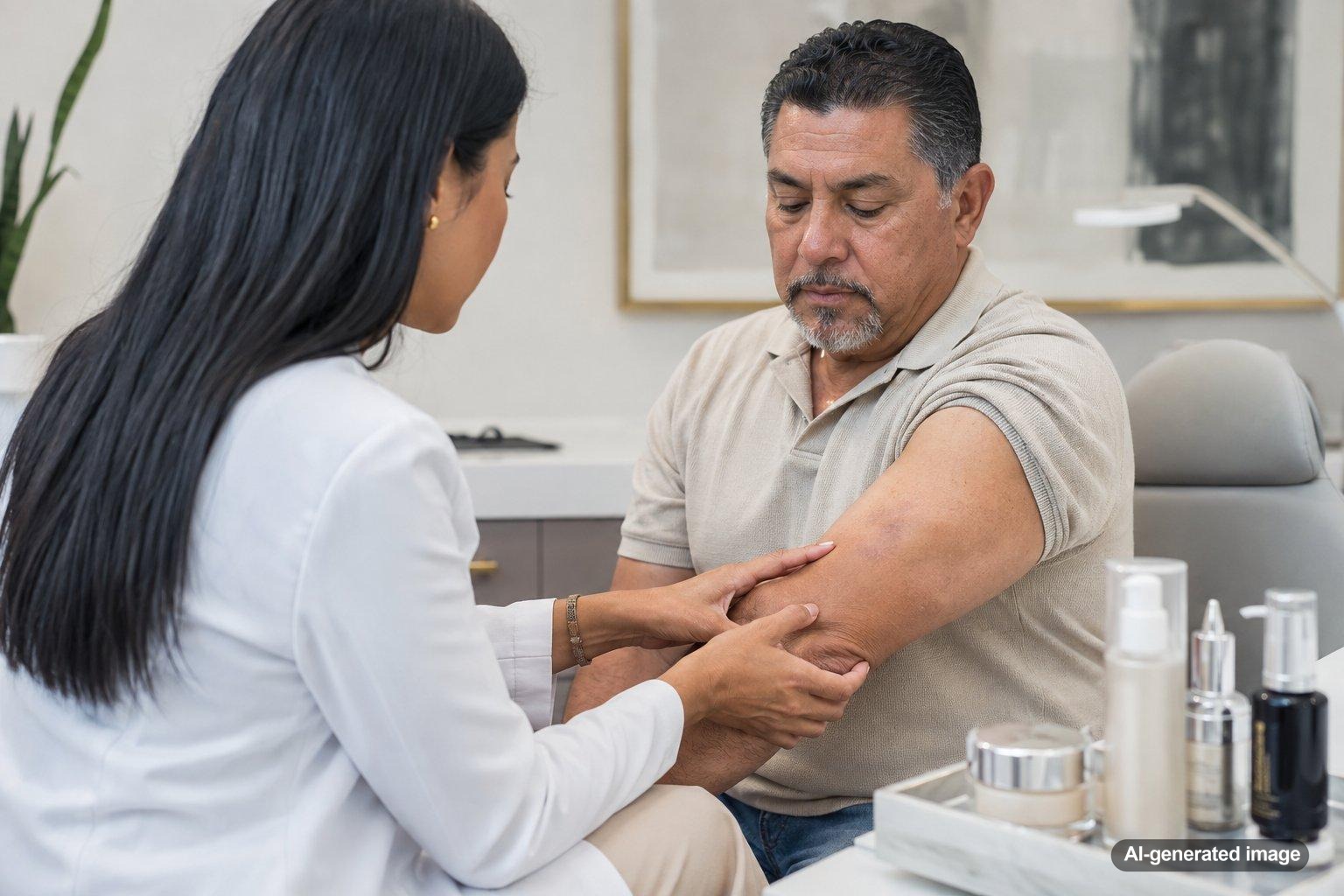
Hard, discolored patches that feel unusually firm, smooth, or almost wood-like can be associated with morphea, an inflammatory condition that causes excess collagen to build up in a localized area of skin. A patch may begin with a reddish, purplish, or bruise-like color and gradually develop a pale center, darker pigmentation, or a waxy surface as it becomes thicker and less flexible.
That appearance is not enough to identify the cause on your own. Several skin conditions can look similar, and morphea varies in shape, depth, and activity. A dermatologist can evaluate the pattern, texture, symptoms, and depth of the change and determine whether testing is appropriate.
Quick answer
- Morphea, also called localized scleroderma, may cause firm, thickened, discolored patches of skin.
- The exact cause is not known, but immune-system activity and excess collagen production are involved.
- Morphea is not contagious and is different from systemic sclerosis, which can affect internal organs.
- Early evaluation matters when a patch is new, spreading, crossing a joint, painful, or affecting movement.
What is morphea?
Morphea is a localized inflammatory condition in which collagen accumulates in the skin and sometimes in the tissue beneath it. Collagen normally gives skin structure. When too much collects in one area, the skin can become thick, tight, bound down, shiny, or difficult to pinch. This change in texture is why some people describe the patch as feeling like wood.
The color can shift as the condition changes. An active edge may look pink, red, or purple, while the center may become ivory, lighter than the surrounding skin, or darker after inflammation settles. Some patches are oval and limited to the trunk. Others form a line on an arm, leg, forehead, or scalp. Deeper forms may involve fat, fascia, muscle, or bone and require closer assessment.
Despite the similar name, localized scleroderma is not the same as systemic sclerosis. Morphea generally does not produce the characteristic internal-organ fibrosis of systemic sclerosis. A dermatologist still needs to assess unusual hardening because the location, depth, and pattern guide the next steps.
What may cause or trigger morphea?
The precise cause remains unclear. Morphea appears to involve misdirected immune activity that stimulates excess collagen in a defined area. It is not caused by poor hygiene, and it cannot be passed from one person to another.
In some cases, a patch has appeared after a local event, but an association does not prove that the event caused the condition. Reported possible triggers include:
- Skin injury, repeated friction, or pressure
- Surgery, an injection, or another procedure involving the area
- Radiation therapy
- Certain medications or chemical exposures
- An infection in a person who is already susceptible
Many people do not recall any trigger at all. There is also no single lifestyle choice that explains every case. An exam is more useful than trying to trace the patch to one product, trip, climate, or isolated event.
What can you do at home?
Home care cannot replace an evaluation, but a few gentle steps can support comfort and make changes easier to track:
- Photograph the area consistently. Use similar lighting, distance, and positioning, and include a ruler nearby without pressing it into the skin.
- Note symptoms and movement. Record itching, tenderness, tingling, tightness, or reduced flexibility, especially when the patch is near a joint.
- Keep skin care simple. A fragrance-free moisturizer and a mild cleanser may reduce dryness and irritation.
- Protect exposed areas from the sun. Broad-spectrum sunscreen and protective clothing can help limit additional contrast between affected and surrounding skin.
- Avoid forceful massage or aggressive treatments. Scrubs, strong peels, and at-home devices may irritate an active or uncertain skin change.
Do not rely on lightening products to judge whether the condition is improving. Color can remain after inflammatory activity has quieted, while texture, expansion, and depth may tell a different story.
How a dermatologist may evaluate and manage it
A dermatologist will usually begin with a full skin examination and a discussion of when the area appeared, how it has changed, and whether it affects comfort or movement. The visual pattern and feel of the skin can be very informative. When the diagnosis or depth is uncertain, a skin biopsy, blood testing, or imaging may be considered. Not every person needs every test.
Management depends on whether the morphea appears active, how deep it extends, where it is located, and whether function is at risk. Common options include prescription topical medicines for limited superficial areas, medically supervised light therapy for selected patterns, and systemic anti-inflammatory or immune-modulating medication for deeper, widespread, linear, or function-threatening disease. Physical therapy may also be part of a coordinated plan when movement is affected. Your clinician can help you decide which approach, if any, fits the examination findings.
The goal is often to control active inflammation and reduce progression. Existing discoloration, thinning, or contour changes may behave differently from active inflammation, so follow-up focuses on more than color alone.
When should you see a dermatologist?
Arrange an evaluation for a new area of skin that is becoming hard, thick, shiny, bound down, or noticeably different in color. Prompt assessment is especially important if:
- The patch is expanding or new patches are appearing
- The area crosses a joint or makes movement feel restricted
- There is pain, tingling, weakness, or a deep pulling sensation
- The change affects the face, scalp, an arm, or a leg
- There is hair loss, an indentation, or an uneven limb contour
- The skin is breaking down or showing signs of infection
- A child develops a firm linear patch or an area that may affect growth
Seek urgent medical care for severe pain, rapidly increasing swelling, fever with a hot or draining skin area, sudden weakness, trouble breathing, or other acute symptoms. These findings are not typical ways to identify morphea and may point to another problem that needs timely care.
Frequently asked questions
Is morphea contagious?
No. Morphea does not spread through touching, sharing towels, swimming, or close contact.
Is morphea the same as systemic sclerosis?
No. Morphea is also called localized scleroderma and mainly affects the skin and, in some forms, underlying tissue. Systemic sclerosis is a different disease that can affect blood vessels and internal organs. A clinician can assess the features rather than relying on the shared word scleroderma.
Does a hard, brown patch always mean morphea?
No. Post-inflammatory color change, scars, certain birthmarks, medication reactions, inflammatory disorders, and other conditions can create firm or discolored areas. The border, texture, depth, location, and pattern over time help narrow the possibilities.
Can morphea affect movement?
It can when inflammation and thickening extend more deeply or cross a joint. Tightness, reduced range of motion, or a linear patch on a limb deserves timely evaluation.
Will the color fade when the condition is inactive?
Color and texture do not always change at the same pace. Pigment differences or thinning may remain after active inflammation has settled. A dermatologist may use photographs and examination findings to track activity more accurately.
Ready to get help?
Schedule an appointment or send a message and our team will get back to you.
Prefer to call? 954-666-3736
This article is for educational purposes and is not medical advice. For diagnosis and personalized treatment, please book an appointment with a board-certified dermatologist.
