

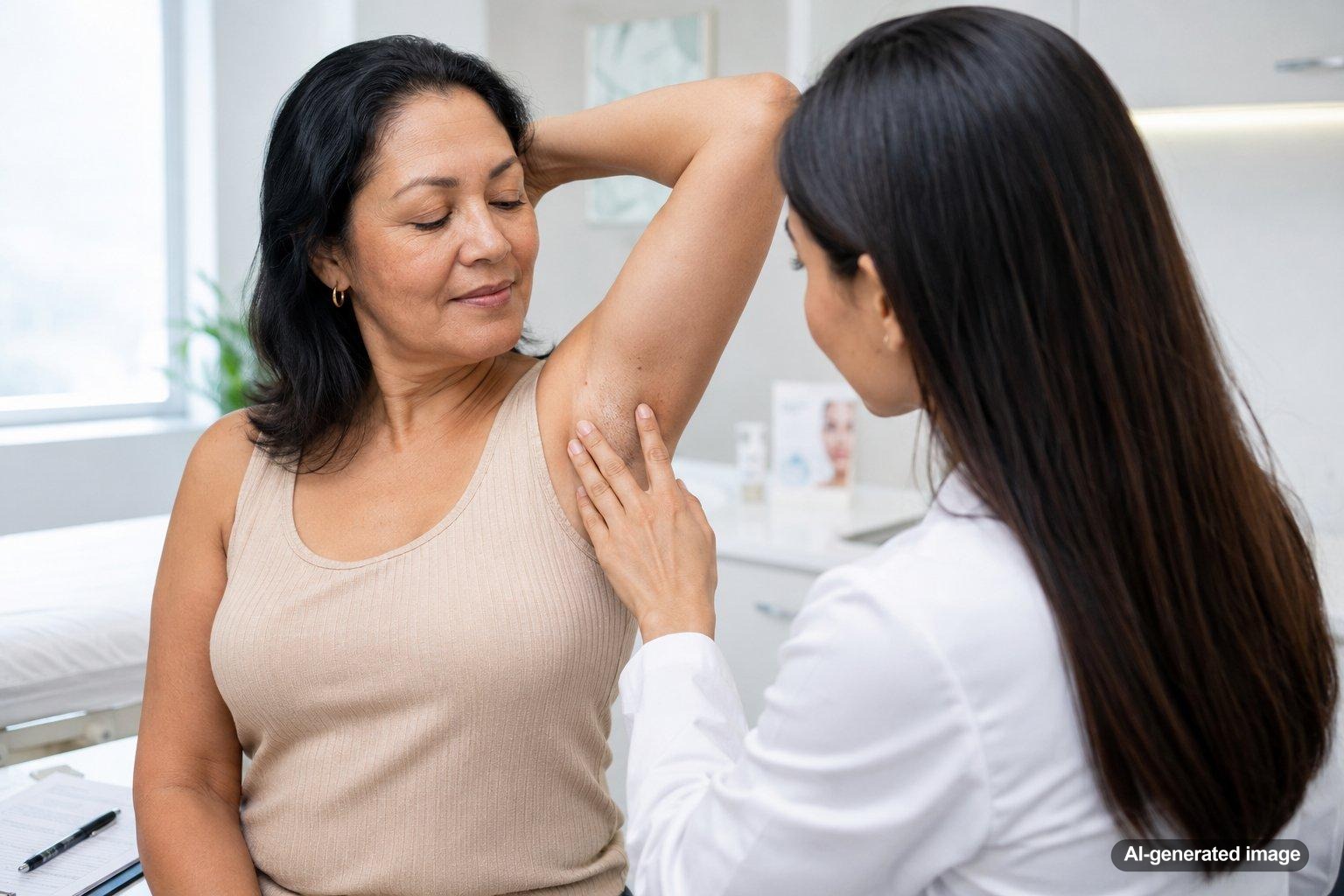
Small, persistent, intensely itchy bumps in the armpits or groin can have many possible causes. One uncommon possibility is Fox-Fordyce disease, a disorder involving the apocrine sweat glands and the hair follicles into which they empty. The condition often produces clusters of tiny, skin-colored or reddish bumps in areas rich in apocrine glands.
Because several other skin conditions can affect these same locations, appearance alone isn’t enough to determine what is causing a rash. A dermatologist can examine the pattern, symptoms, and medical history and decide whether additional evaluation is appropriate.
Quick answer
- Fox-Fordyce disease is an uncommon inflammatory disorder associated with blockage of apocrine sweat ducts.
- It most often causes small bumps centered around hair follicles in the armpits, pubic or groin region, and sometimes around the nipples.
- Itching can be significant and may become more noticeable with heat, humidity, friction, sweating, or stress.
- Other conditions can produce similar-looking bumps, so persistent symptoms are worth having evaluated by a dermatologist.
- Treatment is individualized and may involve prescription topical or other medical therapies selected after an examination.
What is Fox-Fordyce disease?
Fox-Fordyce disease is a follicular skin disorder involving apocrine sweat glands. These glands are concentrated in areas such as the armpits, groin, and around the nipples. Unlike eccrine sweat glands, which open directly onto the surface of the skin, apocrine glands release their secretions into hair follicles.
In Fox-Fordyce disease, material can obstruct the area where the apocrine duct enters the hair follicle. Sweat may become trapped, and inflammation can develop around the follicle. The result can be numerous small, dome-shaped bumps that tend to appear in a fairly uniform pattern across the affected area.
The condition has also been called apocrine miliaria, apocrine duct occlusion, or sweat retention disease. It is different from ordinary Fordyce spots, which are visible sebaceous glands and usually do not produce the same characteristic pattern of intense itching.
What do the bumps usually look and feel like?
Fox-Fordyce disease often appears as multiple small bumps centered around hair follicles. They may be flesh-colored, light brown, or mildly reddish depending on skin tone and the degree of inflammation.
Itching is one of the more characteristic symptoms. For some people it can become persistent enough to interfere with sleep or daily comfort. Repeated scratching can make the surrounding skin look darker, thicker, drier, or more irritated over time.
The distribution also provides useful clues. Fox-Fordyce disease typically affects areas where apocrine glands are concentrated, particularly the underarms and pubic region. The pattern may be present on both sides of the body.
Common causes and triggers
The exact reason some people develop Fox-Fordyce disease isn’t fully understood. The central process appears to involve obstruction near the apocrine duct opening followed by leakage or retention of apocrine sweat and inflammation.
Factors that may influence symptoms or make itching more noticeable include:
- Heat and humidity: Increased sweating can make affected areas feel more uncomfortable.
- Friction: Tight clothing, repetitive rubbing, and skin-on-skin friction may aggravate already sensitive skin.
- Stress: Some people notice that symptoms become more noticeable during periods of emotional stress.
- Hormonal influences: The condition is seen most often after puberty, and hormonal factors are thought to play a role in some cases.
- Hair-removal procedures: Fox-Fordyce disease has occasionally been reported in association with laser hair removal, although this does not mean that laser hair removal will cause the condition in most people.
What you can do at home
If you have unexplained itchy bumps in the armpits or groin, conservative skin care may help reduce additional irritation while you arrange an evaluation. These steps don’t identify or treat the underlying condition, but they can make sensitive areas easier to manage.
- Choose loose, breathable clothing when possible, especially in hot weather.
- Change out of damp workout clothes or swimwear rather than leaving moisture against the skin.
- Use a mild cleanser and avoid aggressive scrubbing of the bumps.
- Try to minimize scratching, which can lead to thickening, discoloration, and further irritation.
- Pause newly introduced fragranced products, harsh exfoliants, or other products that seem to make the area more irritated.
- If shaving, waxing, or another hair-removal method clearly worsens the area, consider stopping temporarily until the skin has been evaluated.
Avoid repeatedly experimenting with strong acids, harsh acne products, or prescription medications that weren’t prescribed for the affected area. Skin in the underarms and groin can be particularly sensitive to irritation.
Professional evaluation and treatment options
A dermatologist usually begins by looking carefully at the distribution and appearance of the bumps and asking about itching, sweating, friction, hair removal, and how long the symptoms have been present. In some situations, additional testing or a small skin sample may be considered when the appearance isn’t typical or another condition needs to be ruled out.
Management can be challenging because responses vary from person to person. Depending on the examination, a dermatologist may discuss prescription topical therapies that influence follicular plugging, medications that reduce inflammation, or antimicrobial treatment when clinically appropriate. More specialized approaches may be considered for selected patients when simpler options haven’t provided enough relief.
Because the groin and underarms are also common locations for folliculitis, contact dermatitis, hidradenitis suppurativa, fungal rashes, and other inflammatory conditions, choosing treatment before knowing what is causing the bumps can sometimes make the area more irritated.
When to see a dermatologist
It’s worth scheduling a dermatology visit when itchy bumps persist, keep returning, interfere with sleep, or don’t improve with gentle skin care. An examination is especially useful when you aren’t sure whether the eruption is centered around hair follicles or when symptoms are occurring in more than one apocrine-gland area.
Seek medical attention sooner if the area becomes increasingly painful, develops deep tender lumps, drains pus or other fluid, forms open sores, scars repeatedly, or is accompanied by rapidly spreading redness, significant swelling, or fever. Those features may point toward a different process that deserves prompt evaluation.
Frequently asked questions
Is Fox-Fordyce disease the same as Fordyce spots?
No. Despite the similar names, they involve different skin structures. Fordyce spots are visible sebaceous glands that commonly appear as pale or yellowish spots on areas such as the lips or genital skin. Fox-Fordyce disease involves apocrine ducts and hair follicles and is more strongly associated with itching in areas such as the armpits and groin.
Can Fox-Fordyce disease affect the groin?
Yes. The pubic and groin region contains apocrine glands, so it is one of the areas where Fox-Fordyce disease may occur. However, many other rashes and follicular conditions also affect the groin, making an examination useful when bumps are persistent or uncomfortable.
Why does heat seem to make the itching worse?
Heat and humidity increase sweating, and Fox-Fordyce disease involves the structures through which apocrine secretions reach hair follicles. Increased sweating may therefore make itching or irritation more noticeable for some people.
Can Fox-Fordyce disease look like folliculitis?
It can resemble other conditions that produce bumps around hair follicles. Folliculitis is generally associated with inflammation or infection of the follicles, while Fox-Fordyce disease involves apocrine duct obstruction and inflammation. A dermatologist can evaluate the pattern and other clinical clues.
Can Fox-Fordyce disease be confused with hidradenitis suppurativa?
Both can involve the armpits and groin, but the typical presentations are different. Hidradenitis suppurativa tends to cause deeper, often painful lumps and can lead to drainage or scarring. Fox-Fordyce disease more commonly presents as numerous small follicular bumps with prominent itching. Anyone with recurrent painful nodules, drainage, or scarring should have the area evaluated rather than assuming the bumps are Fox-Fordyce disease.
Ready to get help?
Schedule an appointment or send a message and our team will get back to you.
Prefer to call? 954-666-3736
This article is for educational purposes and is not medical advice. For diagnosis and personalized treatment, please book an appointment with a board-certified dermatologist.
Sources & further reading
- DermNet – Fox-Fordyce disease
- American Academy of Dermatology (AAD) – Hidradenitis suppurativa: Overview
