

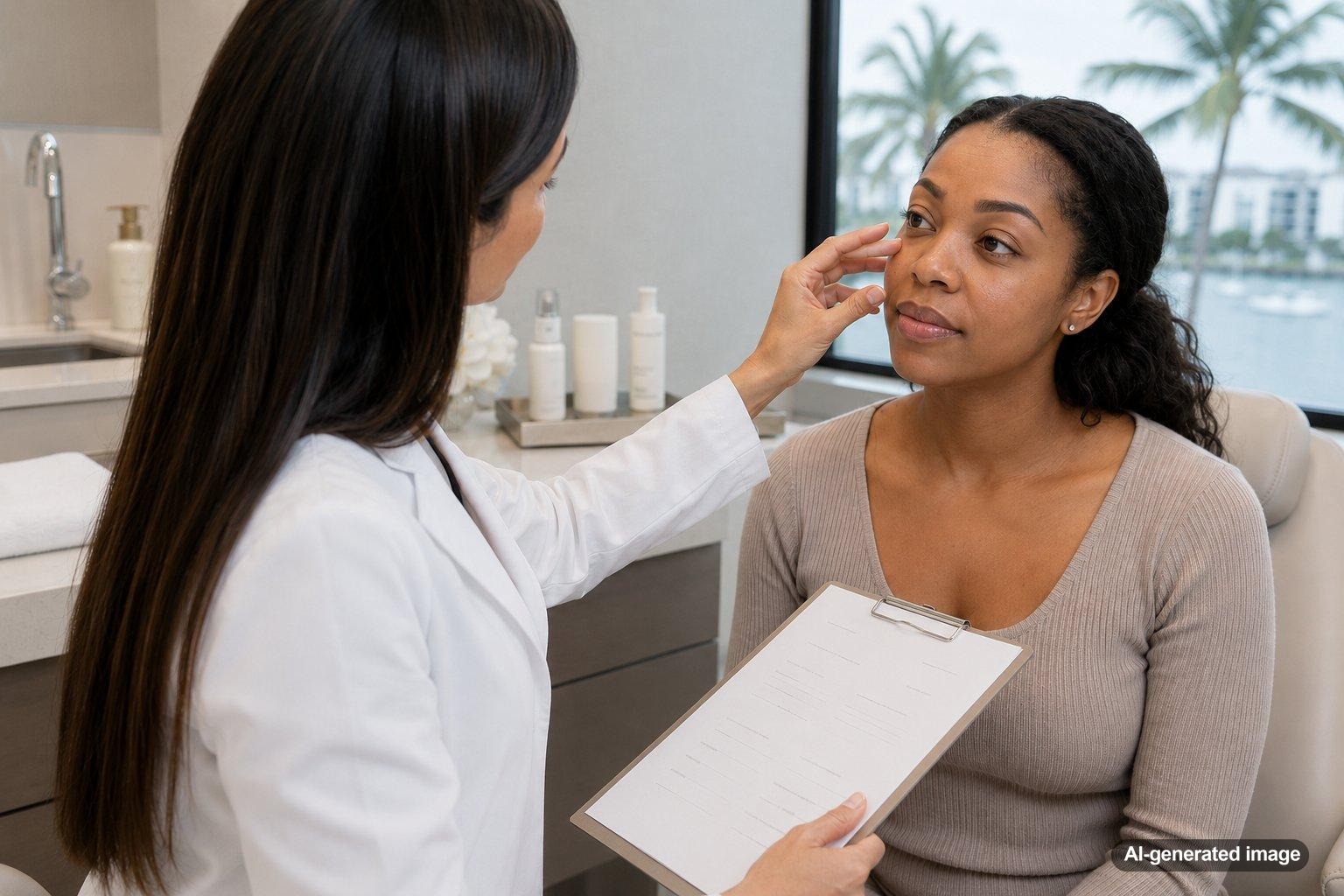
Under-eye hollows can create shadows that make the face look tired even when you feel well rested. Two regenerative approaches that may come up during a consultation are EZ Gel and platelet-rich fibrin, commonly called PRF. Both use components derived from your own blood, but they are prepared differently and are used with somewhat different goals.
For patients in South Florida, choosing between EZ Gel and PRF is less about finding a universally better option and more about matching the treatment approach to your anatomy, skin quality, degree of hollowing, and expectations. A dermatologist can evaluate the under-eye area and explain which option may be more appropriate.
Quick answer: EZ Gel vs. PRF
- EZ Gel is created from a patient’s own blood components and processed into a gel-like material that can provide a degree of structural support while also delivering platelet-derived components.
- PRF is a platelet- and fibrin-rich preparation that is typically more fluid than EZ Gel and is often used with a greater emphasis on skin quality and regenerative support.
- EZ Gel may be considered when visible hollowing or contour support is a primary concern.
- PRF may be considered when the goal is more focused on gradual improvement in skin quality, texture, or the appearance of thin under-eye skin.
- Neither approach is ideal for every type of under-eye concern, so an in-person evaluation matters.
| Comparison | EZ Gel | PRF |
|---|---|---|
| General form | Gel-like preparation | More fluid fibrin-rich preparation |
| Typical emphasis | Contour support plus regenerative components | Regenerative support and skin quality |
| Material source | Prepared from the patient’s own blood | Prepared from the patient’s own blood |
| Best fit | Depends on anatomy and degree of hollowing | Depends on skin quality and treatment goals |
How EZ Gel and PRF are similar
Both approaches begin with a blood draw. The sample is processed to concentrate selected blood components, including platelets and fibrin. Because the material comes from the patient’s own blood rather than a manufactured gel, these treatments are often discussed as autologous or regenerative options.
Both may be used in delicate facial areas where skin quality, subtle contour changes, and a natural-looking result are important considerations. They also tend to be discussed with patients who prefer an approach based on their own blood components.
The main difference is consistency and treatment goal
The most practical distinction is that EZ Gel is processed to create a thicker, gel-like consistency. That added structure may make it useful when a clinician wants to address a visible depression or hollow while still using an autologous material.
PRF generally has less immediate structural volume. Instead, it is often selected when the focus is on supporting the quality and appearance of the under-eye skin over time. The distinction is not absolute, and preparation methods and treatment plans can vary between practices.
When EZ Gel may make more sense
EZ Gel may be worth discussing when the under-eye concern is primarily a contour issue. Some people have a noticeable transition between the lower eyelid and upper cheek that creates a shadow, especially in overhead light or bright South Florida sunlight.
A thicker autologous preparation may provide more support than a fluid PRF treatment alone. However, the under-eye area is anatomically complex. Puffiness, prominent fat pads, skin laxity, pigmentation, and cheek volume can all influence whether adding volume is appropriate.
When PRF may make more sense
PRF may be considered when the main concern is thin, crepey, or tired-looking under-eye skin rather than a pronounced hollow. Because it does not behave like a traditional volumizing filler, it may be used with an emphasis on gradual changes in skin quality rather than immediate contour correction.
Some patients also have a combination of concerns. In those cases, a dermatologist may discuss staged treatment or a different approach entirely rather than relying on a single technique.
Why under-eye anatomy matters
Not every dark circle is caused by volume loss. Pigment, visible blood vessels, thin skin, fluid retention, allergies, facial structure, and shadowing can all contribute to a tired appearance. Treating a pigment concern as if it were purely a hollow may not address what is actually creating the darkness.
Likewise, adding volume to an area with significant puffiness or certain lower-eyelid anatomy may not be the preferred strategy. This is why examination of the lower eyelid, tear trough, cheek, and surrounding skin is an important part of treatment planning.
What about traditional dermal filler?
Traditional dermal fillers are another category that may be discussed for under-eye hollows. They are different from both EZ Gel and PRF because the injected material is manufactured rather than prepared from the patient’s own blood.
Each option has its own advantages, limitations, and potential risks. The appropriate choice depends on facial anatomy, the type of correction being considered, previous treatments, and the clinician’s assessment. Under-eye injections should be approached conservatively because the area contains delicate tissues and important blood vessels.
What to expect from a consultation
A thoughtful consultation should look beyond the hollow itself. Your clinician may assess lower-eyelid skin, cheek support, facial symmetry, pigmentation, puffiness, previous filler or injectable treatments, and how the area changes with facial movement and lighting.
It is also useful to discuss how much change you want. Someone seeking subtle softening may have a different treatment plan from someone with deeper structural hollowing. Your clinician can also explain expected downtime, possible swelling or bruising, the variability of results, and whether more than one session might be considered.
South Florida considerations
Living in South Florida does not fundamentally change how EZ Gel or PRF works, but lifestyle can affect treatment planning. Sun exposure, outdoor activity, travel, social events, and a desire to minimize visible downtime may influence when you schedule a procedure.
Patients who split time between Fort Lauderdale and another city should also tell their clinician about upcoming travel. Follow-up plans are easier to coordinate when your dermatologist knows when you will be in town.
Which option is better for under-eye hollows?
There is no single answer for everyone. EZ Gel may offer more contour support when hollowing is the dominant issue, while PRF may be more aligned with goals involving skin quality and gradual regenerative support. Some under-eye concerns are better addressed with another treatment altogether.
The most useful next step is an evaluation that identifies what is actually causing the shadow or hollow. That makes it possible to choose an approach based on anatomy rather than simply selecting a treatment by name.
FAQ
Is EZ Gel the same as PRF?
No. They are related because both are prepared from a patient’s own blood components, but EZ Gel undergoes additional processing to create a thicker, gel-like consistency. PRF is generally more fluid.
Does EZ Gel act like traditional filler?
EZ Gel can provide some contour support because of its gel-like consistency, but it is not the same material as a traditional manufactured dermal filler. The amount and duration of visible correction can vary.
Can PRF fill a deep tear trough?
PRF may create subtle changes, but a pronounced structural hollow may require a different strategy. A dermatologist can determine whether the concern is primarily volume loss, skin quality, pigmentation, puffiness, or a combination.
Can EZ Gel and PRF help dark circles?
They may help in selected cases when shadowing, thin skin, or hollowing contributes to the appearance. Dark circles caused mainly by pigment, vascular visibility, or another factor may respond differently.
How long do results last?
Results vary based on the preparation used, treatment area, individual biology, anatomy, and treatment plan. Your clinician can give you a more individualized expectation after examining the under-eye area.
Who should perform under-eye treatment?
Because the under-eye region is delicate and anatomically complex, it is important to be evaluated by a qualified medical professional with experience treating this area.
At Waverly DermSpa, we offer EZ Gel (Natural Filler) and can help you understand whether it may be appropriate.
Ready to get help?
Schedule an appointment or send a message and our team will get back to you.
Prefer to call? 954-666-3736
Disclaimer
This article is for educational purposes and is not medical advice. For diagnosis and personalized treatment, please book an appointment with a board-certified dermatologist.
