

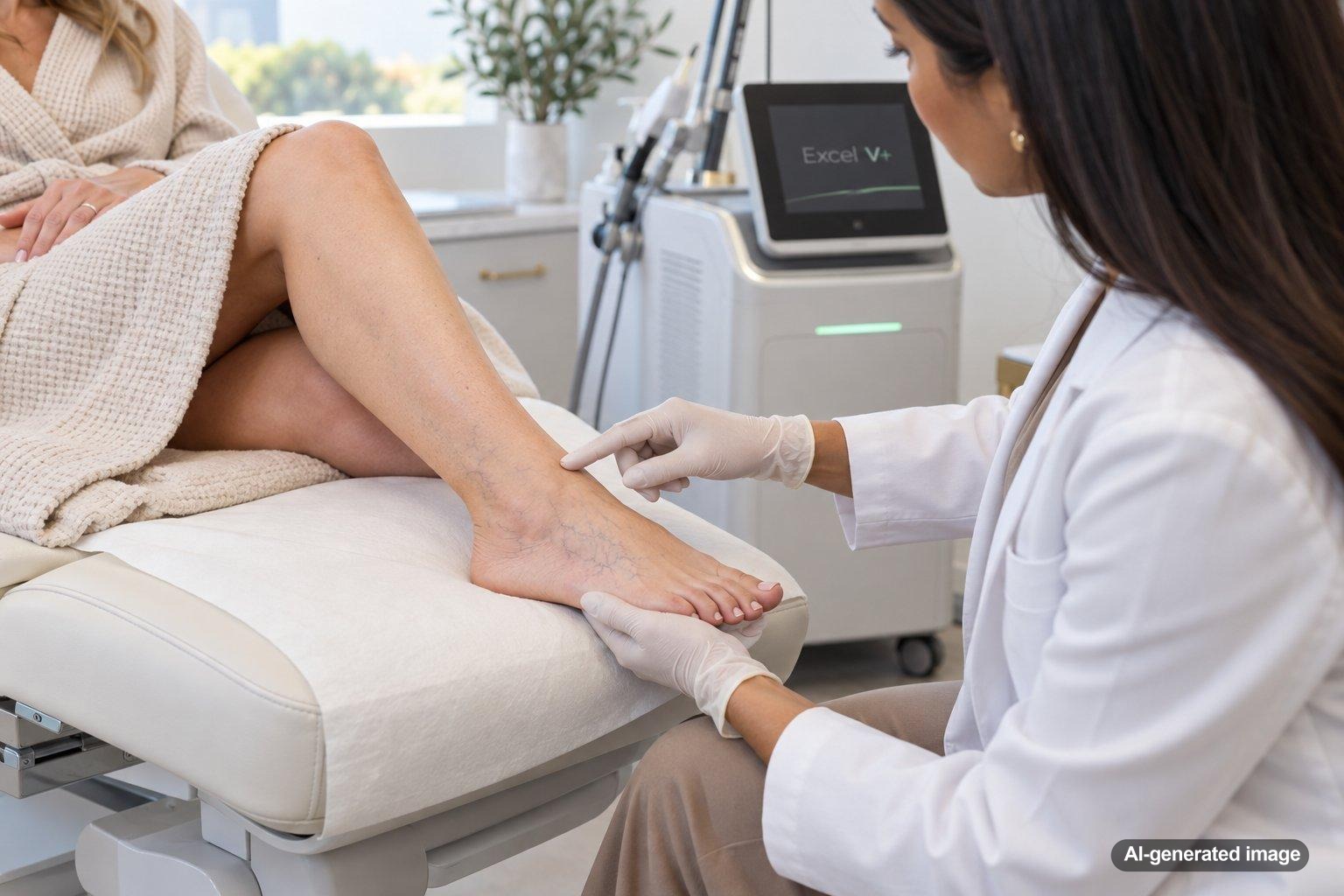
Spider veins around the ankles and across the tops of the feet can become more noticeable in sandals, open shoes, or simply when looking down at your feet. These fine red, purple, or blue vessels are often a cosmetic concern, but their location deserves thoughtful evaluation before treatment. The skin, underlying vessels, and circulation in the lower extremities differ from those of the face, and not every visible vein is an appropriate laser target.
Excel V+ is a vascular laser platform that may help reduce selected superficial blood vessels. However, treating spider veins on the ankles and dorsum of the feet, meaning the upper surface of the feet, requires particular attention to vessel size, depth, skin characteristics, and possible underlying venous disease. A dermatologist can help determine whether laser treatment is reasonable, whether another approach may be preferable, or whether a circulation assessment should come first.
Quick Answer: Can Excel V+ Treat Spider Veins on the Ankles and Feet?
- Potentially, for selected superficial vessels. Excel V+ may be considered for certain small, visible blood vessels after a clinical evaluation.
- Not every visible foot vein is a spider vein. Normal superficial veins, larger reticular veins, and vessels associated with venous insufficiency require different considerations.
- Location matters. The ankles and tops of the feet have distinctive anatomy, and treatment decisions must account for vessel characteristics and nearby structures.
- Results vary. Some vessels may fade, while others may respond incompletely or require additional treatment.
- Symptoms change the priority. Swelling, aching, skin changes, or other circulation-related symptoms should be evaluated before cosmetic treatment.
What Are Spider Veins on the Ankles and Dorsum of the Feet?
Spider veins, also called telangiectasias, are small blood vessels that become visible near the skin’s surface. They may appear as individual fine lines, branching networks, or clusters of red, violet, and blue vessels.
On the ankles, they may form around the inner or outer ankle bones or extend toward the lower leg. On the dorsum of the foot, they may appear between larger visible veins or form delicate networks beneath the skin.
It is important to distinguish these small vessels from normal dorsal foot veins. Healthy superficial veins can be visible through thin skin, particularly when the feet are warm or positioned below heart level. Their visibility alone does not mean they are damaged or need treatment.
Larger bluish vessels beneath the surface may be reticular veins rather than true spider veins. In some patients, these vessels contribute to networks of smaller visible veins. Treating only the superficial branches may not address the underlying source.
Why Do Spider Veins Develop Around the Ankles and Feet?
Several factors can contribute to visible blood vessels in the lower extremities. The appearance of spider veins does not establish a specific diagnosis, and more than one factor may be involved.
- Family history: A tendency toward visible leg veins can run in families.
- Age-related changes: Changes in vessel structure and surrounding skin may make superficial blood vessels more apparent over time.
- Hormonal influences: Hormonal changes, including those associated with pregnancy, may contribute to spider vein development.
- Prolonged standing or sitting: Extended periods in one position can increase pressure within the lower-extremity venous system.
- Venous circulation problems: Some ankle spider veins may occur alongside venous reflux or chronic venous insufficiency.
- Local skin characteristics: Thin skin and limited soft-tissue coverage can make otherwise ordinary vessels easier to see.
Spider veins are often harmless, but clusters near the ankles deserve closer attention when accompanied by swelling, heaviness, persistent discoloration, or skin irritation. Cosmetic appearance and vascular health are related considerations, but they are not interchangeable.
How Excel V+ Works on Superficial Blood Vessels
Excel V+ is a vascular laser system that uses selected wavelengths of light to target blood-containing structures. Its platform includes a 532 nm wavelength and a 1064 nm Nd:YAG wavelength, allowing a clinician to consider different approaches based on the characteristics of a vascular concern.
During vascular laser treatment, light energy is absorbed by components of blood, producing controlled heating within a selected vessel. The goal is to damage the targeted vessel so that it can gradually become less visible as the body processes the treated tissue.
The choice of wavelength, energy settings, pulse duration, spot size, and cooling approach depends on several factors. These include the vessel’s diameter, color, depth, location, surrounding skin pigmentation, and the patient’s medical history.
A laser’s ability to target blood vessels does not mean every vein on the foot or ankle can be treated appropriately. Larger, deeper, or functionally important vessels may not be suitable for superficial cosmetic laser treatment. Evidence for laser treatment of leg vessels also should not be interpreted as a promise of equivalent outcomes on the ankles or dorsal feet.
Why the Ankles and Tops of the Feet Need Special Consideration
Vascular laser treatment is not identical across different areas of the body. The lower legs, ankles, and feet can present challenges that affect treatment selection and recovery.
Thin Skin and Limited Tissue Coverage
The skin over portions of the dorsal feet and around the ankle bones may have relatively little underlying soft tissue. This can make vessels more visible, but it also requires careful treatment planning to minimize unnecessary thermal injury to surrounding tissue.
Different Vessel Sizes and Depths
A network that looks like spider veins may contain vessels of different diameters and depths. A small red surface vessel is not necessarily comparable to a larger blue vein crossing the top of the foot.
Some visible veins play a normal role in venous drainage and should not automatically be treated simply because they are prominent.
Underlying Venous Pressure
Visible ankle vessels may sometimes coexist with impaired venous return. When pressure from deeper or connecting veins contributes to the problem, surface laser treatment alone may not address the cause.
Footwear and Daily Activity
Shoes, socks, walking, and prolonged standing can create friction or pressure around recently treated skin. A clinician may recommend temporary adjustments based on the treatment location and the skin’s response.
Who Might Be Considered for Excel V+?
A person with a small number of fine, superficial spider veins and no concerning circulation symptoms may be considered for vascular laser treatment after an appropriate examination. Suitability cannot be determined from the appearance of the veins alone.
A dermatologist may assess:
- Whether the visible vessels are true spider veins, reticular veins, or normal superficial veins.
- The color, diameter, depth, and distribution of the vessels.
- Skin tone, recent tanning, and the potential for pigment changes.
- History of swelling, leg discomfort, blood clots, or venous disease.
- Prior treatments and whether the visible vessels returned.
- Current medications, medical conditions, and factors that may affect healing.
- Whether additional vascular evaluation is appropriate before proceeding.
A person with larger veins, significant symptoms, or suspected venous insufficiency may benefit more from a vascular assessment than from an immediate cosmetic laser session.
Excel V+ Versus Sclerotherapy for Ankle and Foot Spider Veins
Laser treatment and sclerotherapy are two established approaches to selected superficial leg vessels, but they are not interchangeable for every vessel or anatomical location.
Vascular laser treatment applies light energy through the skin without injecting the target vessel. It may be considered for small superficial vessels when their characteristics and location make laser treatment appropriate.
Sclerotherapy involves injecting a solution into selected veins to cause them to close. It is commonly used for spider veins and certain small varicose veins of the legs, although the precise location and vascular anatomy influence whether it is appropriate.
For veins near the ankles and feet, neither method should be selected solely for convenience. Both require individualized assessment, and the foot and ankle region warrants particular caution because of vascular anatomy and potential tissue complications.
If a deeper venous problem is contributing to the visible vessels, a clinician may recommend evaluation or treatment of that problem before addressing cosmetic concerns.
What Happens During a Vascular Laser Consultation and Treatment?
The first step is an assessment of the visible vessels and the surrounding skin. Your dermatologist may ask when the veins appeared, whether they have changed, and whether you experience swelling, heaviness, discomfort, or other leg symptoms.
If laser treatment is considered appropriate, the clinician will explain the intended target, anticipated limitations, potential risks, and alternatives. Photographs may be used to document the appearance before treatment.
During a session, protective eyewear is used and the laser delivers controlled pulses of energy to selected vessels. Patients may feel brief sensations of heat or snapping against the skin. Cooling methods may be used to improve comfort and protect the surface.
Session length depends on the size and distribution of the treatment area. Some patients may need more than one session, while others may be advised that a different treatment is more suitable.
Temporary redness, swelling, vessel darkening, or localized discomfort may occur afterward. Less common complications can include blistering, burns, changes in pigmentation, scarring, or prolonged skin irritation. The risk profile depends on the treatment parameters, skin characteristics, and anatomical site.
Because the ankles and feet are exposed to regular movement, pressure, and footwear, aftercare should be tailored to the treated area rather than borrowed from a facial laser protocol.
What Can You Do at Home for Visible Ankle and Foot Veins?
Home care cannot reliably erase established spider veins, but practical habits may support comfort and lower-extremity circulation.
- Move regularly: Break up prolonged periods of sitting or standing with comfortable movement.
- Stay active: Walking and other appropriate physical activity support the muscle action involved in returning blood from the legs.
- Elevate your legs when comfortable: Periodic elevation may help with temporary feelings of heaviness or mild dependent swelling.
- Choose comfortable footwear: Avoid unnecessary rubbing or pressure over sensitive ankle and foot skin.
- Protect exposed skin: Use sensible sun protection on the tops of the feet, especially when wearing sandals.
- Ask about compression: Medical compression may be appropriate for some circulation concerns, but garment type and pressure should be selected with professional guidance, particularly when arterial circulation problems are possible.
Topical creams, massage devices, and cosmetic skin care products should not be expected to close established spider veins. Avoid attempting to puncture, inject, burn, or otherwise remove visible vessels at home.
When to See a Dermatologist or Seek Vascular Evaluation
Consider a dermatology evaluation when visible ankle or foot vessels are changing, spreading, becoming cosmetically bothersome, or appearing alongside persistent skin changes.
Additional medical assessment is particularly important when you notice:
- Recurring ankle or foot swelling, especially when accompanied by heaviness or aching.
- Brown discoloration, persistent redness, eczema-like changes, or thickening around the ankles.
- Skin breakdown, sores, or wounds that heal poorly.
- Enlarged, bulging, tender, or increasingly prominent veins.
- A previous history of venous thrombosis or diagnosed circulation problems.
New swelling in one leg, particularly with pain, warmth, or redness, warrants prompt medical evaluation. Sudden shortness of breath, chest pain, or coughing blood requires emergency medical attention because these symptoms can indicate a serious condition.
When venous insufficiency is suspected, a clinician may recommend a duplex ultrasound or referral to an appropriate vascular specialist. This helps distinguish cosmetic surface vessels from problems involving the deeper venous system.
Frequently Asked Questions
Can Excel V+ remove spider veins on the top of my feet?
Excel V+ may help reduce selected superficial vessels, but not all visible veins on the dorsal feet are suitable targets. A dermatologist must assess the vessel type, location, depth, and surrounding skin before recommending treatment. Complete clearance should not be assumed.
Is laser treatment better than sclerotherapy for ankle spider veins?
Neither approach is universally preferable. Laser treatment may be useful for certain superficial vessels, while sclerotherapy is commonly used for appropriate leg spider veins. The specific ankle or foot anatomy, associated symptoms, and underlying circulation determine which approach, if any, should be considered.
Are visible blue veins across the top of the feet normal?
They can be. Normal superficial veins may be particularly visible on the feet because the skin can be thin and the veins lie close to the surface. A clinician can help distinguish normal veins from spider veins, reticular veins, or vessels associated with a medical concern.
How many Excel V+ sessions are needed for spider veins?
The number of sessions varies with vessel characteristics, treatment response, and the area involved. Some vessels may improve after limited treatment, while others may require additional sessions or may not be appropriate laser targets. A personalized estimate can only follow an examination.
Can ankle spider veins come back after laser treatment?
Previously treated vessels may respond incompletely, and new spider veins can develop over time. If ongoing venous pressure contributes to their appearance, treating superficial vessels alone may not prevent new ones from forming.
Can I wear shoes and walk after treatment?
Activity and footwear recommendations depend on the treatment location and the skin’s response. Many people can resume routine activities relatively quickly after superficial vascular laser treatment, but ankle and foot treatments may require specific instructions about friction, pressure, exercise, and skin protection.
Making an Informed Treatment Decision
Spider veins on the ankles and tops of the feet can be visually subtle yet challenging to evaluate. The most useful first step is identifying exactly which vessels are visible and determining whether they represent a cosmetic concern, a normal anatomical feature, or a possible sign of underlying venous disease.
At Waverly DermSpa, we offer Excel V+ and can help you understand whether it may be appropriate.
For patients in Fort Lauderdale, including seasonal residents and visitors, planning around travel, outdoor activity, and regular footwear can also be part of a thoughtful treatment discussion. The goal is an individualized decision based on clinical findings, realistic expectations, and the health of the surrounding skin and circulation.
Ready to get help?
Schedule an appointment or send a message and our team will get back to you.
Prefer to call? 954-666-3736
This article is for educational purposes and is not medical advice. For diagnosis and personalized treatment, please book an appointment with a board-certified dermatologist.
Sources & Further Reading
- American Academy of Dermatology (AAD) – Leg veins: Why they appear and how dermatologists treat them
- Cleveland Clinic – Spider Veins: Causes, Symptoms & Treatment
- American Academy of Dermatology (AAD) – Skin conditions that lasers can treat
- DermNet – Lasers in dermatology
