

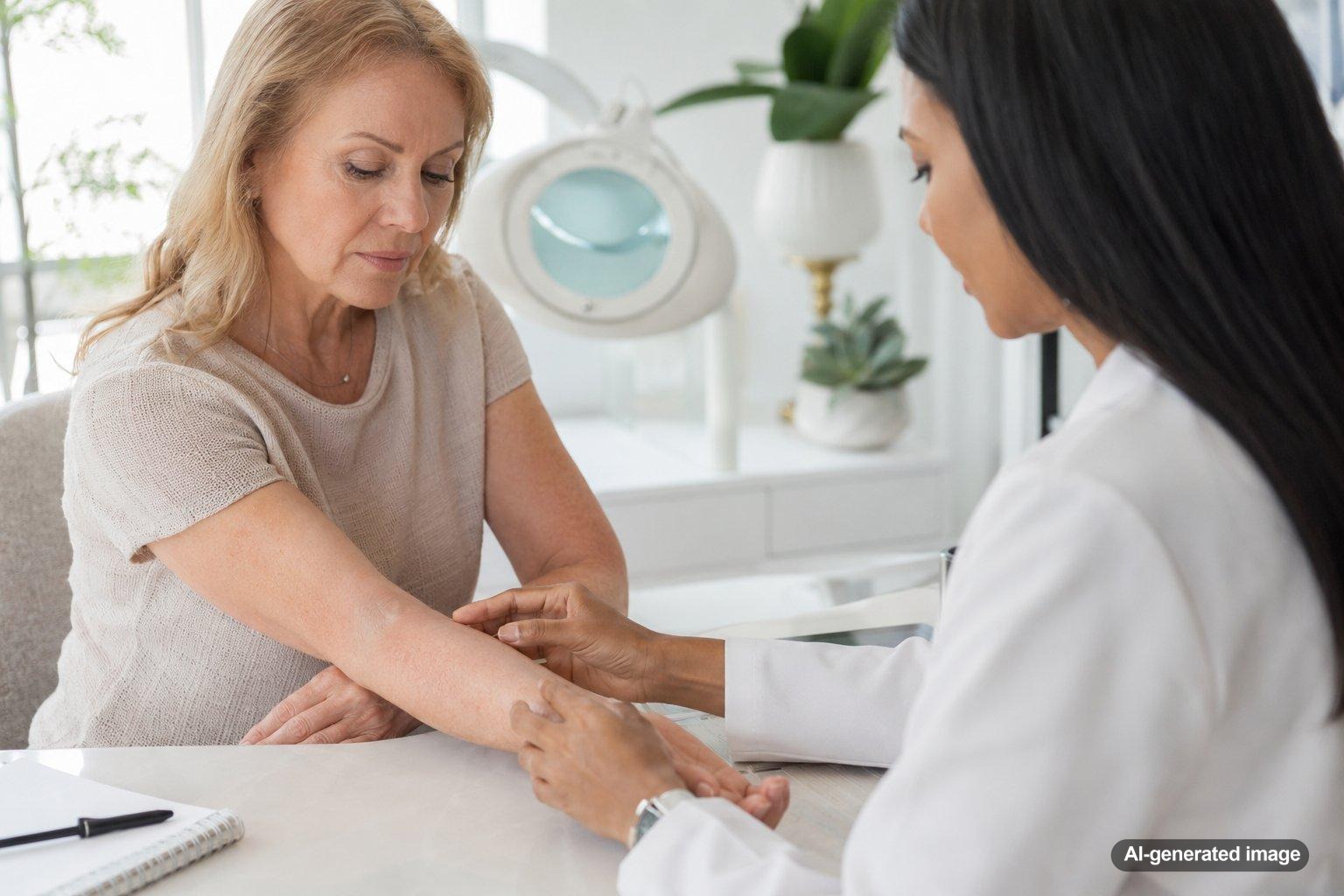
When a rash is dry, itchy, scaly, or inflamed, it can be difficult to tell whether it looks more like eczema or psoriasis. Both conditions can flare, quiet down, and look different depending on skin tone, body area, age, and whether the skin has been scratched or treated. The visual clues below can help you describe what you are seeing more clearly, but they cannot replace an exam.
In general, eczema often looks softer, less sharply bordered, and very itchy, while plaque psoriasis often forms thicker, more defined patches with visible scale. Because overlap is common, a dermatologist can evaluate the pattern, location, symptoms, and history before recommending care.
Quick answer
- Eczema often appears as dry, irritated, itchy patches that may look red, brown, gray, purple, or darker than nearby skin.
- Psoriasis often forms thicker, raised plaques with more defined edges and a noticeable scale.
- Eczema is common in skin folds, hands, neck, eyelids, and areas exposed to triggers.
- Psoriasis commonly affects elbows, knees, scalp, lower back, nails, and other high-friction areas.
- Both can look different on deeper skin tones and both deserve professional evaluation when persistent, painful, spreading, or unclear.
| Visual clue | More typical of eczema | More typical of psoriasis |
|---|---|---|
| Edges | Less defined or blended into nearby skin | Sharper, more clearly outlined plaques |
| Scale | Dry, rough, flaky, or cracked texture | Thicker scale that may look silver, white, gray, or ashy |
| Common sensation | Intense itch is common | Itch, tenderness, burning, or stinging can occur |
1. Edges: eczema often blends, psoriasis often looks more defined
Eczema can look patchy, uneven, and less clearly outlined. The edges may seem to fade into surrounding skin, especially after scratching or when the rash is on delicate areas such as the eyelids, neck, or skin folds. Psoriasis, especially plaque psoriasis, often has more distinct borders. The plaques may look like separate islands of inflamed, thickened skin rather than a rash that gradually blends outward.
This clue is helpful, but not absolute. Longstanding eczema can become thickened, and irritated psoriasis can look less classic. If a rash is not improving or the pattern is changing, an in-person skin exam is the safest next step.
2. Thickness: eczema can look raw or rough, psoriasis often looks built up
Eczema may appear dry, rough, cracked, bumpy, or weepy if the skin barrier is very irritated. It may look more delicate or raw than built up. Psoriasis plaques are often thicker and more raised, with a surface that can feel firm or layered. The skin may look as if scale is sitting on top of the plaque.
On deeper skin tones, inflammation may appear brown, violet, gray, or darker than the surrounding skin, so relying only on redness can be misleading. Texture, thickness, location, and symptoms often tell a more complete story.
3. Scale: eczema tends to flake, psoriasis tends to form heavier scale
Eczema-related dryness may create fine flaking, cracking, or rough patches. Psoriasis is more often associated with thicker scale that may appear silver-white, gray, ashy, or layered depending on skin tone and body area. Scalp psoriasis, for example, may look like stubborn dandruff or thicker plaques that extend beyond the hairline.
Avoid picking or aggressively scrubbing scale. That can irritate the skin, worsen discomfort, and make the pattern harder to evaluate. Gentle cleansing, fragrance-free moisturizing, and sun protection when appropriate are safer first steps while you arrange care.
4. Location: eczema favors folds and trigger zones, psoriasis favors plaques on extensor areas
Eczema commonly appears in areas where the skin is sensitive, exposed to irritants, or prone to friction, including the hands, eyelids, neck, inside elbows, behind knees, and skin folds. Psoriasis commonly appears on elbows, knees, scalp, lower back, around the belly button, and sometimes the nails. Nail pitting, lifting, thickening, or color change can be an important clue for psoriasis, although other nail conditions can look similar.
Location can also be affected by climate, travel, swimwear, sunscreen, sweating, and seasonal routines. In South Florida, heat, humidity, sun exposure, and frequent travel can all complicate sensitive or inflamed skin.
5. Pattern over time: eczema may follow triggers, psoriasis may persist in repeat sites
Eczema often flares after contact with irritants, allergens, fragrance, harsh soaps, sweating, stress, or changes in weather. Psoriasis can also flare with stress, illness, skin injury, certain medications, or other factors, but plaques often return to familiar sites. Many people notice that psoriasis feels more persistent in the same areas, while eczema may move with exposure patterns.
Keep a simple note of when the rash appears, where it appears, what products touched the skin, and whether there is itch, pain, bleeding, oozing, or nail involvement. Those details can help your dermatologist narrow the possibilities without guessing.
What you can do while you are unsure
- Use a gentle, fragrance-free cleanser and avoid scrubbing the area.
- Apply a bland, fragrance-free moisturizer to support the skin barrier.
- Avoid trying multiple new products at once, which can make triggers harder to identify.
- Do not pick scale or scratch irritated skin if you can avoid it.
- Take clear photos in consistent lighting so your clinician can see how the rash changes.
When to see a dermatologist
Book an evaluation if the rash is spreading, painful, bleeding, oozing, crusting, affecting sleep, involving the face or genitals, changing the nails, or not improving with gentle care. You should also be checked promptly if you have signs of possible infection, a rapidly worsening rash, or a rash that appears after starting a new medication.
A dermatologist can evaluate whether the pattern is more consistent with eczema, psoriasis, another type of dermatitis, an infection, or a different skin condition. Common options may include prescription topicals, itch control strategies, trigger guidance, light-based treatment in selected cases, or other therapies based on the diagnosis and severity.
FAQ
Can eczema and psoriasis look alike?
Yes. There can be overlap, and some rashes do not look textbook. A dermatologist may use the appearance, location, symptoms, history, and sometimes testing to help clarify the diagnosis.
Is itching more common with eczema or psoriasis?
Intense itch is very common with eczema. Psoriasis can also itch, but some people describe tenderness, burning, stinging, or soreness along with scale and plaques.
Can skin tone change how these conditions look?
Yes. Inflammation may look red, brown, purple, gray, or darker than surrounding skin. This is one reason texture, scale, borders, and location matter as much as color.
Should I use over-the-counter creams before my appointment?
Gentle moisturizer and fragrance-free cleansing are reasonable for many irritated rashes, but avoid layering several active products or using strong treatments without guidance. If symptoms are severe or worsening, schedule an appointment.
Can a dermatologist tell the difference during a visit?
Often, yes, but not always from appearance alone. Your dermatologist can evaluate the full picture and recommend next steps that fit your skin, symptoms, and medical history.
Ready to get help?
Schedule an appointment or send a message and our team will get back to you.
Prefer to call? 954-666-3736
Disclaimer
This article is for educational purposes and is not medical advice. For diagnosis and personalized treatment, please book an appointment with a board-certified dermatologist.
Sources & further reading
- American Academy of Dermatology (AAD) – What’s the difference between eczema and psoriasis?
- National Institute of Arthritis and Musculoskeletal and Skin Diseases (NIAMS) – Atopic Dermatitis-Eczema Symptoms & Causes
- National Psoriasis Foundation – Psoriasis: Symptoms, Causes, Images & Treatment
