

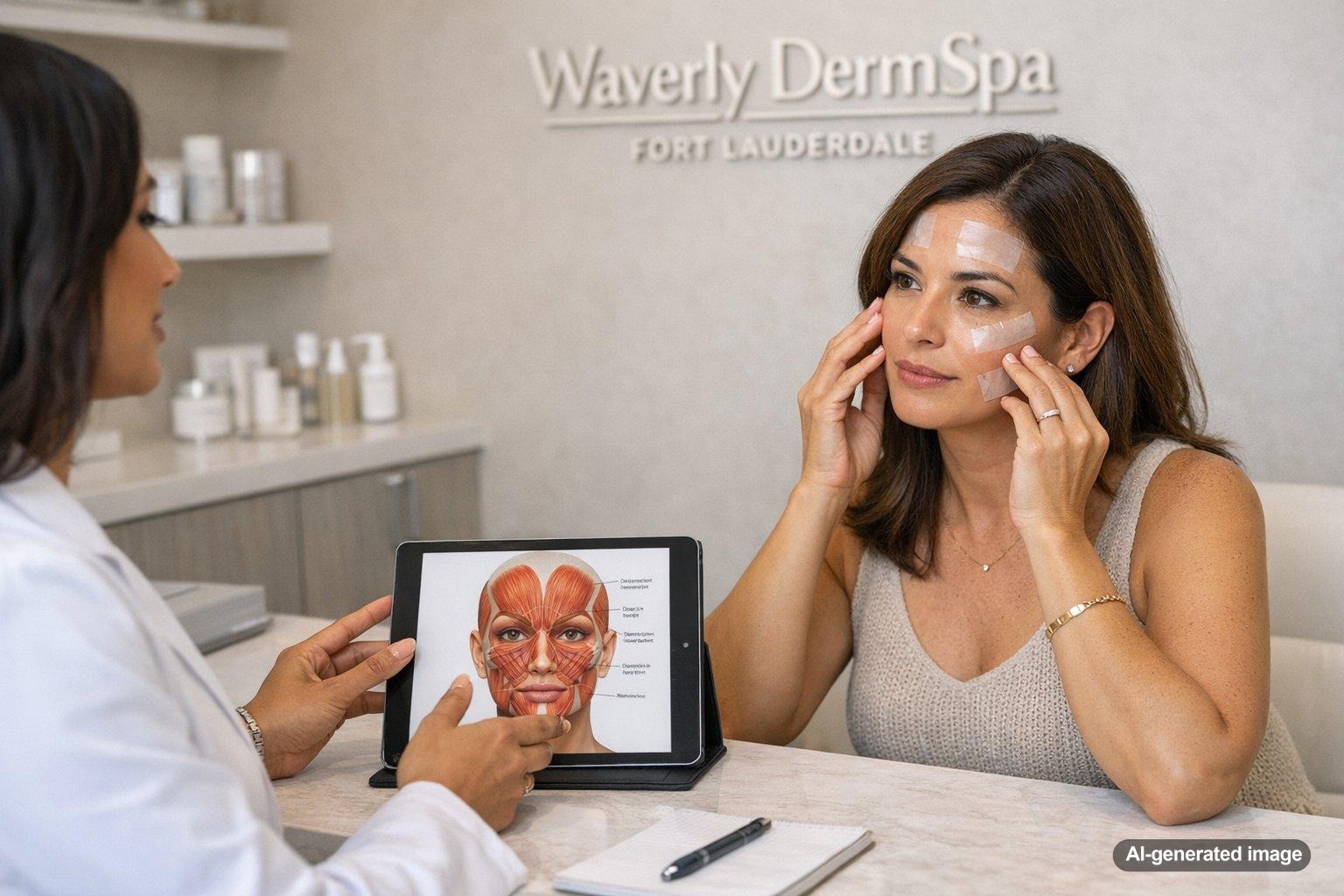
Face taping has become popular because it feels simple: place tape on areas that crease, sleep or relax with it on, and hope the skin learns to stay smoother. The honest answer is more measured. Face taping may temporarily limit facial movement or reduce the look of a crease while the tape is on, but it does not change the underlying muscle activity in the same way neuromodulator injections do.
So, does face taping actually prevent wrinkles? For most people, it is better thought of as a short-term habit cue rather than a true wrinkle-prevention treatment. It may remind you not to furrow your brow or sleep with pressure on one side of the face, but it is not the same as Botox, Dysport, skincare, sun protection, or an individualized treatment plan.
Quick answer
- Face taping may temporarily smooth or hold the skin in place, but it does not relax muscles the way injectable neuromodulators do.
- It may be irritating for sensitive skin, especially if adhesive is used too often or removed aggressively.
- Wrinkles are influenced by repeated expression, sun exposure, skin quality, genetics, sleep position, and natural collagen changes over time.
- For expression lines, professional options may include neuromodulators such as Botox or Dysport after a clinician evaluates whether they are appropriate.
- A balanced plan usually focuses on daily sun protection, gentle skincare, and realistic expectations rather than quick fixes.
What face taping is trying to do
Face taping is the practice of placing adhesive tape on the forehead, between the brows, around the mouth, or other areas where expression lines form. The idea is that the tape physically restricts movement or reminds you not to make certain facial expressions. Some people also use it at night to discourage skin folding from sleep position.
That is why the phrase “internal Botox” can be misleading. Botox and similar neuromodulators are prescription treatments injected into specific muscles to temporarily reduce targeted muscle movement. Face tape sits on the surface of the skin. It may create a cue, but it does not have the same mechanism.
Face taping vs Botox: what is the real difference?
| Feature | Face taping | Neuromodulators such as Botox or Dysport |
|---|---|---|
| How it works | Physically holds skin or limits movement while tape is in place. | Temporarily relaxes targeted muscle activity after injection by a trained clinician. |
| Depth of action | Surface level. | Targets specific facial muscles beneath the skin. |
| Main limitation | Does not meaningfully change muscle movement once removed. | Requires evaluation, careful technique, and an individualized treatment plan. |
| Skin considerations | Adhesive may irritate, dry, or pull sensitive skin. | A medical procedure with possible risks that should be discussed with a qualified clinician. |
Why wrinkles form in the first place
Wrinkles are not caused by one habit alone. Some lines are dynamic, meaning they appear with movement such as smiling, squinting, or frowning. Over time, repeated movement can contribute to lines that remain visible at rest. Skin quality also matters, including collagen, elasticity, hydration, pigmentation, and the cumulative effects of sun exposure.
- Repeated facial expression, especially squinting or brow furrowing
- Sun exposure and inconsistent sunscreen use
- Natural collagen and elasticity changes over time
- Dryness, barrier irritation, or harsh skincare habits
- Sleep position and repeated skin compression
- Genetics and facial anatomy
What you can do at home
If you enjoy face taping and your skin tolerates it, it may be reasonable to treat it as a gentle reminder rather than a treatment. Avoid applying tape over irritated, broken, freshly treated, or very sensitive skin. Remove adhesive slowly, and stop if you notice redness, itching, burning, peeling, or skin pulling.
For a more reliable skin-supportive routine, focus on the basics: daily broad-spectrum sunscreen, a gentle cleanser, moisturizer, and consistent use of products your skin tolerates. Retinoids, antioxidants, and barrier-supportive ingredients may be discussed with your dermatologist or skincare professional, especially if you are pregnant, nursing, sensitive, or using prescription products.
Professional options
For expression lines, common professional options include neuromodulators such as Botox or Dysport. For lines related to volume change, texture, sun damage, or skin quality, a clinician may discuss other categories such as fillers, laser resurfacing, microneedling, chemical peels, or medical-grade skincare. The right option depends on your skin, facial movement, goals, history, and comfort level.
At Waverly DermSpa, we offer Botox and can help you understand whether it may be appropriate.
When to see a dermatologist
Consider seeing a board-certified dermatologist if you are unsure what type of lines you are seeing, if your skin becomes irritated from tape or adhesive, or if you want a conservative plan that fits your skin type and goals. It is also worth getting checked if a spot, mole, rash, or skin change concerns you, because not every visible change is cosmetic.
FAQ
Can face taping train my face not to wrinkle?
It may help some people become more aware of repeated expressions, but it does not truly retrain facial muscles in the same way a prescription neuromodulator temporarily reduces targeted movement.
Is face taping bad for your skin?
It depends on your skin and the adhesive. Some people tolerate occasional use, while others may notice irritation, dryness, clogged pores, or skin pulling. Sensitive skin and active rashes are good reasons to avoid it.
Can I use face tape instead of Botox?
Face tape and Botox are not interchangeable. Tape works on the surface while it is in place. Botox is a medical treatment that acts on targeted muscles and should be performed only after an appropriate evaluation.
What is better for preventing wrinkles?
There is no single answer for everyone. Daily sun protection, gentle skincare, healthy expectations, and clinician-guided options are usually more meaningful than relying on one trend.
Should I bring up face taping at my appointment?
Yes. If you are using tape, adhesive patches, at-home devices, or strong skincare actives, telling your clinician can help them understand your routine and reduce the risk of irritation.
Ready to get help?
Schedule an appointment or send a message and our team will get back to you.
Prefer to call? 954-666-3736
Disclaimer
This article is for educational purposes and is not medical advice. For diagnosis and personalized treatment, please book an appointment with a board-certified dermatologist.
Sources & further reading
- American Academy of Dermatology (AAD) – Botulinum toxin therapy: Overview
- American Academy of Dermatology (AAD) – Botulinum toxin therapy: Preparation
- U.S. Food and Drug Administration (FDA) – BOTOX Cosmetic Prescribing Information
- Cleveland Clinic – Botox (Botulinum Toxin): What it is, Results & Side Effects
