

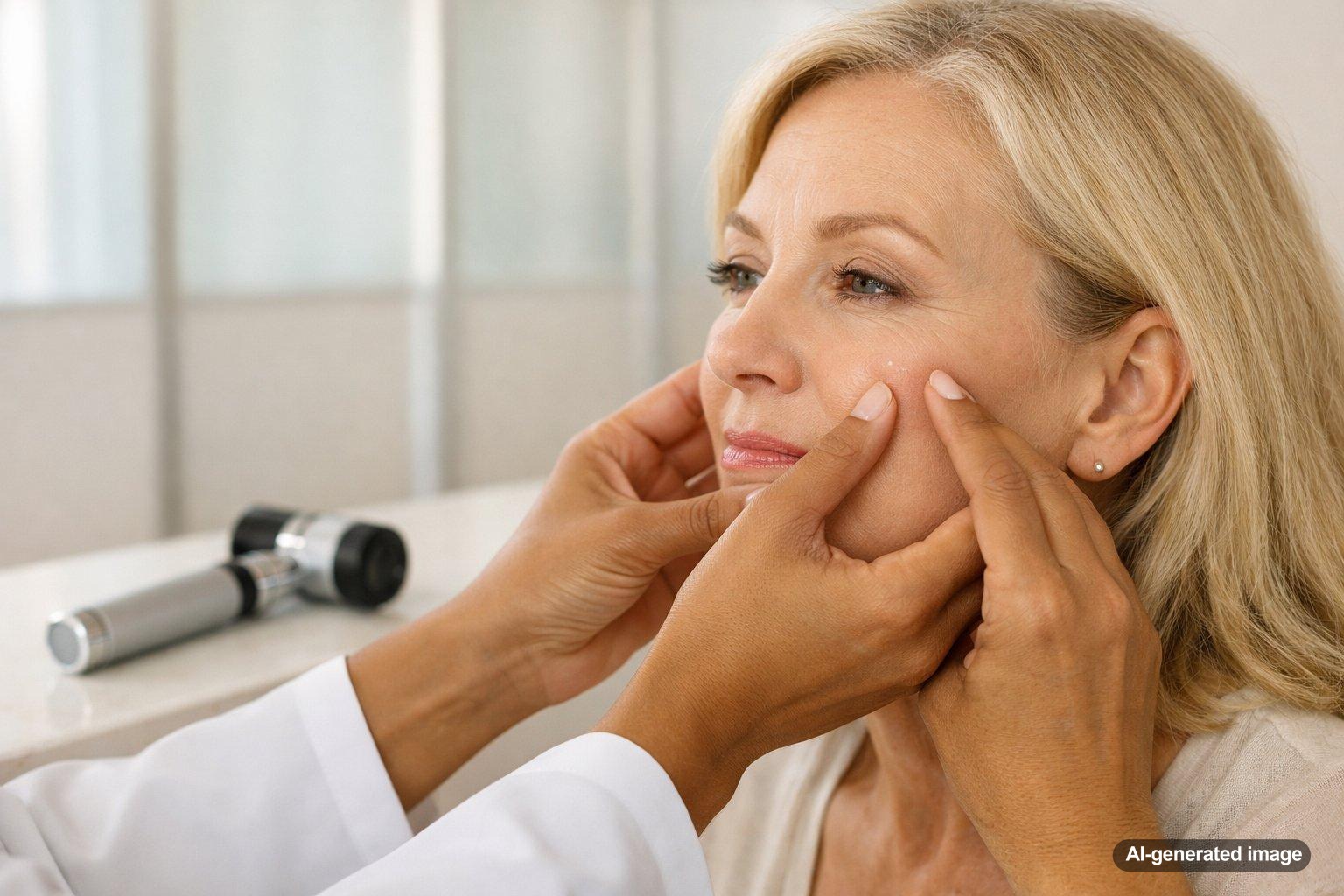
Yes, skin cancer can sometimes look like a pimple, especially in its early stages. A small bump, shiny spot, sore, or scab that seems harmless at first can occasionally be something more than acne, particularly when it does not heal or keeps returning in the same place.
Most pimples improve over time, change as they drain or flatten, and are often related to clogged pores or inflammation. A skin cancer spot may linger, bleed, crust, grow, or look different from the surrounding skin. The safest answer is simple: if a bump behaves unlike your usual acne, a board-certified dermatologist can evaluate it.
Quick answer
- Some skin cancers, especially basal cell carcinoma, can appear as a small pink, skin-colored, brown, glossy, or pearly bump.
- A pimple usually improves within a relatively short period, while a concerning spot may persist, bleed, crust, or reopen.
- A sore that does not heal, a new growth, or a bump that keeps returning in the same location is worth checking.
- Do not squeeze, pick, or repeatedly treat a suspicious spot as acne if it is not behaving like your usual breakouts.
- A dermatologist may recommend a skin exam and, when appropriate, a biopsy to understand what the spot is.
What it may look like
A skin cancer spot that resembles a pimple may appear as a small bump, a shiny or pearly area, a pink or red growth, a brown or glossy bump on deeper skin tones, a sore that crusts over, or a spot that seems to heal and then opens again. Basal cell carcinoma, one of the most common skin cancers, often develops on sun-exposed areas such as the face, scalp, neck, ears, chest, shoulders, and arms.
Squamous cell carcinoma may look more like a rough, scaly patch, firm bump, wart-like growth, or sore. Melanoma does not always look like a classic dark mole. It can appear as a changing spot, an unusual new mark, or a lesion that stands out from the rest of your skin.
Why it can be confused with acne
Acne and early skin cancer can both create raised bumps, redness, tenderness, crusting, or irritation. The difference is often in the behavior over time. A pimple usually follows a familiar pattern: it may swell, come to a head, drain, shrink, and fade. A suspicious lesion may stay in place, slowly enlarge, bleed with minimal friction, or repeatedly form a scab.
- Location matters: a new bump on the nose, eyelid, lip, ear, scalp, or another sun-exposed area deserves attention if it lingers.
- Timing matters: a spot that does not follow your usual acne pattern should not be ignored.
- Texture matters: pearly, waxy, shiny, scaly, firm, or ulcerated areas can be associated with skin cancers.
- Change matters: growth, bleeding, color change, or a border that becomes irregular should prompt a skin check.
What you can do at home
At home, avoid picking or squeezing a spot that keeps returning or will not heal. Repeated irritation can make it harder to tell what is happening and may delay proper evaluation. Take a clear photo in good lighting, note the date, and watch for changes in size, color, texture, bleeding, crusting, or tenderness.
It is also helpful to protect the area from sun exposure with shade, hats, protective clothing, and broad-spectrum sunscreen. Sun protection does not replace a dermatology exam, but it supports overall skin health and helps reduce additional UV damage.
Professional options
A dermatologist can examine the spot closely, often with a specialized lighted tool called a dermatoscope. If the lesion looks suspicious, your clinician may recommend a biopsy, which means taking a small sample of the skin so it can be reviewed under a microscope. If skin cancer is found, treatment depends on the type, location, size, depth, and your overall health history.
Common professional options may include monitoring, biopsy, surgical removal, topical prescription treatment for select superficial lesions, or other dermatology-directed procedures. Your dermatologist can explain what is appropriate for your specific situation.
When to see a dermatologist
Schedule a dermatology appointment if you notice a bump, sore, or pimple-like spot that does not heal, bleeds easily, crusts repeatedly, grows, changes color, hurts, itches, or looks different from your other spots. It is especially important to be checked if the area is on the face, ears, scalp, neck, chest, shoulders, or hands, or if you have a history of significant sun exposure, tanning bed use, or prior skin cancer.
If you are unsure, it is worth getting checked. A skin exam can provide clarity, and earlier evaluation may allow for simpler care when treatment is needed.
FAQ
How long should I wait before getting a pimple-like spot checked?
If a bump does not behave like your usual acne, does not improve, keeps bleeding or crusting, or returns in the same place, schedule a dermatologist visit. There is no single timeline that applies to everyone, so changes and persistence matter more than the calendar alone.
Can basal cell carcinoma look like a whitehead?
It can sometimes look like a small bump or sore, which is why people may mistake it for a pimple. Unlike a typical whitehead, it may not drain and resolve normally, and it may look shiny, pearly, pink, skin-colored, brown, glossy, or scabbed.
Can skin cancer bleed like a picked pimple?
Yes, some skin cancers may bleed, especially after shaving, washing, or minor friction. A spot that bleeds easily or repeatedly should be evaluated rather than repeatedly covered or treated as acne.
Should I use acne products on a suspicious bump?
Gentle skincare is reasonable for typical acne-prone skin, but do not keep treating a persistent or changing lesion as acne without an exam. Strong exfoliants, picking, and repeated spot treatments can irritate the area and may make it harder to assess.
What happens during a skin cancer screening?
A dermatologist examines your skin and may focus closely on any spots that are new, changing, bleeding, or not healing. If a lesion appears suspicious, your dermatologist may discuss whether a biopsy is appropriate.
Ready to get help?
Schedule an appointment or send a message and our team will get back to you.
Prefer to call? 954-666-3736
Disclaimer
This article is for educational purposes and is not medical advice. For diagnosis and personalized treatment, please book an appointment with a board-certified dermatologist.
Sources & further reading
- American Academy of Dermatology (AAD) – Basal cell carcinoma: From symptoms to treatments
- The Skin Cancer Foundation – Basal Cell Carcinoma Warning Signs and Images
- Mayo Clinic – Skin cancer: Symptoms and causes
- American Academy of Dermatology (AAD) – Melanoma: Signs and symptoms
