

Yes, a mole can change without becoming cancerous. Many benign moles naturally evolve over time, becoming slightly lighter, more raised, or less noticeable as the skin ages. Hormonal changes, sun exposure, and normal changes in mole cells can also influence their appearance. However, a changing mole deserves attention because some changes can be early warning signs of melanoma, a potentially serious form of skin cancer.
The important distinction is that change does not automatically mean cancer, but appearance alone cannot reliably establish that a changing mole is harmless. Understanding how ordinary moles develop, recognizing potentially concerning features, and knowing when to seek a dermatology evaluation can help you approach changes in your skin with appropriate awareness rather than unnecessary worry.
Quick Answer: Can a Changing Mole Still Be Benign?
- Yes. Benign moles can gradually change in color, thickness, size, or elevation over a person’s lifetime.
- Age matters. Some longstanding moles become lighter, more raised, or less prominent as people get older.
- Hormones can influence pigmentation. Puberty and pregnancy may affect the appearance of existing moles.
- The pattern of change matters. Rapid, irregular, or unexplained changes deserve professional evaluation, even when a mole has been present for years.
- Only an appropriate medical examination can clarify the concern. A dermatologist may recommend dermoscopy, monitoring, or a biopsy depending on the findings.
What Is a Mole, and Why Can Its Appearance Change?
A mole, medically called a melanocytic nevus, is a growth made up of clusters of pigment-producing cells called melanocytes. Moles may appear as flat spots, slightly raised areas, or more prominent growths. Their colors range from skin-toned and pink to tan, brown, or nearly black.
Most ordinary moles develop during childhood and early adulthood. Their appearance can evolve as the skin and the cells within the mole change over time. A mole that was once flat may gradually become elevated, while another may lose some pigment or become less noticeable.
These developments can be part of a benign mole’s natural life cycle. Nevertheless, the fact that certain changes can occur in harmless moles does not establish that a particular changing lesion is benign. The dermatologist considers its appearance, history, and other clinical factors before determining the next step.
Common Reasons a Benign Mole May Change
Several noncancerous processes can influence the appearance of an existing mole. The following examples help explain why a mole may look different without necessarily indicating malignancy.
- Natural aging: Some moles become more elevated or lighter over many years. Others gradually fade or disappear.
- Puberty: Hormonal changes during adolescence can influence pigmentation and the development of moles.
- Pregnancy: Hormonal effects may cause some moles to darken. Skin stretching can also alter the apparent size of a mole, particularly on the abdomen. Changes during pregnancy should not automatically be attributed to hormones.
- Ultraviolet exposure: Sun exposure may darken existing pigmentation and contribute to the development of additional pigmented lesions. UV exposure also increases skin cancer risk, so changes should not be dismissed as ordinary tanning effects.
- Gradual maturation: Certain benign moles naturally change in texture or elevation as their cells mature over time.
- Local irritation: Friction from clothing or shaving may temporarily irritate a raised mole. Persistent irritation, unexplained bleeding, or a lasting change still warrants examination.
Although these explanations are possible, they cannot be used to diagnose a changing mole at home. Similar-looking changes can have different causes.
Which Mole Changes Are More Concerning?
Dermatologists commonly use the ABCDE warning signs of melanoma to help identify lesions that need closer evaluation. These signs are useful screening clues, not a way to diagnose cancer without an examination.
A: Asymmetry
One half of the mole looks noticeably different from the other half. An irregular overall shape can be concerning, especially if the asymmetry is new or increasing.
B: Border
The edges appear uneven, scalloped, notched, or poorly defined. A mole whose previously smooth outline becomes irregular deserves attention.
C: Color
A mole develops several colors or shows an uneven distribution of pigment. Brown, black, red, white, or blue areas may be relevant depending on the lesion. Some melanomas have little dark pigment, so color alone is not enough to rule out concern.
D: Diameter
A diameter greater than approximately 6 millimeters, about the size of a pencil eraser, can be a warning sign. However, melanoma can also be smaller than this measurement. Small size does not establish that a mole is harmless.
E: Evolving
Any meaningful change in a mole’s size, shape, color, thickness, or other characteristics deserves attention. New itching, bleeding, crusting, tenderness, or persistent irritation can also be concerning.
One important point: A mole does not need to meet all five criteria to require evaluation. A single suspicious feature, particularly a new or progressive change, can be reason enough to schedule a dermatology appointment.
Can a Mole Get Bigger Without Being Cancerous?
Yes. Certain benign moles may grow gradually during childhood, adolescence, or other periods of physical change. Some longstanding raised moles may also become more prominent as they mature.
However, growth in an existing mole should not be automatically attributed to aging or normal development, particularly in adulthood. A dermatologist may want to examine a mole that is enlarging, growing unevenly, or changing alongside other features such as its color or border.
There is no single amount of growth that establishes whether a lesion is benign or malignant. Its overall appearance, rate of change, clinical history, and examination findings are more informative than size alone.
Can a Mole Become Darker or Lighter and Still Be Harmless?
Changes in pigmentation are not always cancerous. Some benign moles darken with hormonal influences or sun exposure, while others gradually become lighter as they mature. A mole may also fade with age.
The concern increases when color changes are irregular, newly pronounced, or accompanied by additional changes. A spot that develops several distinct shades, a new dark area, or an uneven pattern should be examined.
A lighter mole is not necessarily safer than a darker one. Some concerning skin lesions have little pigment or appear pink or skin-colored. Dermatologists assess the complete lesion rather than relying on how dark it looks.
What Is the Difference Between a Benign Changing Mole and Melanoma?
Both benign moles and melanoma can change in appearance, which is why the distinction cannot always be made through casual observation. Many benign changes develop gradually and maintain a relatively consistent overall pattern. Melanoma may develop new or unusual features, sometimes over a shorter period.
These are tendencies rather than dependable diagnostic rules. Some melanomas change subtly, and some benign lesions can look unusual. A mole that appears stable for years can still develop a concerning feature, while an atypical-looking mole may ultimately prove benign.
Another useful observation is the ugly duckling sign. This describes a mole or spot that looks noticeably different from the other moles on the same person’s skin. Even without an obvious ABCDE feature, a distinctly unusual lesion may deserve evaluation.
Melanoma can arise within an existing mole or develop as a new lesion on previously normal-appearing skin. For that reason, monitoring should include both longstanding moles and newly appearing spots.
What Can You Do at Home if You Notice a Mole Changing?
Home observation can help you recognize changes, but it should complement rather than replace a medical examination. If a mole has already changed, arranging a dermatologist evaluation is the appropriate next step.
- Record what you notice. Write down whether the mole appears larger, darker, more elevated, or otherwise different, and approximately when the change became apparent.
- Take a clear photograph. Use consistent lighting and include a small ruler for scale when practical. Photographs can help communicate the history of a lesion to your clinician.
- Examine your skin regularly. Look at the scalp, back, legs, palms, soles, and other areas that are easy to overlook. A mirror or another person’s assistance may be useful.
- Protect your skin from ultraviolet exposure. Seek shade, wear protective clothing, avoid indoor tanning, and use broad-spectrum sunscreen with SPF 30 or higher as directed.
- Avoid removing or treating the mole yourself. At-home cutting, burning, freezing, or chemical removal can cause injury and interfere with appropriate diagnosis.
- Do not delay evaluation to collect more photographs. Documentation is helpful, but monitoring an already concerning lesion without medical guidance can postpone an important diagnosis.
If you travel frequently or spend part of the year in South Florida, keeping dated photographs or prior dermatology records accessible may make it easier to discuss changes with a clinician. Sun protection remains important throughout the year in Fort Lauderdale.
How Does a Dermatologist Evaluate a Changing Mole?
A dermatology evaluation typically begins with a discussion of the lesion’s history. Your clinician may ask when you first noticed the mole, what changed, whether you have experienced symptoms, and whether you have a personal or family history of skin cancer.
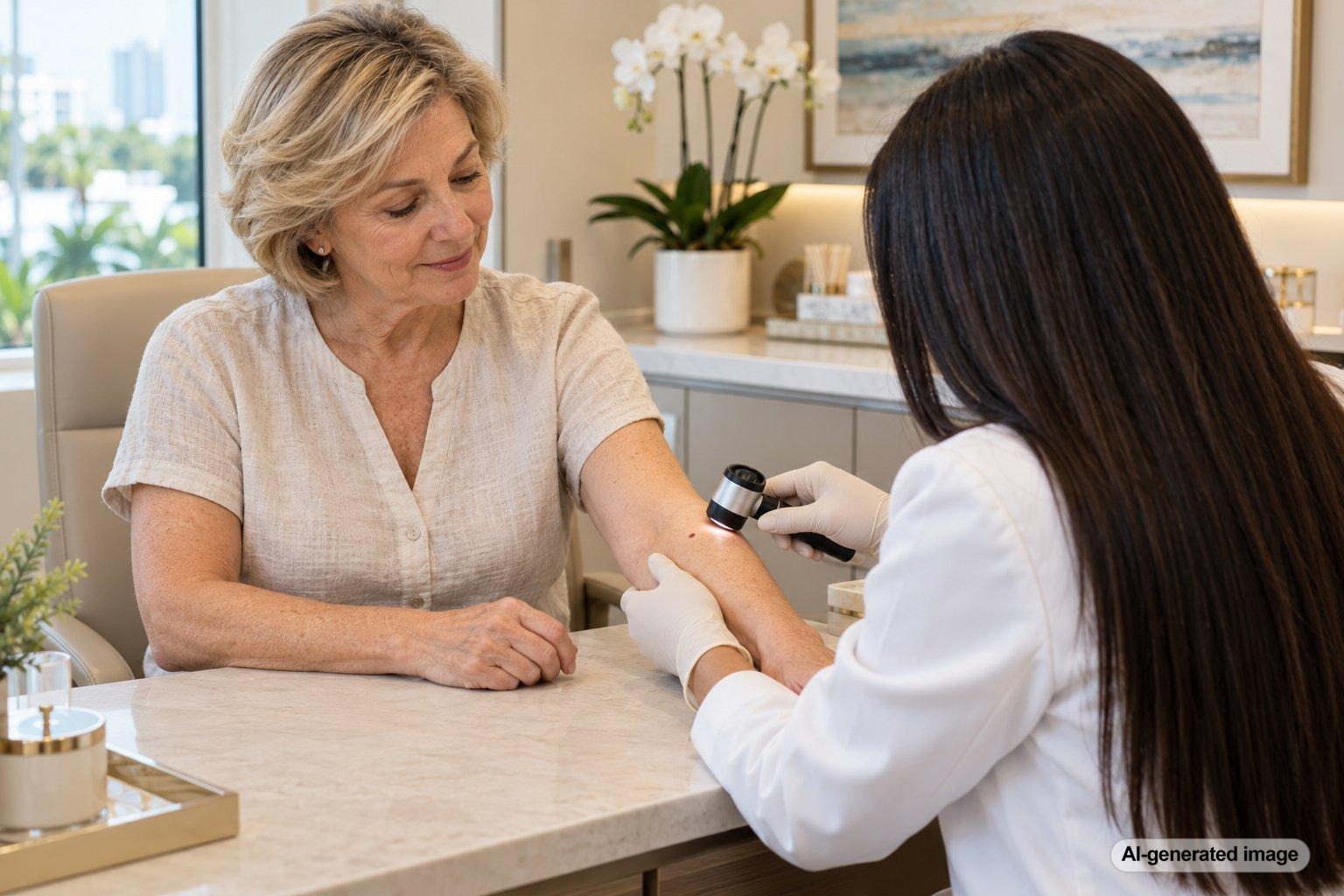
The dermatologist then examines the lesion and may assess other areas of your skin. A handheld instrument called a dermatoscope can provide a magnified view of structures and pigment patterns that are not readily visible to the naked eye.
Depending on the findings, common next steps may include:
- Clinical reassurance: If the lesion appears benign, the dermatologist may explain the findings and recommend an appropriate follow-up approach.
- Photographic monitoring: Selected lesions may be documented and reevaluated at intervals determined by the dermatologist.
- Skin biopsy: If a lesion is suspicious, a sample or the entire growth may be removed for examination by a pathologist. The technique depends on the clinical concern and the lesion’s characteristics.
- Additional skin surveillance: People with numerous atypical moles, a previous melanoma, or certain family histories may benefit from a personalized examination schedule.
A biopsy provides tissue for microscopic assessment and can help establish whether a lesion is benign or cancerous. Not every changing mole requires removal, but a suspicious lesion should not be managed solely through cosmetic treatment.
When Should You See a Dermatologist About a Changing Mole?
Schedule a dermatology appointment when you notice a new or unexplained change in an existing mole. Seek prompt evaluation if you observe any of the following:
- A mole changes in size, shape, border, or color, particularly over a relatively short period.
- A mole bleeds without a clear injury, develops a persistent crust, or does not heal normally.
- A previously comfortable mole begins itching, hurting, or becoming tender without an obvious explanation.
- A mole develops several colors or looks distinctly different from your other moles.
- A new pigmented spot appears in adulthood and seems unusual or continues changing.
- A suspicious spot develops on the palm, sole, beneath a nail, or another less visible area.
Changes during pregnancy should also be evaluated rather than automatically dismissed as hormonal. The same applies to moles that seem to change after sun exposure or irritation.
If you have previously had melanoma, have many atypical moles, or have a strong family history of melanoma, your dermatologist may recommend a more individualized surveillance plan.
Frequently Asked Questions
Can a mole change shape and still be benign?
Yes. Some benign moles gradually change shape or elevation as they mature. However, a newly irregular outline, increasing asymmetry, or progressive change should be examined by a dermatologist. Shape alone cannot confirm whether a lesion is harmless.
Is it normal for a mole to become raised with age?
Some longstanding benign moles gradually become more raised as their cells mature. This can be part of a normal process, but a new or noticeable change in elevation still warrants evaluation, especially when accompanied by other changes or symptoms.
Can pregnancy cause a mole to change without cancer?
Hormonal changes during pregnancy may affect mole pigmentation, and stretching skin can alter the apparent size of some moles. Nevertheless, suspicious changes should not be assumed to be pregnancy-related. A dermatologist can evaluate the lesion and determine whether additional assessment is needed.
Does a changing mole always need a biopsy?
No. A dermatologist may determine that a changing mole has reassuring features and does not require a biopsy. Other lesions may need tissue sampling to establish a diagnosis. The decision depends on the examination, clinical history, and degree of concern.
Can a mole turn into melanoma after being harmless for years?
Yes. Although most benign moles do not become melanoma, melanoma can sometimes develop within an existing mole. It can also arise independently as a new lesion. A history of stability is useful information, but it does not justify ignoring a new suspicious change.
Should I wait to see whether a changing mole returns to normal?
It is better to arrange a dermatology evaluation rather than waiting for a suspicious mole to improve on its own. Some harmless changes may stabilize, but observation without an appropriate examination can delay the identification of a concerning lesion.
The Bottom Line
A mole can change without becoming cancerous. Gradual lightening, changes in elevation, and certain hormone-related changes may occur in benign moles. The challenge is that potentially serious lesions can also change, and there is no reliable home test that distinguishes every harmless change from melanoma.
Pay attention to what is new, evolving, or unusual for your skin. A dermatologist can examine the lesion, explain whether its features are reassuring, and recommend monitoring or a biopsy when appropriate. Seeking an evaluation is a practical way to address uncertainty without assuming that every change represents cancer.
Ready to get help?
Schedule an appointment or send a message and our team will get back to you.
Prefer to call? 954-666-3736
Disclaimer
This article is for educational purposes and is not medical advice. For diagnosis and personalized treatment, please book an appointment with a board-certified dermatologist.
Sources & further reading
- Cleveland Clinic – Moles: What They Are, Causes, Types & Examination
- The Skin Cancer Foundation – Skin Cancer 101
