

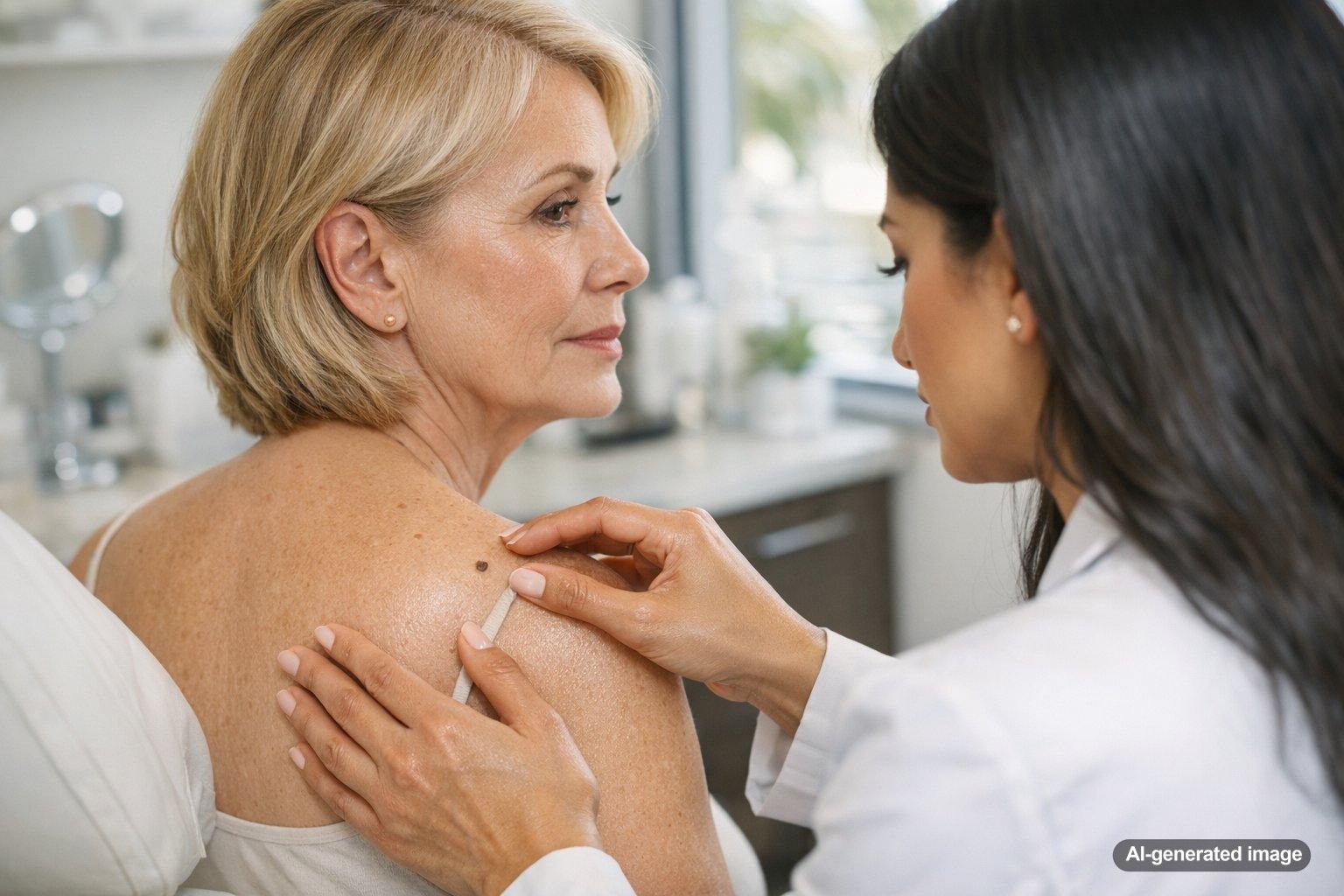
In many cases, a dermatologist can tell when a mole looks concerning just by examining it closely. Experienced dermatologists are trained to spot patterns that raise suspicion, including asymmetry, irregular borders, multiple colors, growth, or bleeding. They may also use a dermatoscope, a handheld magnifying device that helps reveal details not visible to the naked eye.
But there is an important limit: a dermatologist usually cannot confirm that a mole is cancer just by looking at it. A visual exam can identify whether a spot seems benign, atypical, or suspicious, but a biopsy is the step that confirms a diagnosis. If you’re unsure, it’s worth getting checked.
Quick answer
- A dermatologist can often recognize warning signs that a mole may be cancerous.
- A visual exam alone cannot confirm skin cancer with certainty.
- Dermoscopy may help a dermatologist get a closer, more detailed look.
- If a mole looks suspicious, a biopsy may be recommended.
- Changes in size, shape, color, itching, or bleeding are good reasons to schedule an exam.
What a dermatologist can tell from an exam
Dermatologists are trained to evaluate moles and other pigmented spots quickly and carefully. During an exam, they look for features often associated with melanoma and other skin cancers. You may hear about the ABCDE rule: asymmetry, border irregularity, color variation, diameter, and evolving over time. A spot that stands out from your other moles can also be a reason for closer attention.
That said, some harmless moles can look unusual, and some skin cancers do not follow a perfect textbook pattern. That’s why a trained eye matters, but so does follow-up when something does not look quite right.
Why looking alone is not always enough
Even when a mole appears suspicious, appearance alone does not provide a final diagnosis. Some benign lesions can mimic skin cancer, and some early skin cancers can look subtle. A dermatologist can make a strong clinical judgment, but pathology is what confirms whether cancer cells are present.
In practical terms, that means your visit may end with reassurance, short-term monitoring, photography for comparison, or a recommendation for biopsy depending on how the mole looks and whether it has changed.
What dermoscopy adds
A dermatoscope is a small handheld tool that helps a dermatologist examine structures beneath the skin surface. It does not replace a biopsy, but it can improve the accuracy of the skin exam and help distinguish a routine mole from one that deserves closer evaluation. This added detail is one reason skin checks with a dermatologist can be more informative than a self-exam alone.
When a biopsy may be recommended
If a mole has concerning features, your dermatologist may recommend a biopsy. This means removing part or all of the spot so it can be examined under a microscope. That lab review is how skin cancer is diagnosed. Not every unusual mole needs a biopsy, but a changing lesion, a spot that looks different from your other moles, or one that itches, bleeds, or will not heal can all justify a closer look.
What you can do at home
- Check your skin regularly in good lighting.
- Notice whether any mole is new, changing, itchy, tender, or bleeding.
- Pay attention to spots that look different from your other moles.
- Take a photo if you want a simple way to compare changes over time.
- Use daily sun protection to help reduce future skin damage.
When to see a dermatologist
- A mole has changed in size, shape, or color.
- The border looks uneven or the colors are mixed.
- A spot is itching, bleeding, crusting, or not healing.
- You notice a new dark spot that looks different from your usual moles.
- You simply have a mole that worries you.
FAQ
Can a dermatologist usually tell if a mole is normal?
Often, yes. Many moles have features that look clearly benign on exam. When a spot falls into a gray area, your dermatologist may recommend monitoring or biopsy.
Does every suspicious mole mean cancer?
No. Many suspicious-looking spots turn out to be benign or atypical rather than cancerous. The reason to evaluate them is that appearance alone cannot rule skin cancer in or out with certainty.
Is a biopsy the only way to know for sure?
Yes. A biopsy allows the tissue to be examined under a microscope, which is the standard way to confirm a diagnosis.
Should I wait to see if a changing mole settles down?
In general, a changing mole is worth having checked rather than watched indefinitely at home. Early evaluation is the safer approach.
Ready to get help?
Schedule an appointment or send a message and our team will get back to you.
Prefer to call? 954-666-3736
This article is for educational purposes and is not medical advice. For diagnosis and personalized treatment, please book an appointment with a board-certified dermatologist.
Sources & further reading
- American Academy of Dermatology (AAD) – What to look for: ABCDEs of melanoma
- The Skin Cancer Foundation – Annual Exams
- Mayo Clinic – Melanoma pictures to help identify skin cancer
