

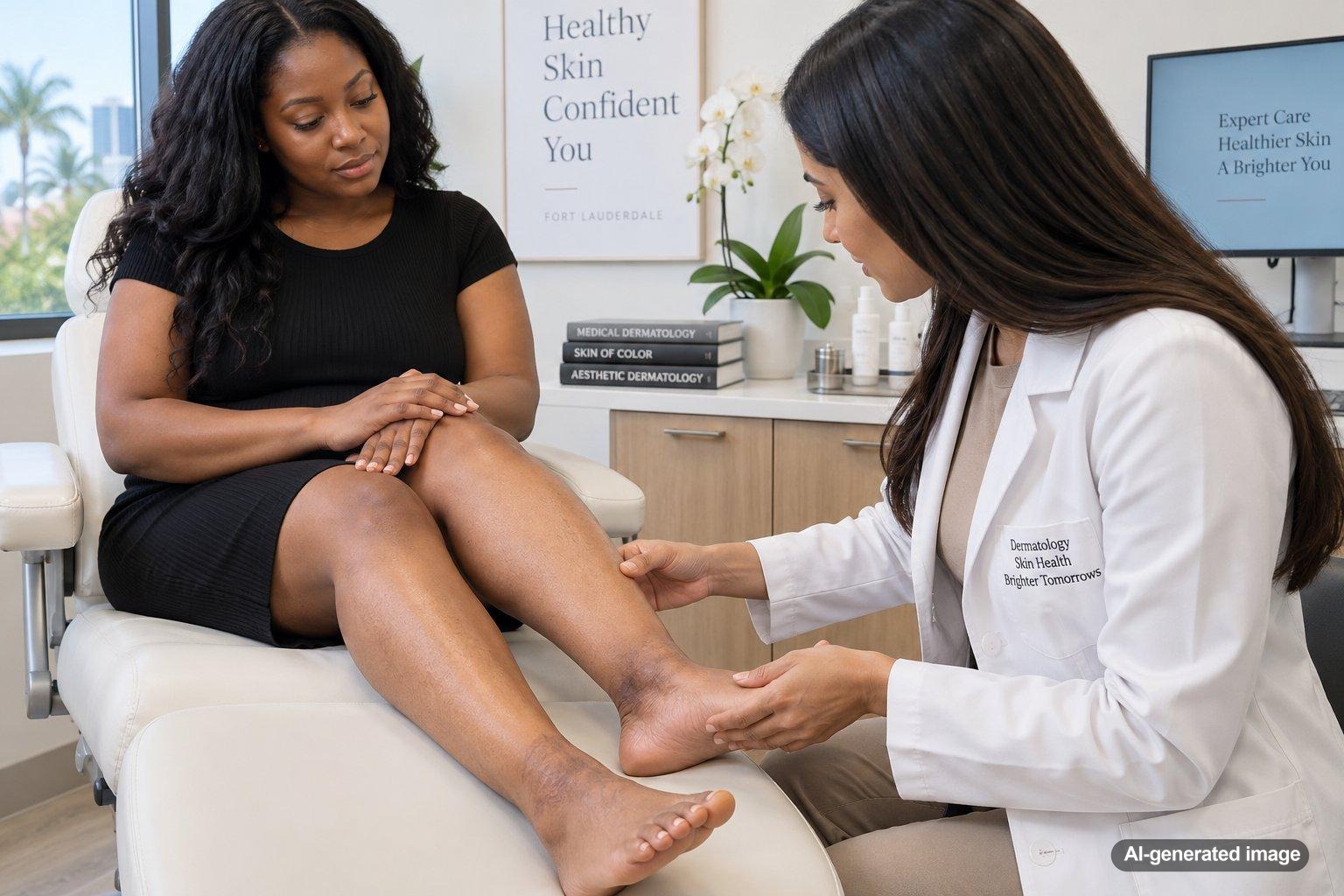
Brown or rusty-looking skin around the ankles can develop for several reasons, and the pattern often matters as much as the color itself. One important possibility is a circulation-related change in the lower legs, especially when discoloration appears along with swelling, visible veins, itching, dryness, or a heavy feeling in the legs. Other causes of pigmentation and inflammation can look similar, so color alone cannot identify the cause.
If the change is new, gradually spreading, affecting both ankles, or accompanied by other symptoms, a dermatologist can examine the skin and help determine whether the issue begins primarily in the skin or may be connected to circulation or another medical condition.
Quick answer
- Brown discoloration around the ankles can be associated with chronic swelling and reduced return of blood through the leg veins.
- When blood and fluid remain under increased pressure in the lower legs, inflammation and pigment from blood breakdown can contribute to reddish-brown or brown staining.
- Stasis dermatitis, also called venous eczema, may cause discoloration together with dryness, itching, scaling, swelling, or irritation.
- Post-inflammatory hyperpigmentation, prior injury, irritation, and other skin conditions can also darken this area.
- A dermatologist should evaluate persistent or changing discoloration, particularly when there is swelling, pain, warmth, skin breakdown, or a wound.
Why circulation problems can cause brown skin near the ankles
The veins in the legs have the demanding job of returning blood upward toward the heart. Valves inside the veins help keep blood moving in the proper direction. If those valves are not working effectively, blood and fluid may pool in the lower legs. This is often referred to as venous insufficiency.
The ankle region is particularly vulnerable because gravity increases pressure in the lower part of the legs. Over time, persistent pressure can allow fluid and components of blood to move into surrounding tissues. As red blood cells break down, iron-containing pigment called hemosiderin can remain in the skin and contribute to a rusty, reddish-brown, or darker appearance.
This type of pigmentation is often more than a purely cosmetic issue. It may be a visible clue that the skin has been exposed to ongoing swelling, inflammation, or altered circulation.
Could it be stasis dermatitis?
Stasis dermatitis is a form of eczema associated with poor blood flow in the lower legs. It frequently develops near the ankles and may begin with subtle swelling and discoloration. The American Academy of Dermatology notes that the condition can cause discolored, dry, itchy, irritated, or sore skin, often in association with venous insufficiency.
Possible accompanying features include:
- Swelling around the ankles or lower legs, especially later in the day
- Itching, dryness, flaking, or scaling
- Red, reddish-brown, yellow-brown, or darker patches
- Visible or enlarged veins
- A heavy, aching, or uncomfortable feeling after prolonged standing
- Skin that gradually becomes thicker or firmer
- Areas that become sensitive or irritated by products that previously felt comfortable
These findings are not enough to make a diagnosis on your own. Several skin and vascular conditions can overlap in appearance, and a professional examination can help distinguish them.
Other reasons the lower legs can become darker
Not every brown patch around the ankle is caused by venous disease. Dermatologists consider the overall appearance, distribution, symptoms, medical history, and how the pigmentation developed.
Post-inflammatory hyperpigmentation: Skin can remain darker after inflammation from a rash, scratching, dermatitis, insect bites, or another injury. The discoloration may persist even after the original irritation has improved.
Repeated friction or irritation: Footwear, socks, braces, shaving, or frequent rubbing can irritate the skin and sometimes leave lingering pigmentation.
Contact dermatitis: An allergic or irritant reaction to a topical product, fabric, adhesive, medication, or other substance may produce inflammation followed by darker coloration.
Previous trauma: Bruising or injury can leave temporary or longer-lasting pigment changes while blood products and inflammation resolve.
Other medical or dermatologic conditions: A variety of disorders can affect pigmentation of the legs. This is one reason persistent changes should be evaluated rather than assumed to be a simple cosmetic concern.
Clues that circulation may be contributing
A dermatologist may be more suspicious of a circulation-related process when discoloration occurs together with repeated ankle swelling, varicose veins, chronic leg heaviness, or skin changes concentrated around the inner ankles and lower calves. Symptoms that worsen after long periods of sitting or standing can also provide useful context.
During an evaluation, your clinician may ask about previous blood clots, leg injuries, surgery, chronic swelling, heart or kidney conditions, medications, and other factors that can affect the legs. When the clinical picture suggests a vascular issue, additional evaluation by an appropriate medical professional may be recommended. In some situations, ultrasound testing is used to assess blood flow or investigate possible vein problems.
What you can do at home while arranging an evaluation
Gentle skin care is usually a reasonable place to start when the area is dry or easily irritated. Avoid aggressive attempts to scrub away brown pigmentation because discoloration caused by inflammation or deposited pigment is not surface dirt.
- Wash gently with lukewarm water rather than very hot water.
- Use a mild, fragrance-free cleanser if the skin is sensitive or dry.
- Apply a fragrance-free cream or ointment to help support the skin barrier.
- Avoid vigorous exfoliating scrubs, harsh acids, or repeated rubbing over irritated skin.
- Try not to scratch itchy areas because scratching can further damage the skin.
- Pay attention to whether prolonged standing or sitting seems to worsen ankle swelling.
Leg elevation and physical activity may be part of a clinician-directed plan when venous insufficiency is present. Compression garments are also commonly used for certain circulation problems, but they are not appropriate for every person. It is better to discuss compression with a healthcare professional, particularly if you have known vascular disease, significant leg pain, wounds, or uncertainty about the cause of your symptoms.
Can the brown discoloration be treated?
The appropriate approach depends on why the pigmentation developed. If inflammation, swelling, or venous insufficiency is continuing, addressing the underlying process generally takes priority over trying to lighten the color.
A dermatologist may recommend treatment aimed at controlling dermatitis, supporting the skin barrier, reducing inflammation, or coordinating care for an underlying circulation problem. Persistent pigmentation can be difficult to improve, and the appearance may not completely return to its previous color even when the underlying condition is better controlled.
For pigmentation that remains after the medical cause has been assessed and stabilized, a dermatologist can discuss whether any topical, procedural, or light-based options are reasonable for your individual skin type and situation. These choices require particular care on the lower legs because healing can be affected when circulation is impaired.
When should you see a dermatologist?
Consider scheduling an evaluation if the brown discoloration is persistent, spreading, unexplained, or accompanied by itching, scaling, swelling, tenderness, or recurrent irritation. Earlier assessment can be especially useful when the skin is beginning to thicken or when the discoloration is becoming progressively more noticeable.
Seek prompt medical attention for concerning changes such as:
- A new open sore, ulcer, blister, or area that is not healing
- Rapidly increasing redness, warmth, swelling, or pain
- Drainage, crusting, or other signs that could suggest infection
- Sudden significant swelling, particularly if it affects one leg
- Sudden leg symptoms accompanied by chest pain, shortness of breath, or other acute symptoms
These findings require medical assessment rather than cosmetic treatment alone.
FAQ
Why does the discoloration often start around the ankles?
The lower legs and ankles are exposed to greater pressure from gravity when blood does not return efficiently through the veins. This can make the ankle region one of the first places where swelling, inflammation, and pigmentation become noticeable.
Does brown skin around the ankles automatically mean poor circulation?
No. Circulation problems are one possibility, but inflammation, prior injury, friction, dermatitis, and other causes of hyperpigmentation can produce a similar appearance. An examination is needed to determine what is most likely.
Why is the skin sometimes itchy as well as brown?
When discoloration is associated with stasis dermatitis or another form of dermatitis, inflammation can disrupt the skin barrier and lead to dryness, scaling, and itching. Scratching can then add more inflammation and potentially more pigmentation.
Can I use a skin-lightening product on my ankles?
It is worth identifying the cause before concentrating on lightening the area. If active dermatitis, swelling, or circulation problems are present, irritating products may make the skin more uncomfortable. A dermatologist can help determine whether pigmentation-focused treatment is appropriate.
Will the brown color disappear if the swelling improves?
The appearance varies from person to person. Some discoloration may improve as inflammation and swelling are controlled, while pigment that has accumulated over time can be persistent. A clinician can give more individualized guidance after examining the skin.
Should I be worried if only one ankle is affected?
One-sided discoloration can have several explanations, including prior injury, localized dermatitis, or a vascular issue. A new or unexplained change on one leg deserves evaluation, particularly if it comes with swelling, warmth, pain, or other new symptoms.
Ready to get help?
Schedule an appointment or send a message and our team will get back to you.
Prefer to call? 954-666-3736
This article is for educational purposes and is not medical advice. For diagnosis and personalized treatment, please book an appointment with a board-certified dermatologist.
Sources & further reading
- American Academy of Dermatology (AAD) – Eczema types: Stasis dermatitis overview
- Cleveland Clinic – Venous Stasis Dermatitis: Causes, Symptoms & Treatment
- DermNet – Venous eczema
