

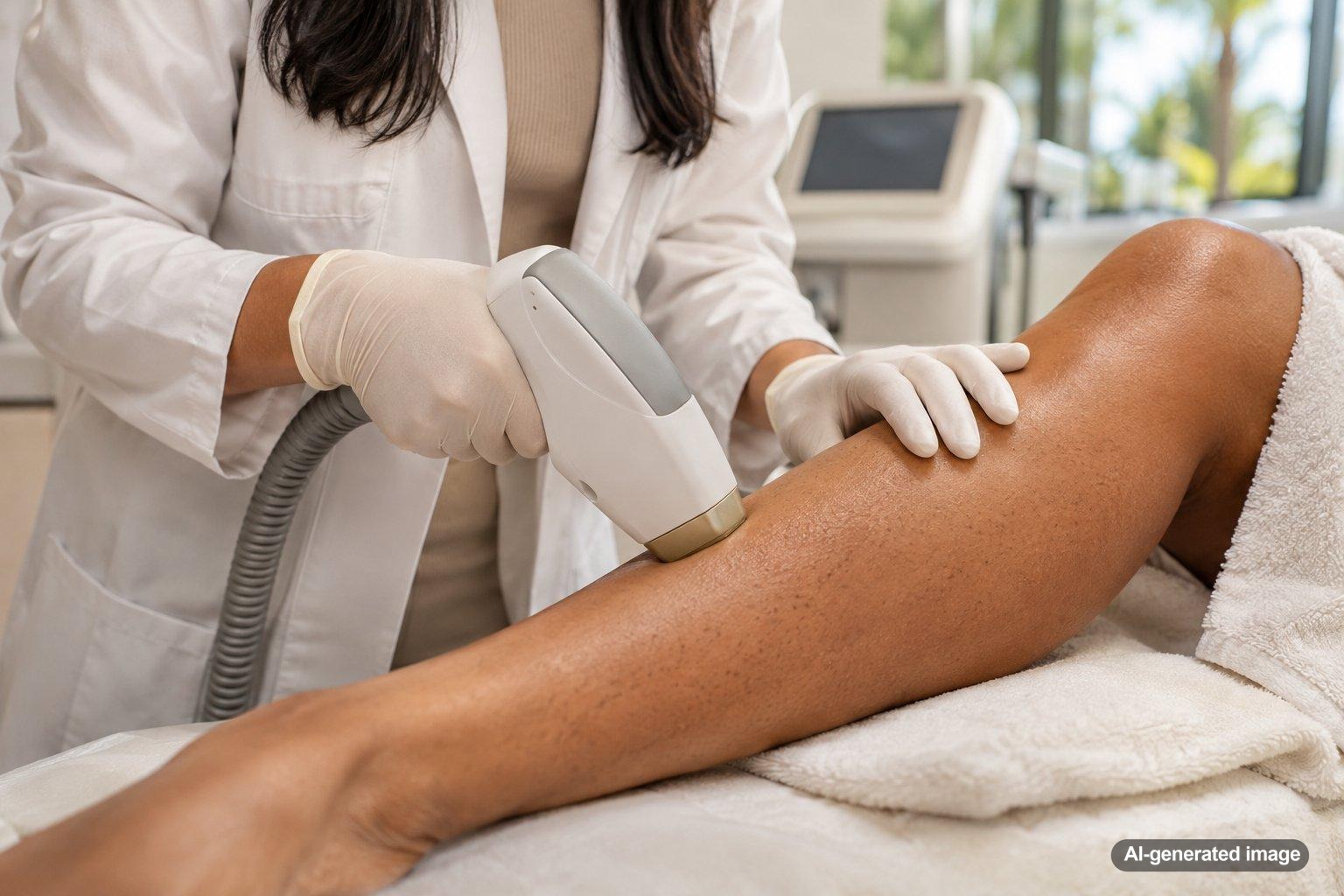
For Black and brown skin, the long-pulsed 1064 nm Nd:YAG laser is often the preferred option for hair removal. Its longer wavelength can reach hair follicles while reducing the amount of energy absorbed by pigment near the skin’s surface. This matters because darker skin contains more melanin, which can also absorb laser energy and increase the risk of unwanted skin changes.
However, choosing the right laser involves more than selecting a wavelength. Skin tone, hair thickness, recent sun exposure, treatment settings, and the experience of the clinician all influence safety and effectiveness. Modern laser technology has expanded treatment possibilities for people with deeper complexions, but individualized evaluation remains essential.
Quick answer: Which laser is best for darker skin?
- Long-pulsed Nd:YAG at 1064 nm: Often the preferred starting point for medium-deep to very deep skin tones because it reduces absorption by epidermal melanin.
- Diode lasers around 800-810 nm: May be appropriate for some brown skin tones when carefully selected and operated by an experienced clinician.
- Alexandrite lasers at 755 nm: Generally require greater caution on deeply pigmented skin because of increased melanin absorption.
- Professional technique matters: Cooling, pulse duration, energy settings, and skin assessment are important regardless of the device.
- No laser suits everyone: A dermatologist should evaluate your individual skin and hair characteristics before recommending treatment.
Why laser selection matters for Black and brown skin
Laser hair removal works by directing light energy toward pigment in the hair. That energy becomes heat, which can damage structures involved in hair growth and gradually reduce unwanted hair.
The challenge is that melanin exists in both the hair and surrounding skin. When the skin contains substantial pigment, certain laser wavelengths may deposit more energy near the surface rather than primarily targeting the follicle.
Excessive heating can contribute to burns, blisters, post-inflammatory hyperpigmentation, or areas of lighter skin known as hypopigmentation. Some pigment changes may persist. These complications are not inevitable, but they explain why treatment settings developed for lighter complexions should not automatically be applied to darker complexions.
Skin color also varies within broad racial and ethnic categories. Two people who identify as Black or brown may have different levels of skin pigmentation, tanning histories, and responses to treatment. A personalized assessment is more useful than choosing equipment based on ethnicity alone.
Nd:YAG vs. diode vs. alexandrite lasers
Several laser technologies can reduce unwanted hair, but their wavelengths interact differently with skin pigment.
Long-pulsed Nd:YAG laser: 1064 nm
The long-pulsed Nd:YAG laser uses a wavelength that is absorbed less strongly by epidermal melanin than shorter-wavelength hair removal lasers. This allows treatment energy to penetrate relatively deeply while helping limit heating at the skin’s surface.
For this reason, Nd:YAG is commonly favored for darker skin phototypes, particularly when the hair is coarse and dark. It is frequently considered for areas such as the underarms, legs, bikini line, and certain facial regions.
Its advantages do not eliminate risk. Improper settings or inadequate cooling can still injure the skin. Results may also differ depending on hair thickness and the number of treatment sessions.
Diode laser: approximately 800-810 nm
Diode lasers offer another potential option for hair reduction. They are commonly used for darker hair and may be suitable for selected medium and brown skin tones.
Because diode wavelengths interact with melanin differently from 1064 nm Nd:YAG wavelengths, clinicians must consider the patient’s pigmentation, device characteristics, and treatment parameters carefully.
A diode system should not automatically be considered inappropriate for every person with brown skin. However, suitability becomes more individualized as epidermal pigmentation increases.
Alexandrite laser: 755 nm
Alexandrite lasers are effective hair removal tools for many patients with lighter complexions. Their shorter wavelength is absorbed more strongly by melanin, which can increase the potential for epidermal injury in deeply pigmented skin.
For Fitzpatrick skin types V and VI, clinicians commonly exercise particular caution and may favor an alternative wavelength. An alexandrite laser should not be selected simply because it is available or because someone else experienced good results with it.
What affects laser hair removal safety?
The laser platform is important, but the details of treatment can be equally significant.
- Natural skin pigmentation: Deeper skin tones require attention to epidermal melanin absorption.
- Recent tanning: Additional pigment from sun exposure can increase treatment risk, even when using equipment commonly selected for darker skin.
- Hair characteristics: Dark, coarse hairs generally provide a clearer target than fine, blonde, gray, white, or red hairs.
- Cooling: Appropriate skin cooling helps protect the outer layers during treatment.
- Treatment parameters: Pulse duration, energy delivery, and other settings must be selected for the individual.
- Clinical experience: Recognizing skin responses and adjusting treatment appropriately are essential parts of laser safety.
Some clinicians may also perform a test spot before treating a larger area, especially when skin response is uncertain. A test spot can provide useful information, although it cannot eliminate the possibility of complications.
How to prepare your skin before treatment
Preparation should begin with a consultation rather than an assumption that a particular laser will work for your complexion.
Tell your clinician about recent tanning, previous reactions to cosmetic treatments, a history of abnormal scarring, and any medications or topical products you use. Certain products and medications may affect treatment planning.
Avoid intentional tanning and protect exposed skin from the sun. In South Florida, where outdoor activities are common throughout the year, this deserves particular attention. A recent beach vacation or extended time outdoors may affect when treatment can safely proceed.
Patients are often instructed to shave before treatment and avoid waxing or plucking for a period beforehand because laser treatment depends on targeting pigment associated with the hair follicle. Follow your treating clinician’s specific preparation instructions rather than creating your own schedule.
Gentle skin care and consistent sun protection may also help minimize unnecessary irritation before an appointment.
What results should you expect?
Laser hair removal is better understood as a process of progressive hair reduction rather than an immediate removal of every hair.
Hair follicles cycle through different growth stages, and not every follicle responds equally during one session. Multiple appointments are generally needed, with intervals determined by the treatment area and individual growth patterns.
Many patients experience reduced hair density or finer regrowth. Some may need occasional maintenance sessions. The response can vary according to hormonal factors, hair characteristics, treatment technique, and skin tone.
Laser treatment may also be considered when recurrent shaving-related irritation or ingrown hairs are a concern, although these symptoms should be evaluated appropriately rather than assumed to have a single cause.
When to see a dermatologist
Consult a board-certified dermatologist before laser treatment if you have previously experienced burns, persistent dark spots, lighter patches, or significant irritation after a cosmetic procedure.
A professional assessment is also valuable if you have active inflammation in the proposed treatment area, a tendency toward keloid scarring, or uncertainty about whether your hair and skin characteristics are suitable for laser reduction.
Following a treatment, significant pain, blistering, worsening discoloration, or other concerning skin changes warrant prompt medical evaluation. Do not assume that pronounced skin injury is a normal part of achieving results.
At Waverly DermSpa, we offer Excel HR Laser Hair Removal and can help you understand whether it may be appropriate.
Frequently asked questions
Is Nd:YAG laser hair removal safe for very dark skin?
Long-pulsed 1064 nm Nd:YAG lasers are commonly preferred for very dark skin because their wavelength reduces absorption by pigment in the outer skin layers. However, burns and pigment changes remain possible, making experienced medical supervision and appropriate settings important.
Can brown skin be treated with a diode laser?
Yes, some people with brown skin may be candidates for diode laser hair removal. Suitability depends on their specific pigmentation, hair characteristics, device technology, and clinical assessment. Nd:YAG may be preferred when the risk of epidermal heating is greater.
Can laser hair removal cause dark spots?
Yes. Post-inflammatory hyperpigmentation can occur when treatment causes excessive irritation or skin injury. Darker complexions may be particularly susceptible to pigment changes. Appropriate equipment, technique, and aftercare can help reduce risk, but cannot eliminate it.
Does laser hair removal work on fine facial hair?
Fine hair generally responds less predictably than coarse, dark hair. In certain circumstances, laser treatment of fine hair may be associated with unexpected increased hair growth. A dermatologist can help assess whether laser treatment or another hair removal method makes more sense.
Is IPL the same as laser hair removal?
No. Intense pulsed light, or IPL, uses a broad spectrum of light rather than the specific wavelength of a laser. Some IPL systems may be less suitable for deeply pigmented skin because of their interaction with epidermal melanin. Device selection should be individualized.
How do I choose a laser hair removal provider?
Ask which device and wavelength will be used, how frequently the clinician treats patients with your skin tone, what cooling measures are available, and how potential complications are managed. A consultation with a board-certified dermatologist is a sensible starting point.
Ready to get help?
Schedule an appointment or send a message and our team will get back to you.
Prefer to call? 954-666-3736
Disclaimer
This article is for educational purposes and is not medical advice. For diagnosis and personalized treatment, please book an appointment with a board-certified dermatologist.
Sources & further reading
- DermNet – Laser therapy in skin of colour
- American Academy of Dermatology (AAD) – Laser hair removal: FAQs
- Cleveland Clinic – Laser Hair Removal: Plastic Surgery
