

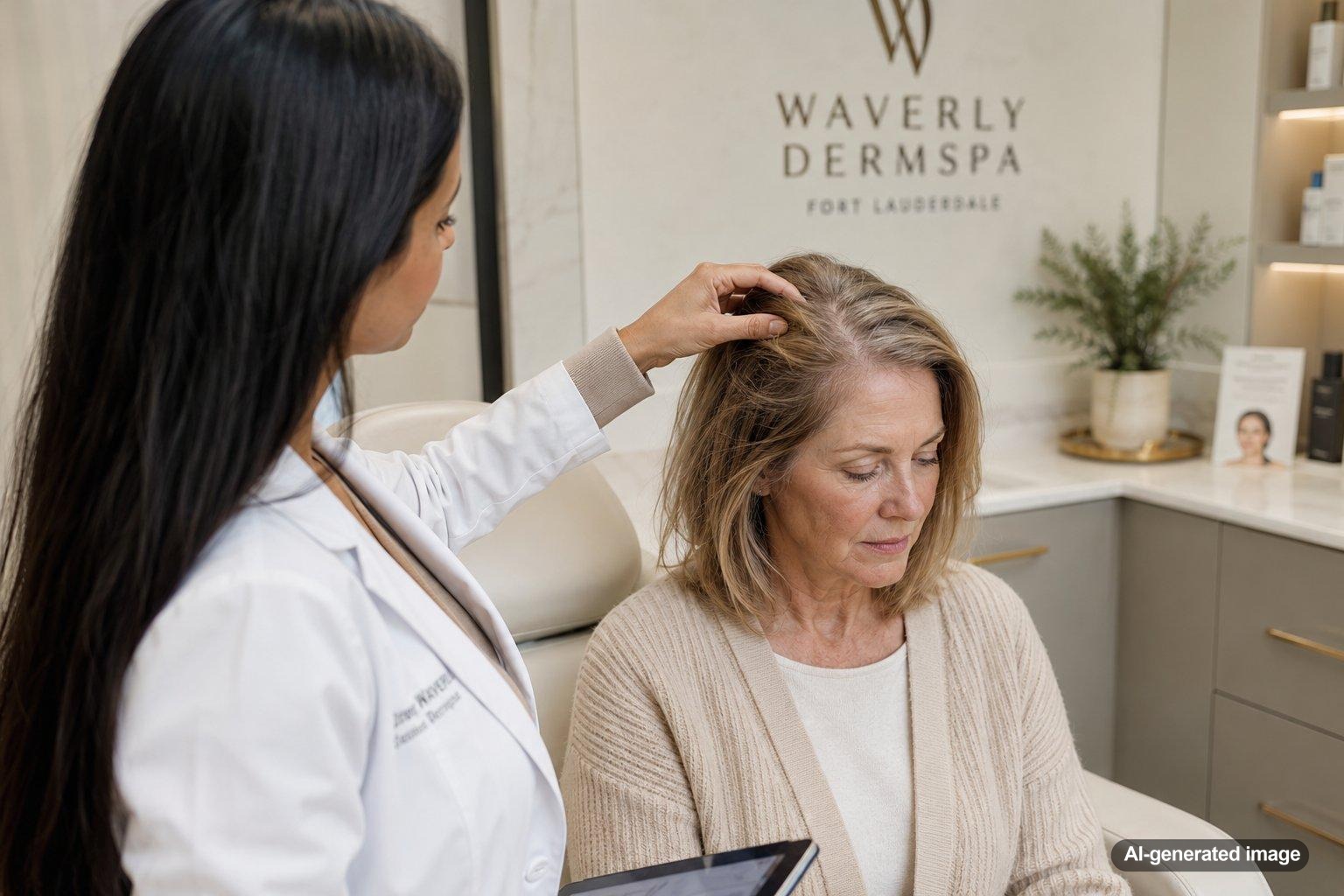
Hair that appears unusually beaded, remains short, or breaks despite careful grooming may reflect a structural difference within the hair shaft. One possible explanation is monilethrix, an inherited condition in which affected strands develop regularly spaced narrow areas. These weak points can fracture easily, creating short, uneven hair that may look sparse.
Monilethrix cannot be identified from appearance alone. Heat damage, chemical processing, traction, nutritional concerns, and other hair shaft conditions can produce overlapping changes. A dermatologist can examine the scalp and individual strands to determine what may be contributing.
Quick answer
- Monilethrix is a genetic hair shaft disorder associated with a beaded appearance under magnification.
- The narrow portions of affected strands are fragile and prone to breaking.
- Gentle hair care may reduce avoidable damage, but it does not change the underlying genetic structure.
- A dermatologist can distinguish monilethrix from acquired breakage and other causes of short or fragile hair.
What is monilethrix?
Monilethrix is a condition that affects the structure and growth of hair. An affected strand alternates between areas of relatively normal thickness and narrowed segments. Under magnification, this pattern can resemble beads arranged along a necklace.
The narrowed segments are mechanically weak, so strands may snap before growing very long. The scalp is most commonly affected, although the degree of involvement can vary. Some people have only limited areas of fragile hair, while others experience more noticeable breakage and sparse-looking growth. Changes often become apparent during infancy or childhood, but the timing and severity are not identical for everyone.
What causes beaded, fragile strands?
Monilethrix is associated with genetic changes that affect proteins involved in forming the hair shaft. Inheritance patterns can vary depending on the gene involved. A family history may offer a useful clue, although an evaluation is still important because other conditions can resemble monilethrix.
Monilethrix itself is not caused by shampoo, coloring, stress, or poor hygiene. However, everyday sources of friction and heat can place additional strain on already fragile strands. Factors that may increase visible breakage include:
- Frequent flat-ironing, curling, or high-heat blow-drying
- Bleaching, chemical straightening, or repeated permanent color
- Tight braids, ponytails, extensions, or other high-tension styles
- Forceful brushing, backcombing, or detangling
- Rubbing the hair vigorously with a towel
- Repeated friction from clothing, bedding, hats, or head coverings
What can you do at home?
The most practical approach is to reduce unnecessary stress on the hair shaft. These measures cannot alter the underlying structure, but they may help preserve vulnerable strands and limit additional breakage.
- Wash gently with lukewarm water and avoid aggressive scalp scrubbing.
- Use conditioner to improve slip before carefully detangling.
- Choose a wide-tooth comb and begin detangling near the ends.
- Blot wet hair with a soft towel instead of rubbing or twisting it.
- Limit high heat and use the lowest effective temperature when styling.
- Avoid tight hairstyles and heavy extensions that pull on fragile hair.
- Space out chemical services and discuss breakage with your stylist beforehand.
- Protect the hair from repeated friction when sleeping, traveling, or wearing head coverings.
Before starting supplements, consider speaking with a clinician. Brittle hair has several possible causes, and taking a supplement without identifying a deficiency may not address the problem.
How a dermatologist can evaluate fragile hair
A dermatologist may begin by reviewing when the changes started, whether relatives have similar hair, which areas are affected, and what styling or chemical exposures are part of your routine. Examination of the scalp and hair under magnification can reveal the regularly spaced narrowing associated with monilethrix. In selected situations, microscopic examination or genetic evaluation may be discussed.
Professional management is individualized. It may include a conservative hair-care plan, attention to scalp inflammation or other conditions that could worsen shedding, and periodic monitoring. A dermatologist can also explain the limits of available options and help determine whether any medical therapy is reasonable for the individual situation. Outcomes vary, and no single approach is appropriate for everyone.
When should you see a dermatologist?
Consider scheduling an evaluation when breakage is persistent, begins without a clear styling explanation, or prevents the hair from growing beyond a short length. An appointment is also appropriate if changes began in childhood, affect several relatives, or involve the eyebrows, eyelashes, or nails.
More prompt evaluation is advisable if hair changes occur with scalp pain, significant redness, scaling, sores, drainage, rapidly expanding bare areas, or smooth areas that appear scarred. These findings may point to another scalp disorder that needs separate attention.
Frequently asked questions
Is monilethrix contagious?
No. Monilethrix is associated with inherited changes in hair formation and does not spread through contact, shared brushes, towels, or salon tools.
Can monilethrix look like ordinary heat damage?
Yes. Both can lead to short, brittle, uneven strands. The regular beaded pattern of monilethrix is generally easiest to recognize with magnification, which is one reason a professional examination can be useful.
Does beaded hair always mean monilethrix?
No. Several inherited and acquired hair shaft abnormalities can cause unusual texture or breakage. Product buildup, lighting, and surface damage may also make strands look irregular. Appearance alone is not enough to establish a diagnosis.
Can someone develop monilethrix from hair coloring?
Hair coloring does not create the genetic condition. Chemical processing can weaken hair, however, and may make breakage more noticeable in strands that are already fragile.
Should family members be evaluated?
If several relatives have similar short, fragile, or beaded hair, sharing that history with a dermatologist can help guide the evaluation. Your clinician can discuss whether examination or genetic counseling would be useful.
Ready to get help?
Schedule an appointment or send a message and our team will get back to you.
Prefer to call? 954-666-3736
This article is for educational purposes and is not medical advice. For diagnosis and personalized treatment, please book an appointment with a board-certified dermatologist.
