

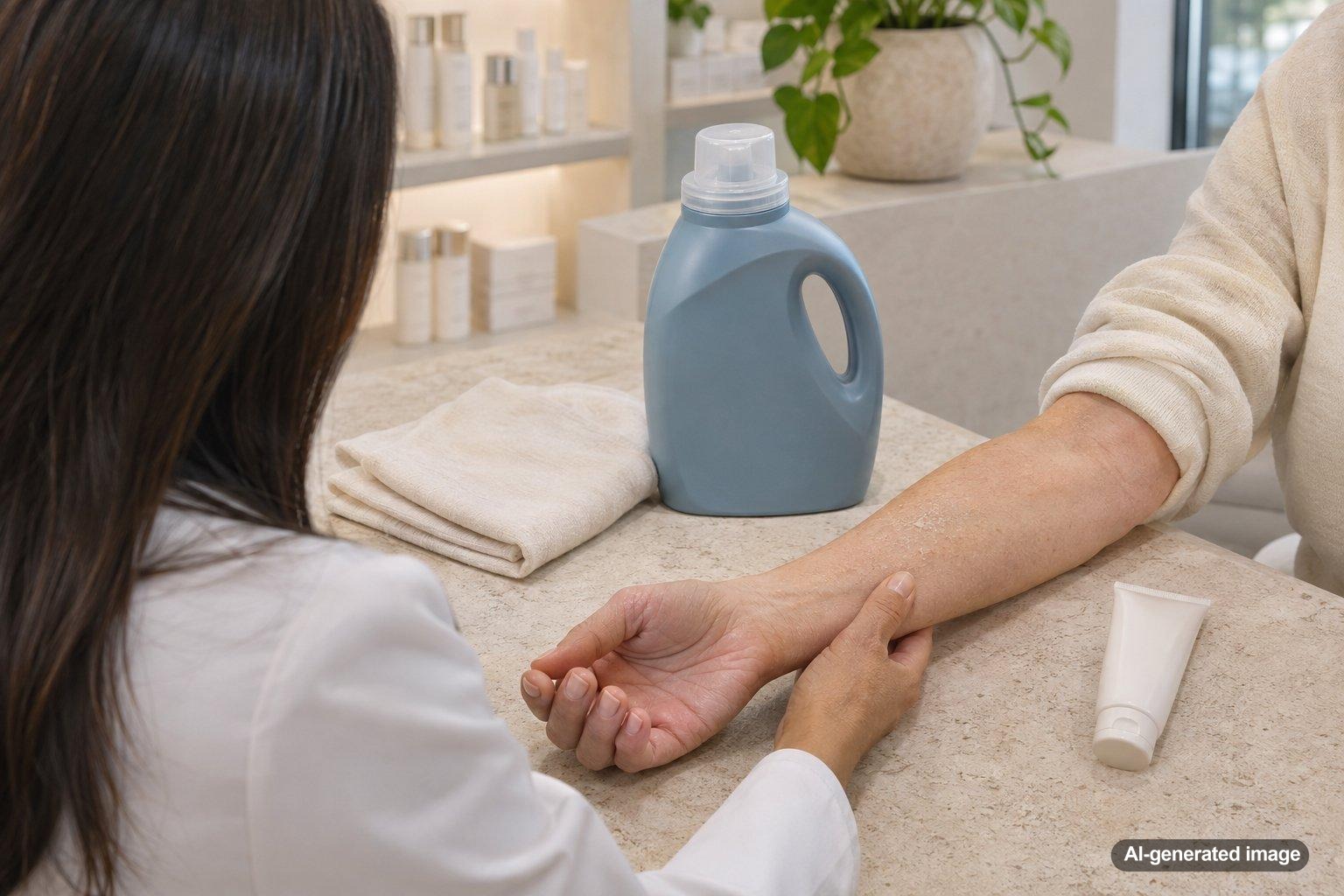
Noticing dry, flaky skin after switching laundry detergent can be frustrating, especially when the new product seems gentle or is marketed for sensitive skin. The connection may be more than a coincidence. Detergents contain cleaning agents and other ingredients that can irritate the skin or, in some people, trigger an allergic response. When freshly washed clothing, towels, or bedding repeatedly touch the skin, that exposure may contribute to dryness, itching, redness, or peeling.
Skin flaking after a detergent change is often associated with irritation of the skin barrier or a form of contact dermatitis. However, the timing alone does not establish the cause. Existing eczema, fabric treatments, dry weather, and other skincare products can produce similar symptoms. Understanding these possibilities can help you make practical changes while recognizing when a dermatologist should evaluate persistent irritation.
Quick Answer: Why Is My Skin Flaking After Changing Detergent?
- Detergent ingredients may irritate the skin barrier. Cleaning agents and other components can contribute to dryness and inflammation in susceptible skin.
- Fragrance or preservatives may trigger contact dermatitis. Some people develop allergic reactions to particular ingredients, even when they previously tolerated other detergents.
- Residue may contribute to continued exposure. Using excessive detergent or inadequate rinsing can leave more product in fabrics.
- Existing sensitive skin or eczema may increase susceptibility. Skin that is already dry or inflamed may react more readily to changes in laundry products.
- The detergent may not be the only explanation. Fabric dyes, friction, weather, and changes in personal care products can cause overlapping symptoms.
How Can Laundry Detergent Cause Flaky Skin?
The outermost layer of your skin serves as a protective barrier. It helps retain moisture while limiting exposure to potentially irritating substances. When that barrier becomes disrupted, the skin may lose moisture more readily and become dry, rough, itchy, or flaky.
Laundry detergents are formulated to remove oils, dirt, and stains from fabric. Their ingredients are intended to be washed away during the rinse cycle, but individual sensitivity and repeated contact with laundered textiles can influence how skin responds.
Two important possibilities are irritant contact dermatitis and allergic contact dermatitis. Both can produce inflammation and scaling, but they develop through different mechanisms.
Irritant Contact Dermatitis
Irritant contact dermatitis occurs when exposure to a substance disrupts or damages the skin’s protective barrier. It does not require an allergy. Detergents, soaps, and other cleaning products are recognized potential irritants.
Symptoms may include dryness, tightness, burning, itching, roughness, and visible flaking. Repeated exposure can be particularly uncomfortable when the skin is already compromised by eczema, frequent washing, or dry environmental conditions.
Allergic Contact Dermatitis
Allergic contact dermatitis involves a delayed immune response to an ingredient that the body has become sensitized to. Fragrances and certain preservatives are examples of ingredients that may contribute to allergic reactions in susceptible individuals.
Symptoms may include itching, redness or discoloration, swelling, scaling, or small blisters. Allergic reactions can develop after repeated exposure, so a product does not necessarily have to cause symptoms the first time it is used.
Because these two conditions can look similar, identifying the specific mechanism may require a clinical evaluation rather than relying on appearance alone.
Common Detergent Ingredients and Laundry Habits That May Trigger Flaking
There is no single ingredient responsible for every detergent-related skin reaction. The formulation, amount used, washing conditions, and individual skin sensitivity can all matter.
- Fragrances: Added scents can trigger allergic contact dermatitis in some people. Products labeled fragrance-free may be preferable when fragrance sensitivity is suspected.
- Preservatives: Certain preservatives used in household products can occasionally cause allergic contact dermatitis.
- Surfactants: These cleaning ingredients help remove oils and soil from clothing. Some formulations may contribute to irritation, particularly with direct exposure or inadequate rinsing.
- Excess detergent: Using more product than the manufacturer recommends can make thorough rinsing more difficult.
- Fabric softeners and dryer sheets: Fragrance and other additives in these products may contribute to skin irritation.
- Fabric dyes and finishing agents: Sometimes the fabric itself, rather than the detergent, is responsible for a reaction.
A product described as natural, botanical, gentle, or hypoallergenic is not automatically suitable for every person. Ingredient sensitivity is individual, and marketing terminology does not establish that a product cannot cause irritation.
Where Does Detergent-Related Skin Flaking Usually Appear?
Symptoms associated with clothing or bedding exposure may develop in areas that experience prolonged contact, pressure, friction, or warmth. These can include the waistline, underarms, neck, inner elbows, backs of the knees, and areas beneath snug clothing.
The face may also be affected indirectly through contact with pillowcases, towels, or other laundered items. However, facial flaking has numerous possible causes, including reactions to skincare products and underlying inflammatory skin conditions.
In Fort Lauderdale’s warm, humid climate, perspiration and friction beneath clothing can further aggravate already sensitive skin. This does not mean that sweating causes a detergent allergy, but it may make existing irritation more noticeable.
Pay attention to whether symptoms correspond with recently washed fabrics. This pattern can offer useful clues, although it cannot confirm the diagnosis on its own.
What Can You Do at Home if Your Skin Starts Flaking?
When the symptoms are mild, conservative adjustments to your laundry routine and skincare habits may help reduce unnecessary irritation.
Stop Using the Suspected Detergent
If symptoms began soon after introducing a new detergent, consider discontinuing it and returning to a previously tolerated product. Avoid switching between several new formulations at once, since that can make it more difficult to identify a potential trigger.
Choose a Fragrance-Free Detergent
Consider a detergent labeled fragrance-free, especially if your skin reacts to scented personal care or household products. Fragrance-free and unscented are not always equivalent. Some unscented products contain masking fragrances.
There is no universally ideal detergent for every person with sensitive skin. A simpler formulation may be helpful, but specific ingredient allergies still matter.
Rewash Clothing, Towels, and Bedding
Rewashing items that were cleaned with the suspected detergent may reduce continued exposure to residual ingredients. Follow garment care instructions, measure detergent according to the manufacturer’s directions, and consider an additional rinse cycle if appropriate for your washing machine.
Temporarily avoiding scented fabric softeners, laundry scent boosters, and dryer sheets may also simplify the process of identifying the trigger.
Support Your Skin Barrier
Gentle skincare can be useful while irritated skin settles. Consider the following general measures:
- Use lukewarm rather than very hot water for bathing.
- Choose a mild, fragrance-free cleanser.
- Apply a fragrance-free moisturizer after bathing while the skin is still slightly damp.
- Avoid abrasive scrubs, harsh exfoliating acids, and heavily fragranced skincare products on irritated areas.
- Wear comfortable, breathable clothing that does not rub excessively against sensitive skin.
- Resist scratching or peeling away loose skin, which may worsen irritation.
Creams and ointments are often more protective than lightweight lotions for very dry skin, although the appropriate formulation depends on the individual. If a moisturizer stings or increases irritation, discontinue it and discuss alternatives with a clinician.
How Long Does Skin Flaking From Detergent Irritation Last?
Recovery varies depending on the severity of inflammation, whether exposure continues, and whether an underlying skin condition is present. Mild irritation may begin improving after the suspected product is removed and the skin barrier receives appropriate care. More pronounced dermatitis can take longer to settle.
Allergic contact dermatitis may persist even after the suspected ingredient is discontinued, particularly when the same allergen is present in other products.
Rather than relying on a fixed recovery timeline, watch for a gradual reduction in itching, redness, tenderness, and flaking. If symptoms remain unchanged, spread, or worsen despite avoiding the suspected detergent, a dermatologist can assess whether another cause is involved.
Could It Be Eczema Instead of a Detergent Reaction?
Yes. Eczema is an umbrella term for several inflammatory skin conditions, and detergent exposure may aggravate some of them. Atopic dermatitis, for example, is associated with skin barrier dysfunction and increased susceptibility to dryness and irritation.
Someone with an existing eczema tendency may experience a flare after changing laundry products without having a true allergy to the detergent. Conversely, allergic contact dermatitis can coexist with atopic dermatitis.
Other conditions, including seborrheic dermatitis, psoriasis, and ordinary dry skin, can also cause scaling. The location, appearance, associated symptoms, and timing of flares help guide the evaluation.
Persistent flaking should not automatically be attributed to a detergent change, especially if symptoms occur in areas that have little contact with laundered fabrics.
What Can a Dermatologist Do for Persistent Flaking?
A dermatologist can review the sequence of symptoms, examine affected areas, and evaluate possible irritant, allergic, or inflammatory causes.
Depending on the findings, professional options may include:
- Skin examination: Assessing the distribution and characteristics of scaling, redness, and inflammation.
- Exposure review: Discussing recent detergent changes, fabric softeners, skincare products, clothing, and relevant environmental factors.
- Patch testing: When allergic contact dermatitis is suspected, testing for delayed reactions to selected allergens may help identify relevant sensitivities.
- Barrier-support recommendations: Helping identify suitable cleansing and moisturizing practices.
- Medical treatment when appropriate: A dermatologist may consider topical anti-inflammatory therapy or other treatments based on the diagnosis and severity.
Patch testing is different from testing for immediate allergies, and it is not necessary for every episode of dry skin. It may be particularly useful when dermatitis recurs, remains unexplained, or does not improve after reasonable exposure changes.
At Waverly DermSpa in Fort Lauderdale, Dr. Maryann Mikhail, MD, can evaluate persistent skin irritation and help patients understand whether a detergent reaction, eczema, or another skin condition may be contributing to their symptoms.
When Should You See a Dermatologist?
Consider scheduling a dermatology evaluation when flaking is persistent, recurrent, increasingly uncomfortable, or affecting daily activities or sleep.
Other reasons to seek medical attention include:
- Significant redness, swelling, burning, pain, or persistent itching.
- Cracking, bleeding, or painful areas of skin.
- Blisters, widespread inflammation, or symptoms involving sensitive areas such as the eyelids.
- Rashes that continue despite discontinuing the suspected detergent.
- Repeated reactions to different household or personal care products.
- Signs of possible infection, such as increasing warmth, spreading tenderness, pus, or fever.
Seek prompt medical care if a rash is rapidly worsening or infection is suspected. Sudden swelling of the lips, tongue, or throat, or difficulty breathing, requires emergency medical attention rather than a routine dermatology appointment.
Frequently Asked Questions
Can laundry detergent cause peeling skin without a visible rash?
Yes. Irritation may initially appear as dryness, rough texture, or fine scaling without a prominent red rash. However, peeling alone is not specific to detergent exposure, and other causes may need consideration.
Can you suddenly become allergic to a detergent you previously tolerated?
Yes. Allergic contact dermatitis can develop after repeated exposure to an ingredient. A person may tolerate a product for some time before becoming sensitized. Not every delayed reaction is an allergy, however, so evaluation may be useful when symptoms recur.
Is fragrance-free detergent better for eczema-prone skin?
Fragrance-free detergent is often a reasonable option for people with eczema-prone or sensitive skin because it eliminates one potential category of triggers. Other ingredients may still cause irritation, and individual tolerability varies.
Can detergent residue on bedsheets cause facial flaking?
Residue from laundry products may contribute to irritation when pillowcases or bedding remain in prolonged contact with sensitive skin. However, facial scaling can also result from skincare products, seborrheic dermatitis, eczema, and other conditions. Persistent symptoms warrant assessment.
Should I use an extra rinse cycle if detergent seems to irritate my skin?
An extra rinse may be helpful in reducing residual detergent, particularly if too much product was used. Measuring detergent correctly and avoiding unnecessary laundry additives are also practical steps. An extra rinse cannot eliminate a true ingredient sensitivity if meaningful exposure continues.
How do I know whether the problem is detergent irritation or an allergy?
Symptoms overlap considerably. Irritant reactions involve skin barrier injury, while allergic contact dermatitis involves a delayed immune response. A dermatologist can review your exposure history and may recommend patch testing if an allergy is suspected.
Ready to get help?
Schedule an appointment or send a message and our team will get back to you.
Prefer to call? 954-666-3736
Disclaimer
This article is for educational purposes and is not medical advice. For diagnosis and personalized treatment, please book an appointment with a board-certified dermatologist.
Sources & Further Reading
- American Academy of Dermatology (AAD) – Eczema types: Contact dermatitis causes
- American Academy of Dermatology (AAD) – Atopic dermatitis: Self-care
- Mayo Clinic – Contact dermatitis: Symptoms and causes
- DermNet – Textile contact dermatitis
