

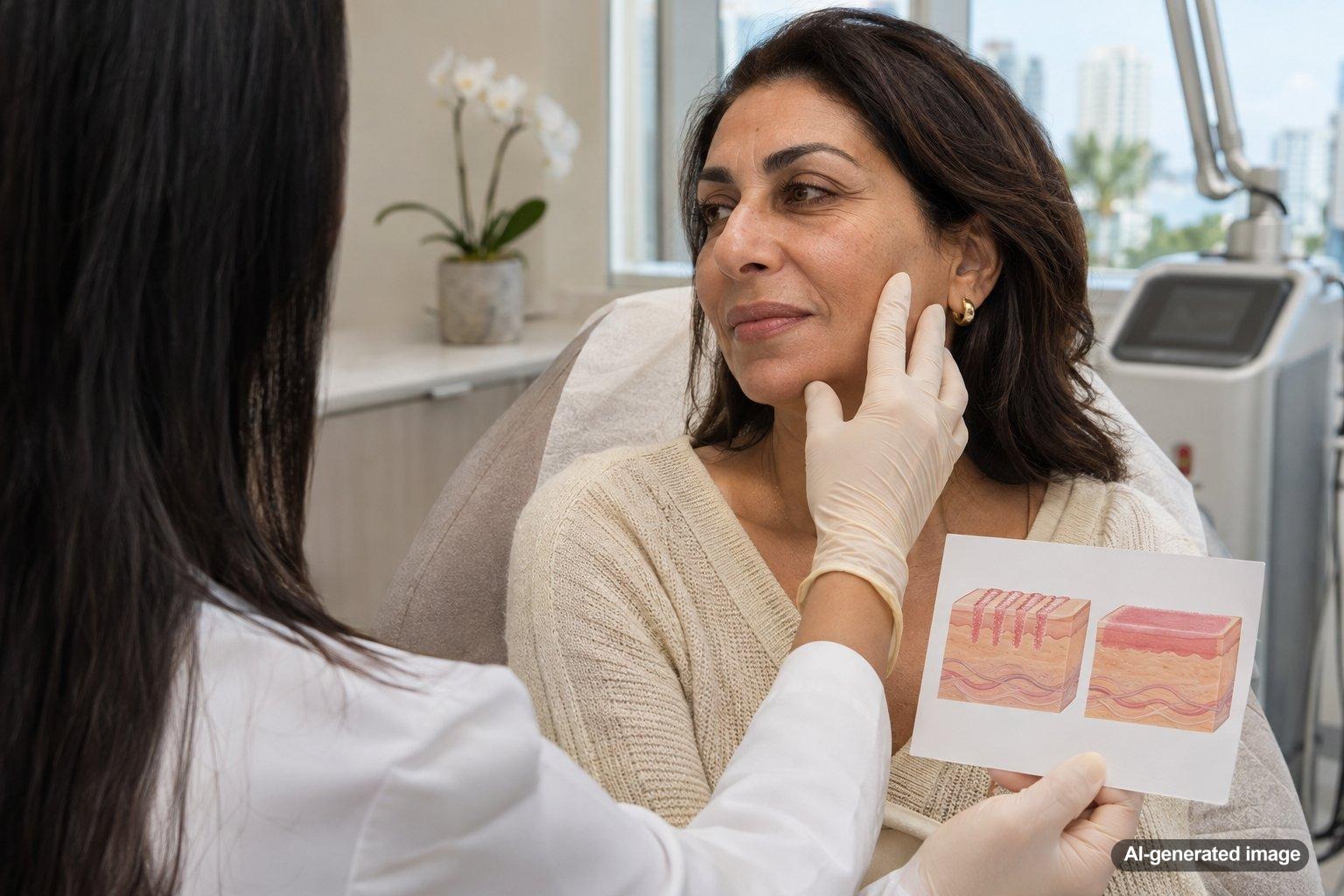
Fractional CO2 laser and traditional CO2 laser treatments use the same type of laser energy, but they deliver that energy to the skin differently. Traditional, fully ablative CO2 resurfacing treats an entire selected surface area, while fractional CO2 resurfacing creates microscopic treatment zones separated by areas of relatively untouched skin. This distinction influences healing, treatment intensity, and the types of concerns a dermatologist may address.
Both approaches may improve the appearance of wrinkles, certain scars, and sun-related texture changes. However, neither is automatically the better option. The appropriate treatment depends on your skin, the concern being treated, your medical history, and how much recovery time you can accommodate. Understanding the differences helps you approach a consultation with realistic expectations.
Quick Answer: Fractional CO2 vs. Traditional CO2 Laser
- Fractional CO2 laser: Treats microscopic columns of skin while leaving surrounding tissue relatively intact, often allowing a shorter initial recovery.
- Traditional fully ablative CO2 laser: Resurfaces the entire selected treatment area, generally creating a more extensive healing process.
- Both treatments: Use ablative laser energy to remove or injure targeted skin tissue and encourage remodeling during healing.
- Treatment intensity: Depends on settings, depth, density, and individual treatment goals, not simply whether the laser is fractional.
- Choosing between them: Requires professional assessment of skin tone, scarring, pigmentation risk, healing history, and expectations.
How Does Fractional CO2 Laser Resurfacing Work?
A fractional CO2 laser divides its energy into numerous small treatment zones rather than treating every point across the skin surface. These microscopic columns create controlled injury while preserving portions of the surrounding tissue.
The untreated tissue between the columns supports the healing process. This is one reason fractional resurfacing is often associated with less initial downtime than fully ablative treatment of a comparable area.
Fractional CO2 treatment remains an ablative procedure. It can disrupt the outer skin barrier and affect deeper layers, depending on the settings selected. Redness, swelling, sensitivity, and peeling may occur even when the treatment is described as relatively gentle.
Fractional treatments may be considered for concerns such as uneven texture, certain acne scars, fine lines, and visible sun damage. Some patients may need more than one session to approach their goals, although the number and intensity of treatments vary.
How Does Traditional CO2 Laser Resurfacing Work?
Traditional CO2 laser resurfacing generally refers to fully ablative treatment, in which the laser removes thin layers of skin across the selected treatment area rather than leaving a regular pattern of untreated skin between microscopic treatment zones.
This method can produce substantial resurfacing in a single treatment. It may be considered when addressing more pronounced wrinkles or significant surface irregularities, provided the patient is an appropriate candidate.
Because a larger continuous area of skin is affected, healing typically involves more extensive wound care and a longer period before the surface barrier recovers. Persistent redness and other visible changes can continue after the skin has initially healed.
Traditional does not necessarily mean outdated or imprecise. Modern fully ablative CO2 systems can use controlled pulses and scanning technology. The meaningful distinction is the pattern and extent of tissue treatment, not simply the age of the equipment.
Comparing the Main Differences
| Feature | Fractional CO2 | Traditional CO2 |
|---|---|---|
| Treatment pattern | Microscopic treatment columns with intervening untreated areas | Continuous resurfacing of the selected area |
| Typical initial recovery | Often shorter, depending on treatment intensity | Generally longer with more extensive wound care |
| Common treatment goals | Texture, selected scars, fine lines, and sun-related changes | More extensive resurfacing for selected wrinkles and surface irregularities |
| Treatment planning | May involve staged sessions | May involve a more intensive single session |
| Potential complications | Pigment changes, prolonged redness, infection, and scarring | Similar complications, with risks influenced by treatment extent and depth |
These are general distinctions rather than fixed outcomes. Aggressive fractional resurfacing can require significant recovery, while a more limited fully ablative procedure may involve a smaller treatment area.
Which Approach May Be More Appropriate for Different Skin Concerns?
Fine Lines and Early Texture Changes
Fractional CO2 treatment may be considered when the goal is to improve fine lines or uneven texture without resurfacing every point of the treatment area. Settings can be adjusted according to the desired treatment intensity.
Deeper Wrinkles and Pronounced Sun Damage
More extensive resurfacing may be considered for certain deeper wrinkles and established texture changes. Traditional fully ablative CO2 treatment can provide a different level of surface removal, but its additional recovery burden must be weighed against the potential benefit.
Acne Scars
Fractional CO2 laser treatment is one option for selected atrophic acne scars. However, scar shape, depth, and distribution matter. Ice-pick, rolling, and boxcar scars do not necessarily respond in the same way. A dermatologist may consider other approaches or combinations of treatments rather than relying on laser resurfacing alone.
Uneven Pigmentation
Laser resurfacing can affect discoloration associated with sun damage, but it can also trigger post-inflammatory hyperpigmentation. This is particularly important for patients prone to pigment changes. Conditions such as melasma require especially careful evaluation because heat and inflammation may worsen pigmentation in some individuals.
How Does Recovery Compare?
Recovery is one of the most practical differences between fractional and fully ablative CO2 resurfacing. Both involve controlled skin injury, so the skin needs time to restore its protective barrier.
Following fractional treatment, patients may experience redness, swelling, warmth, roughness, and peeling. Initial healing can take approximately a week in some treatment plans, but deeper or denser treatments may require substantially longer. Residual redness can persist beyond the initial recovery period.
Fully ablative resurfacing often requires around two weeks or longer for initial healing, depending on the procedure. Some treatments may take approximately 10 to 21 days for the treated surface to heal. Visible pinkness or redness may continue for weeks or months afterward.
These ranges are general examples, not predictions for an individual patient. Healing varies with laser settings, treatment location, skin characteristics, and medical history.
For patients planning around travel, social events, or time outdoors in Fort Lauderdale, recovery planning also means accounting for sun avoidance, follow-up visits, and the possibility of persistent redness after the initial healing phase.
What Are the Risks and Limitations?
Both procedures can cause temporary inflammation and carry the possibility of complications. Potential concerns include:
- Prolonged redness, swelling, or discomfort.
- Post-inflammatory hyperpigmentation or lighter patches of skin.
- Delayed healing and changes in skin texture.
- Bacterial infection or reactivation of herpes simplex in susceptible patients.
- Scarring, particularly when healing is complicated.
- Results that are less noticeable than anticipated or that do not fully address the underlying concern.
Skin tone is an important consideration, but it is not the only factor. Previous pigmentation problems, recent tanning, medications, active skin conditions, and a history of abnormal scarring can influence treatment planning.
Fractional treatment may reduce the amount of skin injured during a session, but it does not eliminate procedural risk. Similarly, a more intensive treatment does not automatically produce a better outcome for every skin concern.
How to Prepare Your Skin and Support Recovery
Appropriate preparation begins with a consultation and a review of your existing skincare routine. Rather than starting new exfoliating products or attempting to prepare your skin aggressively, discuss your current products and medications with the treating clinician.
General considerations include:
- Sun exposure: Avoid tanning and discuss any recent sunburn or significant sun exposure before treatment.
- Skincare ingredients: Ask when to pause or resume retinoids, exfoliating acids, and other potentially irritating products.
- Medical history: Disclose previous cold sores, unusual scarring, pigment changes, and relevant health conditions.
- Aftercare: Follow the specific cleansing, moisturizing, and wound-care instructions provided by your clinician.
- Healing skin: Avoid picking, scrubbing, or introducing unapproved products while the skin barrier is recovering.
- Sun protection: Follow your clinician’s guidance on physical sun avoidance during early healing and appropriate sunscreen use once the skin can tolerate it.
In South Florida, outdoor activities and strong sunlight deserve particular attention when planning treatment. A procedure that requires careful sun avoidance may be less convenient immediately before a beach vacation or an extended period outdoors.
When Should You See a Dermatologist?
A dermatologist can evaluate whether resurfacing is appropriate for your concerns and explain the tradeoffs between treatment intensity, recovery, and potential complications.
Professional assessment is especially important if you have a history of pigment changes, significant scarring, recurrent cold sores, recent tanning, or skin that reacts unpredictably to procedures.
After resurfacing, contact the treating clinician promptly for worsening pain, spreading redness, increasing warmth, unexpected drainage, fever, or other symptoms that raise concern during healing. These findings warrant individualized assessment rather than relying on general recovery descriptions.
At Waverly DermSpa, we offer Tetra CoolPeel CO2 and can help you understand whether it may be appropriate.
Frequently Asked Questions
Is fractional CO2 laser less aggressive than traditional CO2 laser?
It is often less extensive because untreated skin remains between microscopic treatment zones. However, fractional CO2 settings can vary considerably. A deeper or higher-density fractional treatment may still require meaningful downtime and careful aftercare.
Does fractional CO2 laser remove the top layer of skin?
Fractional ablative CO2 treatment creates microscopic zones where skin tissue is removed or disrupted. It does not uniformly remove the entire outer surface across the treatment area in the way fully ablative resurfacing does.
Which CO2 laser treatment has a shorter recovery period?
Fractional CO2 resurfacing generally has a shorter initial recovery period when compared with fully ablative treatment of a similar area. Actual downtime depends on treatment settings, skin response, and the extent of resurfacing.
Is fractional CO2 laser appropriate for darker skin tones?
Some patients with darker skin tones may be candidates, but pigment changes are an important consideration. A dermatologist should evaluate skin characteristics, pigmentation history, treatment settings, and alternatives before recommending ablative resurfacing.
Can fractional CO2 laser improve acne scars?
Fractional CO2 resurfacing may improve the appearance of certain depressed acne scars through tissue remodeling. The degree of improvement varies with scar type and depth, and additional treatments may be considered.
Does traditional CO2 laser produce better results in one session?
Fully ablative resurfacing may create more extensive changes in a single session for selected concerns, but it also usually involves greater recovery demands. Whether that tradeoff makes sense depends on individual goals, treatment risks, and a dermatologist’s assessment.
Ready to get help?
Schedule an appointment or send a message and our team will get back to you.
Prefer to call? 954-666-3736
Disclaimer
This article is for educational purposes and is not medical advice. For diagnosis and personalized treatment, please book an appointment with a board-certified dermatologist.
Sources & further reading
- Cleveland Clinic – Laser Skin Resurfacing: Lasers Types, Skin Conditions, What to Expect
- DermNet – Laser resurfacing
- DermNet – Fractional laser treatment
- Cleveland Clinic – Carbon Dioxide Laser Resurfacing
