

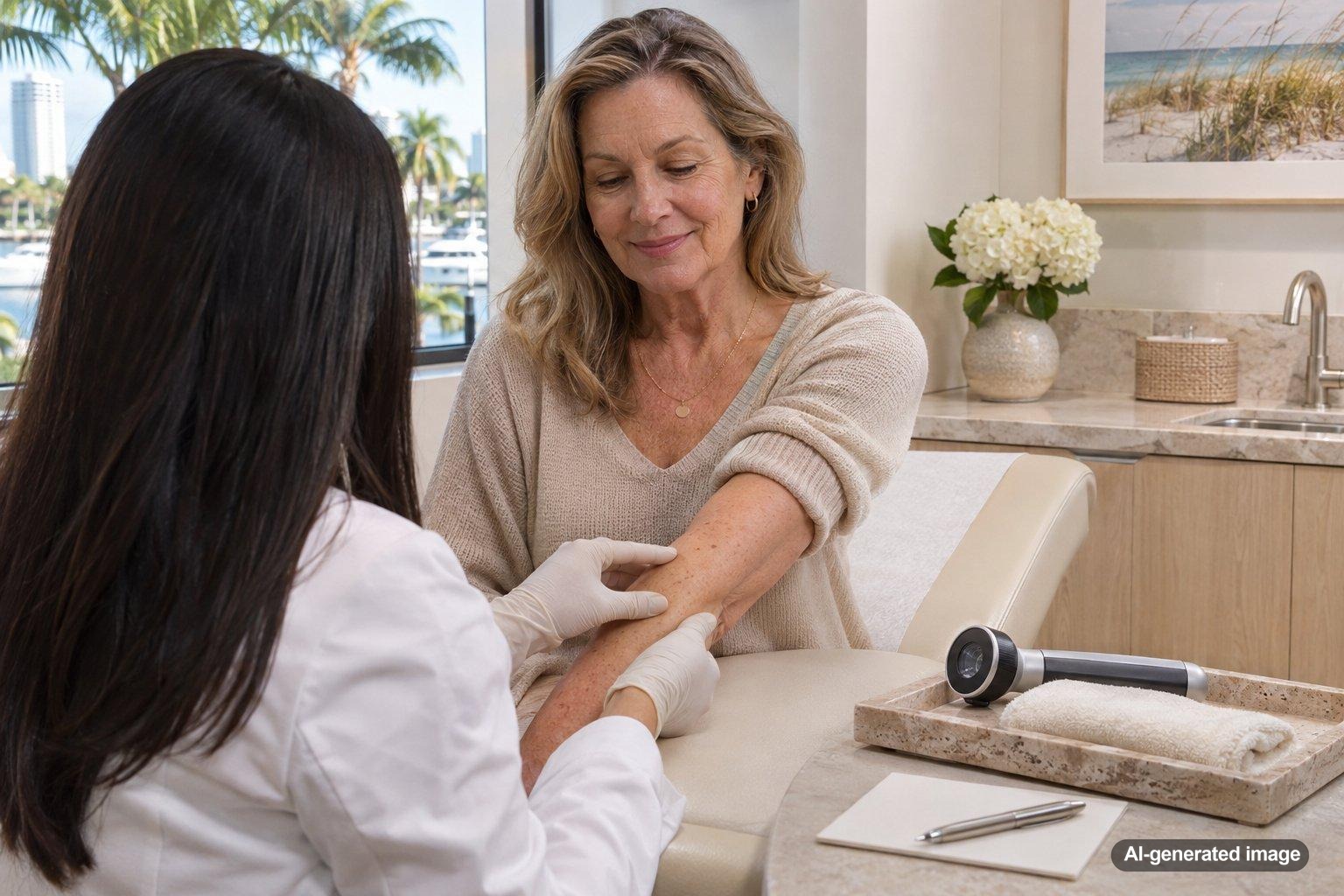
Noticing a new bump, raised spot, or unusual growth on your skin can be unsettling, especially when your next annual dermatology appointment is still months away. The important thing to know is that you do not have to wait for your scheduled skin exam to have a new growth evaluated. Many skin growths are benign, but some require medical attention, and appearance alone cannot reliably distinguish between them.
If you discover a new skin growth, take note of when you first noticed it, document its appearance, and contact a board-certified dermatologist for guidance. This is particularly important if the spot is growing, changing, bleeding, or behaving differently from the surrounding skin. At Waverly DermSpa in Fort Lauderdale, Dr. Maryann Mikhail, MD, evaluates skin concerns that arise between routine appointments. A focused visit can help determine what the growth may represent and whether additional examination or testing is appropriate.
Quick Answer: What Should You Do About a New Skin Growth?
- Do not automatically wait until your annual exam. Contact your dermatologist when you notice a genuinely new or concerning skin growth.
- Document its appearance. Take a clear photograph and note its location, approximate size, color, and the date you first noticed it.
- Watch for concerning changes. Growth, bleeding, recurring crusting, color changes, pain, and persistent itching deserve attention.
- Avoid removing or treating an unidentified growth yourself. Cutting, burning, picking, or applying wart-removal products may injure the skin and complicate evaluation.
- Arrange a professional assessment. A dermatologist can examine the spot and determine whether observation, additional testing, or treatment is appropriate.
Why Can a New Skin Growth Appear Between Annual Exams?
Your skin continues to change throughout the year. New spots can develop because of aging, genetics, friction, sun exposure, inflammation, and various skin conditions. Some appear gradually, while others become noticeable over a relatively short period.
A skin growth is a broad description rather than a specific diagnosis. It may refer to a small raised bump, a mole, a rough patch, a firm nodule, or an area of skin that looks different from the surrounding tissue.
Many new growths are harmless. However, certain skin cancers can initially resemble ordinary bumps, moles, or irritated areas. That overlap is why a new or changing growth should not be identified solely through photographs, online comparisons, or assumptions about its appearance.
An annual skin examination provides an important opportunity to review your skin, but it is not intended to replace evaluation of new concerns that appear between appointments. The appropriate examination schedule also varies according to personal risk factors and medical history.
What Are Some Possible Causes of New Skin Growths?
There are several reasons a new growth might appear. The following examples illustrate why an accurate diagnosis depends on an examination rather than a visual guess.
- Skin tags: These are generally soft, benign growths that can develop in areas where skin rubs against skin or clothing, such as the neck, underarms, and skin folds.
- Seborrheic keratoses: These common benign growths may have a waxy, rough, or stuck-on appearance. Their color and texture can vary.
- Cherry angiomas: These benign blood vessel growths often appear as small red or reddish-purple spots or bumps.
- Warts: Certain types of human papillomavirus can cause raised or rough growths. Their appearance depends on the location and type.
- Cysts: Some cysts form rounded bumps beneath the skin and may become noticeable when they enlarge or become inflamed.
- Moles: Pigmented skin growths can appear or change over time. A new or evolving mole, particularly in adulthood, deserves professional attention.
- Skin cancers: Basal cell carcinoma, squamous cell carcinoma, and melanoma may develop as new growths or changes in existing spots. Their appearances differ, and some do not resemble the familiar images of dark, irregular moles.
These possibilities can share visible characteristics. Even a growth that looks similar to a previously diagnosed benign lesion may require an independent assessment.
How Can You Tell Whether a New Growth Is Concerning?
There is no reliable at-home method for determining whether a new skin growth is benign or cancerous. However, certain changes are useful reasons to contact a dermatologist promptly.
A Growth That Changes in Size or Shape
A spot that progressively enlarges, develops an irregular outline, becomes more elevated, or changes in texture should be evaluated. Some concerning growths change slowly, while others may change more noticeably.
Bleeding, Crusting, or a Sore That Does Not Heal
Pay attention to a growth that bleeds without an obvious injury, repeatedly forms a crust, or resembles a sore that does not heal. A spot that seems to improve and then repeatedly reopens also warrants assessment.
New or Uneven Pigmentation
A growth with changing colors, an uneven distribution of pigment, or an appearance unlike your other spots should be examined. Skin cancer can occur in all skin tones, and suspicious growths are not necessarily dark brown or black.
Persistent Itching, Tenderness, or Pain
Many benign conditions can itch or become irritated. Nevertheless, persistent symptoms associated with a new or changing growth are worth discussing with a dermatologist. The absence of discomfort does not establish that a growth is harmless.
A Spot That Looks Different From Your Other Spots
Dermatologists sometimes describe this as the ugly duckling sign. A spot that stands out because of its size, shape, color, or overall appearance deserves attention even if it does not match every familiar warning sign.
Do the ABCDEs of Melanoma Apply to a New Growth?
The ABCDE guidelines are useful for recognizing suspicious pigmented lesions, especially possible melanoma. They describe five features to consider:
- A – Asymmetry: One half of the spot does not resemble the other.
- B – Border: The edges appear irregular, uneven, or poorly defined.
- C – Color: The spot contains varying shades or develops a noticeable color change.
- D – Diameter: A spot larger than approximately 6 millimeters may raise concern, although melanomas can be smaller.
- E – Evolving: The spot changes in size, shape, color, elevation, or symptoms.
These guidelines are helpful but not comprehensive. Some melanomas do not display the classic ABCDE features, and other forms of skin cancer may appear as pale bumps, persistent rough patches, or nonhealing sores.
A new growth should not be dismissed simply because it is small, symmetrical, skin-colored, or painless.
What Should You Do at Home Before Your Dermatology Appointment?
While arranging an examination, a few conservative steps can help you preserve useful information without interfering with the growth.
Take a Clear Baseline Photograph
Photograph the area in even lighting, preferably with one close-up image and another showing its location on your body. A ruler placed beside the growth can provide a useful size reference. Keep the image with its original date so your dermatologist can understand when it was taken.
Photographs are helpful documentation, but they are not a substitute for a professional examination. Do not delay an appointment in order to collect several weeks of pictures.
Make a Brief Note About Its History
Record when you first noticed the growth, whether its appearance has changed, and whether it has bled, itched, become painful, or developed a crust. Mention any personal history of skin cancer, previous atypical moles, or relevant family history when contacting your dermatologist.
Leave the Growth Intact
Avoid scratching, squeezing, cutting, freezing, or attempting to remove the growth with household products. Over-the-counter wart treatments and chemical removal preparations should not be used on an unidentified lesion. These products can irritate or damage the tissue and may make subsequent evaluation more difficult.
Protect the Surrounding Skin
Continue sensible sun-protection habits, including shade, protective clothing, and broad-spectrum sunscreen with SPF 30 or higher on exposed skin. Avoid friction or unnecessary manipulation of the growth. Sun protection supports overall skin health, but it does not replace evaluating an existing suspicious lesion.
What Happens When a Dermatologist Examines a New Skin Growth?
A dermatologist typically begins by asking when the growth appeared, whether it has changed, and whether it causes symptoms. Your medical history and previous skin examinations may provide helpful context.
The clinician will visually examine the spot and surrounding skin. In some cases, a handheld magnifying instrument called a dermatoscope can help reveal structures that are not easily visible to the unaided eye.
Depending on the findings, professional options may include:
- Clinical observation: A growth that appears benign may be documented and followed according to an individualized plan.
- Additional examination: The dermatologist may recommend examining other areas of skin or reviewing previous photographs and medical records.
- Skin biopsy: If the diagnosis remains uncertain or the lesion appears suspicious, a sample of tissue may be removed and examined under a microscope.
- Removal or other treatment: Management depends on the diagnosis, the location of the growth, symptoms, and relevant medical considerations.
Not every new growth requires a biopsy or removal. The purpose of the visit is to understand the finding and choose an appropriate next step. If a biopsy is recommended, your clinician can explain the technique, expected healing process, and how results will be communicated.
When Should You See a Dermatologist Rather Than Wait for Your Annual Exam?
Contact your dermatologist when you notice a genuinely new or unusual growth rather than assuming it can wait until your next routine appointment. The office can help determine how soon an assessment is appropriate based on your description and medical history.
A prompt evaluation is particularly important when a lesion:
- Is growing or changing in appearance.
- Bleeds spontaneously or repeatedly crusts over.
- Looks like a sore that will not heal or keeps returning.
- Develops irregular pigmentation or an unusual outline.
- Is persistently painful, tender, or itchy.
- Looks noticeably different from your other moles or spots.
- Appears in someone with a personal history of melanoma or another skin cancer.
Rapidly worsening redness, warmth, swelling, drainage, or fever can suggest an acute problem that needs timely medical attention. Severe symptoms or rapidly spreading signs of infection should be assessed urgently rather than waiting for a routine dermatology visit.
There is no single waiting period that is appropriate for every new skin growth. The safest approach is to communicate the concern when it appears and follow the clinician’s recommendations about scheduling.
Does Having a Recent Normal Skin Exam Change What You Should Do?
A reassuring annual skin examination is valuable, but it describes your skin at the time of that visit. New changes can arise afterward, and a previously normal examination does not establish that every future growth is harmless.
For this reason, regular self-observation complements professional skin examinations. Becoming familiar with your usual spots can help you recognize something genuinely new or different.
When checking your skin, remember areas that are easily overlooked, including the scalp, behind the ears, back, soles of the feet, spaces between the toes, and around the nails. Skin cancer can occur in areas that receive relatively little sunlight as well as on frequently exposed skin.
If you spend part of the year in Fort Lauderdale and part elsewhere, keep a record of the growth and any previous dermatology findings. Sharing photographs or relevant records with the clinician evaluating the spot may help maintain continuity of care when you travel.
Frequently Asked Questions
Can I wait until my next annual skin exam if the growth is small?
Size alone does not establish whether a growth is benign. Some concerning lesions are small when first noticed. Contact your dermatologist about a new or unusual spot, especially if it is changing, so the office can recommend an appropriate evaluation schedule.
Does a new skin growth always mean skin cancer?
No. Many new skin growths are benign, including skin tags, seborrheic keratoses, and certain cysts. However, some skin cancers can resemble common benign growths. An examination is the appropriate way to distinguish among possible causes.
Should I be concerned about a skin-colored bump that does not hurt?
A painless, skin-colored bump may have several explanations, including benign conditions. However, certain skin cancers can also be painless or have little visible pigment. A new, growing, or otherwise unusual bump should be evaluated rather than judged solely by color or discomfort.
Can I send my dermatologist a photograph instead of scheduling a visit?
A photograph may help your dermatologist understand the concern or advise on appointment timing. However, image quality and the absence of a hands-on examination can limit what can be determined remotely. Your clinician may recommend an in-person assessment and, when appropriate, a biopsy.
Should I use an over-the-counter wart remover on a new growth?
Not unless the growth has been appropriately identified and a clinician has advised that the product is suitable. Wart removers can irritate or damage skin, and a growth that resembles a wart may have a different cause. Suspicious or uncertain lesions should be evaluated before treatment.
If a new growth turns out to be benign, will it need removal?
Not necessarily. Many benign growths can be left alone if they are not causing symptoms or other problems. Your dermatologist can explain whether monitoring, treatment, or optional removal makes sense for the specific finding.
The Bottom Line
A new skin growth between annual examinations is a reason to pay attention, not a reason to assume the worst. Many growths are harmless, but a new or changing spot deserves an informed assessment. Document what you notice, avoid attempting to remove it yourself, and contact a board-certified dermatologist instead of waiting automatically for your next scheduled skin check.
For patients in Fort Lauderdale, including seasonal residents and international visitors, Dr. Maryann Mikhail, MD, at Waverly DermSpa can evaluate new skin concerns and discuss appropriate next steps based on the examination.
Ready to get help?
Schedule an appointment or send a message and our team will get back to you.
Prefer to call? 954-666-3736
This article is for educational purposes and is not medical advice. For diagnosis and personalized treatment, please book an appointment with a board-certified dermatologist.
Sources & Further Reading
- American Academy of Dermatology (AAD) – Skin cancer: Symptoms, diagnosis, and causes
- Cleveland Clinic – Skin Lesions: What They Are, Types, Causes & Treatment
- Cleveland Clinic – Skin Biopsy: Skin Cancer Test, Punch Biopsy, Shave Biopsy
