

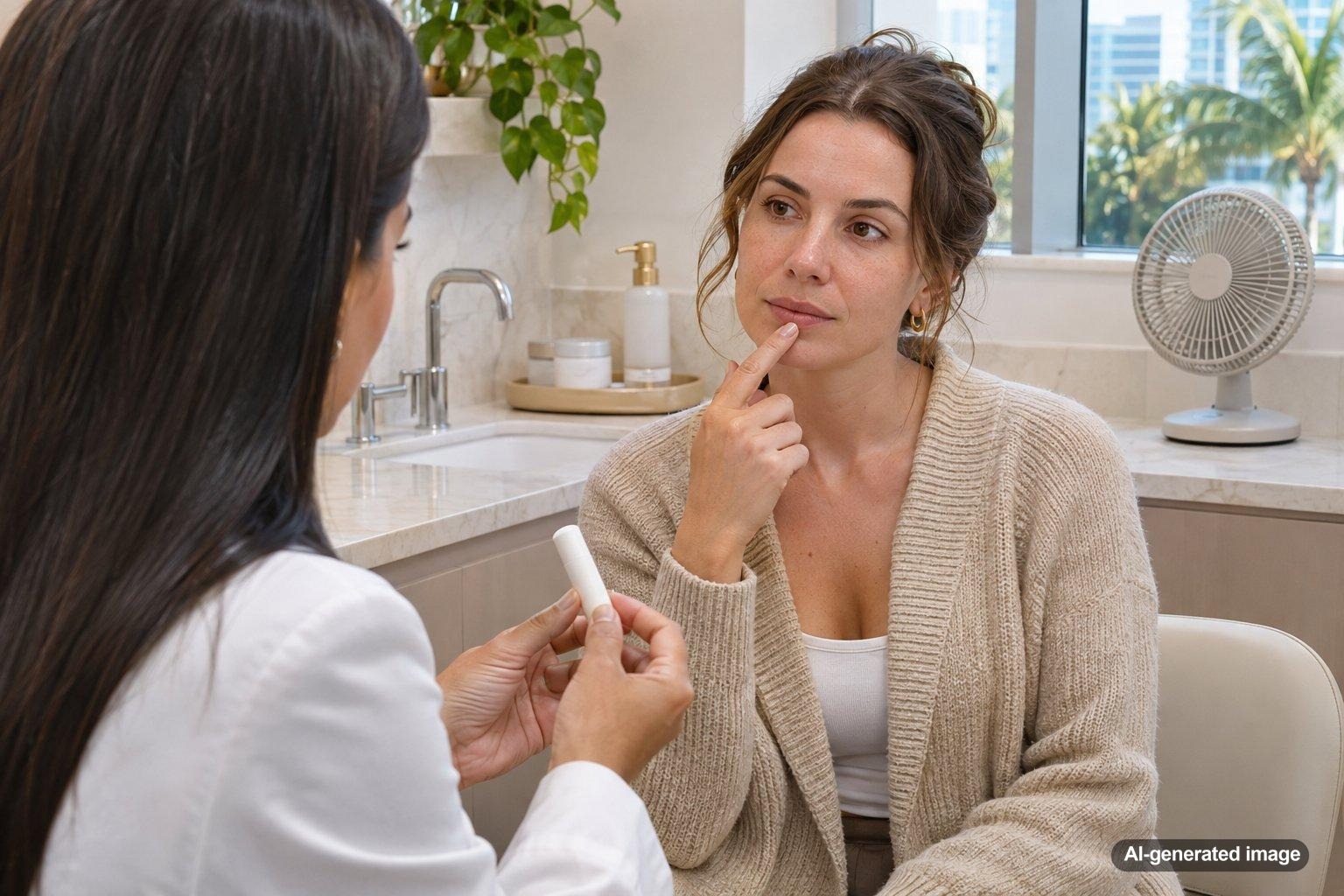
Waking up with lips that feel tight, rough, or unexpectedly chapped can be frustrating, especially when your lips felt comfortable before bedtime. If you regularly sleep with a ceiling fan, bedside fan, or air circulator running, you may have noticed that the dryness seems worse after a night of direct airflow. There is a practical explanation: moving air can increase moisture evaporation from the delicate surface of your lips, particularly when the surrounding air is already dry.
A fan does not necessarily cause a medical skin condition, and sleeping with one is not inherently harmful. However, airflow direction, room humidity, mouth breathing, and your existing lip care routine can all influence how your lips feel in the morning. Understanding these factors can help you make small adjustments without sacrificing a comfortable night’s sleep.
Quick Answer: Why Does Sleeping With a Fan Dry Out Your Lips?
Sleeping with a fan can contribute to dry lips because continuous airflow encourages moisture to evaporate from the lip surface. Several factors may make this effect more noticeable:
- Direct airflow: A steady stream of moving air across the face may increase evaporation from exposed lips.
- Low room humidity: Air conditioning, heating, or naturally dry indoor conditions can make moisture loss more noticeable.
- Mouth breathing: Sleeping with your mouth open can expose the lips to additional airflow and moisture loss.
- A vulnerable lip barrier: Lips that are already dry or irritated may react more noticeably to overnight exposure.
- Limited overnight protection: Without a protective lip ointment, moisture may escape more readily during sleep.
The most useful first step is often to redirect the fan away from your face while maintaining comfortable room ventilation.
What Happens to Your Lips When Air Blows Across Them?
Your lips are structurally different from much of the skin covering your face. The visible pink or red portion of the lips, known as the vermilion, has a relatively delicate protective surface and lacks the same oil-producing structures found in many other skin areas. This makes the lips particularly dependent on their surface barrier and external protection to maintain comfort.
Water naturally moves toward the skin surface and evaporates into the surrounding environment. This process is called transepidermal water loss. When air continuously moves across exposed skin, it can remove the moisture-rich layer of air immediately above the surface and promote further evaporation.
A fan does not automatically lower the amount of water vapor in your bedroom air. Instead, it circulates existing air. The important distinction is that faster-moving air can increase evaporative moisture loss even when the fan itself is not changing room humidity.
If your lips already have small areas of dryness or an impaired surface barrier, this additional exposure may make them feel rougher or tighter by morning.
Why Your Lips May Feel Especially Dry in the Morning
Several overnight conditions can overlap with the effects of a fan. Identifying which ones are relevant to your sleeping environment can help explain why dryness varies from one night to another.
Direct airflow toward your face
A bedside fan positioned near your pillow may expose your lips to hours of uninterrupted moving air. A ceiling fan can also produce noticeable airflow across your face, depending on its speed, direction, and your position in bed. The closer and more direct the airflow, the more likely you may be to notice drying.
Air conditioning or indoor heating
In Fort Lauderdale, air conditioning is a familiar part of sleeping comfortably throughout much of the year. Air conditioning removes moisture from indoor air as part of its cooling process. Heating systems can also produce conditions associated with low relative humidity. When a fan circulates already dry air, your lips may feel particularly uncomfortable.
Sleeping with your mouth open
Mouth breathing during sleep may contribute to dryness of the mouth and lips. People who experience nighttime nasal congestion, snoring, or difficulty breathing comfortably through the nose may be more likely to notice this pattern.
If you frequently wake with both a dry mouth and dry lips, airflow from a bedroom fan may be only one contributing factor. Persistent mouth breathing or accompanying sleep symptoms deserve appropriate medical evaluation rather than an assumption that the fan is solely responsible.
Licking your lips before bed
When lips feel dry, licking them can provide temporary relief. However, saliva evaporates quickly and repeated exposure can contribute to irritation. This may create a cycle in which dry lips lead to more licking, followed by additional discomfort.
Existing irritation from lip products
Some flavored, fragranced, or highly active lip products can irritate sensitive lips. Ingredients that produce a tingling, cooling, or warming sensation may feel noticeable without necessarily supporting barrier comfort. If your lips are already irritated, overnight airflow may make the discomfort more apparent.
Can a Fan Cause Chapped or Cracked Lips?
Continued moisture loss may contribute to chapping, particularly when the lip barrier is already compromised. Chapped lips can feel tight or rough and may develop visible flaking. More substantial dryness can sometimes be associated with painful fissures.
However, not every case of cracked lips is caused by environmental airflow. Persistent lip inflammation, irritation at the mouth corners, sensitivity to personal care products, and certain underlying health conditions can produce similar symptoms.
A useful clue is whether your lips improve when you change your sleeping environment. If your lips consistently feel better after redirecting the fan and using a bland protective ointment, environmental exposure may be contributing. This pattern is informative, but it does not establish a diagnosis.
How to Prevent Dry Lips While Sleeping With a Fan
You do not necessarily need to stop using your fan. Conservative changes to airflow and nighttime lip care may help reduce discomfort.
Redirect the fan away from your face
Try positioning a bedside fan so that it circulates air around the room instead of blowing directly across your pillow. An oscillating setting or lower speed may also reduce prolonged exposure to one area of the face.
If you use a ceiling fan, consider adjusting its speed or airflow direction while maintaining a comfortable sleeping temperature.
Apply a simple protective lip ointment before bed
A thin layer of plain petroleum jelly or another bland, fragrance-free occlusive lip ointment can help reduce moisture loss by forming a protective layer over the lip surface.
Apply it gently to clean lips before sleeping. If your lips are sensitive, products with minimal ingredients may be easier to tolerate than heavily flavored or fragranced formulas.
Pay attention to bedroom humidity
If your bedroom air is particularly dry, a clean, properly maintained humidifier may help improve comfort. Many indoor comfort recommendations use a relative humidity range of approximately 30% to 50%, although the ideal setting depends on environmental conditions and moisture control.
In humid climates such as South Florida, adding moisture is not always appropriate. Excess indoor humidity can encourage mold growth and other indoor air quality problems. A basic hygrometer can help you determine whether your room is actually dry before considering a humidifier.
Avoid irritating lip products
If your lips feel uncomfortable after using a particular balm, consider simplifying your routine. Products containing strong flavors, fragrance, or ingredients that cause burning or stinging may aggravate already sensitive lips.
During periods of dryness, a straightforward protective product may be more comfortable than a complicated collection of treatments.
Reduce repeated lip licking and picking
Try to avoid peeling loose skin from your lips or repeatedly licking them when they feel tight. Both habits can contribute to irritation. A protective ointment may help make this habit easier to manage by reducing the sensation of dryness.
Maintain normal hydration habits
Getting adequate fluids supports overall health, but drinking additional water is not necessarily enough to resolve lips that are drying because of direct airflow. If environmental evaporation is the main contributing factor, barrier protection and airflow adjustments may be more relevant than simply increasing fluid intake.
Is a Ceiling Fan Better Than a Bedside Fan for Dry Lips?
Neither fan type is automatically better for your lips. What matters most is how much air reaches your face, how quickly it moves, and how long the exposure continues.
A bedside fan pointed directly at your pillow may create stronger localized airflow than a ceiling fan on a low setting. However, a powerful ceiling fan positioned directly above your bed may also produce substantial airflow across exposed skin.
Consider these practical differences:
- Bedside fan: Easier to redirect away from the face, but may create concentrated airflow when positioned close to the bed.
- Ceiling fan: Often provides broader room circulation, although exposure varies with fan speed and direction.
- Oscillating fan: May reduce continuous exposure to a single area, depending on its placement and settings.
- Indirect circulation: Moving air elsewhere in the room may provide comfort while limiting direct evaporation from the lips.
A simple comparison over several nights, changing one factor at a time, may help you identify a more comfortable arrangement.
What If Your Lips Are Dry Even Without a Fan?
If your lips remain persistently dry after adjusting your sleeping environment, it is worth considering other explanations.
Common possibilities include irritation from toothpaste or lip products, frequent lip licking, environmental exposure during the day, and sensitivity to certain skincare ingredients. Some forms of lip inflammation, collectively described as cheilitis, may resemble ordinary chapping but require a different approach.
For example, discomfort concentrated at the corners of the mouth, ongoing redness, swelling, or recurring cracking may not respond adequately to changes in fan placement alone.
Medications and certain health conditions can also contribute to dryness. A dermatologist can review the pattern of symptoms, examine the affected area, and determine whether additional evaluation is appropriate.
Professional Options for Persistent Lip Dryness
When straightforward environmental and skincare adjustments are not sufficient, a professional evaluation can help clarify what is maintaining the irritation.
A dermatologist may consider the appearance and location of the dryness, your skincare and oral care products, potential environmental triggers, and any accompanying symptoms. Depending on the findings, options may include changes to the skincare routine, protective barrier care, assessment for contact sensitivities, or targeted treatment of an identified inflammatory condition.
Prescription treatments are not routinely necessary for uncomplicated environmental dryness. When medication is appropriate, its selection should follow an individualized medical assessment rather than self-treatment based on appearance alone.
When Should You See a Dermatologist for Dry Lips?
Occasional lip dryness that improves with gentle care may not require an office visit. However, professional evaluation is appropriate when symptoms persist, recur frequently, or involve changes beyond ordinary tightness and flaking.
Consider arranging an appointment if you notice:
- Dryness that does not improve despite reducing direct airflow and using gentle protective care.
- Repeated painful cracking, bleeding, or significant inflammation.
- Persistent redness, scaling, or irritation extending beyond the lip border.
- Recurring fissures at the corners of the mouth.
- A persistent rough, scaly, or changing area on the lip, especially on a sun-exposed surface.
- New symptoms that begin after a medication or personal care product change.
Sudden lip or tongue swelling accompanied by difficulty breathing or swallowing requires emergency medical attention rather than a routine dermatology appointment.
For ongoing or unexplained dryness, a board-certified dermatologist such as Dr. Maryann Mikhail, MD, can provide an individualized assessment and help distinguish environmental irritation from other causes.
Frequently Asked Questions
Does sleeping with a fan on dehydrate your lips?
A fan may increase moisture evaporation from the lip surface, especially when air blows directly across your face. This is different from whole-body dehydration. You can experience dry lips from local environmental exposure even when your overall fluid intake is adequate.
Can a fan make your lips dry even if the room feels humid?
Yes. Moving air can encourage evaporation even when the surrounding air contains moisture. Higher humidity generally reduces the tendency for moisture to evaporate, but direct airflow can still contribute to surface dryness. The effect varies with airflow speed, humidity, temperature, and the condition of your lip barrier.
Should I put petroleum jelly on my lips before sleeping with a fan?
Plain petroleum jelly is a commonly used protective option for dry lips. It forms an occlusive layer that can reduce moisture loss. Many people find it useful as part of a simple bedtime routine, although persistent symptoms may require evaluation for an underlying cause.
Why are my lips dry when I wake up but not during the day?
Several overnight factors may contribute, including direct fan exposure, low indoor humidity, mouth breathing, and limited lip protection during sleep. During the day, you may change environments more frequently or reapply lip products. If the pattern persists, consider whether other symptoms suggest a cause beyond environmental dryness.
Can sleeping with air conditioning and a fan make lip dryness worse?
It may. Air conditioning can reduce indoor humidity, while a fan increases air movement. Together, these conditions may encourage moisture evaporation from exposed lips. Redirecting the fan and using a protective lip ointment may help improve comfort without requiring you to stop cooling your bedroom.
How long should dry lips take to improve after changing fan direction?
Improvement varies depending on the degree of dryness, existing irritation, and other contributing factors. Mild environmental dryness may become more comfortable relatively quickly with gentle care, while more substantial inflammation can take longer. Persistent, worsening, or recurrent symptoms are reasons to seek professional evaluation rather than relying on a fixed recovery timeline.
The Bottom Line
Sleeping with a fan can contribute to dry lips by increasing evaporation from a delicate surface that is naturally vulnerable to moisture loss. Direct airflow, low indoor humidity, mouth breathing, and existing irritation can all influence how your lips feel in the morning.
For many people, simple changes such as redirecting the fan, maintaining appropriate room humidity, and applying a bland protective lip ointment before bed may help. If dryness continues despite these adjustments, a dermatologist can evaluate whether another condition or irritant is involved.
Ready to get help?
Schedule an appointment or send a message and our team will get back to you.
Prefer to call? 954-666-3736
This article is for educational purposes and is not medical advice. For diagnosis and personalized treatment, please book an appointment with a board-certified dermatologist.
