

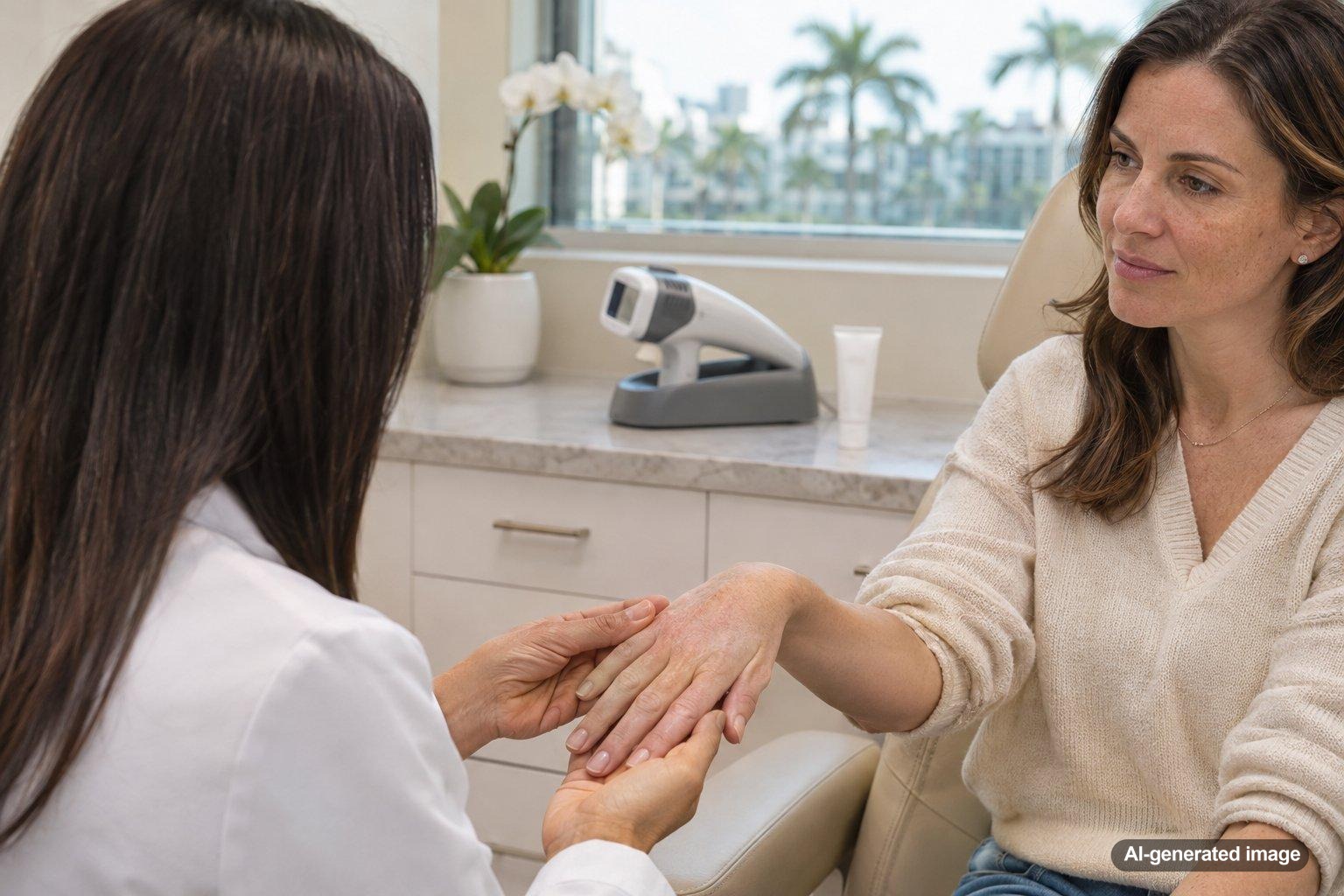
Hand psoriasis can make everyday activities surprisingly uncomfortable. Washing dishes, opening containers, typing, and even shaking hands may become difficult when the skin is thick, inflamed, itchy, or cracked. Because hands are constantly exposed to water, friction, and environmental irritants, managing psoriasis in this area can require a particularly thoughtful treatment approach.
Two options dermatologists may consider are topical corticosteroids and excimer laser therapy. Both aim to reduce psoriasis-related inflammation, but they work differently. Topical steroids are medications applied directly to affected skin, while excimer laser therapy delivers targeted ultraviolet light during supervised treatment sessions. Neither approach is automatically superior. The right choice depends on the location and severity of the psoriasis, previous treatment response, practical considerations, and individual medical history.
Quick Answer: How Do These Treatments Compare?
- Topical steroids: Common first-line medications that reduce inflammation, scaling, redness, and itching. They are generally applied at home according to a dermatologist’s instructions.
- Excimer laser: A targeted form of ultraviolet B phototherapy that may be considered for localized, persistent psoriasis, particularly when topical treatment alone has not provided adequate control.
- Convenience: Steroid treatment usually involves home application, while excimer therapy requires appointments at an appropriately equipped medical office.
- Safety considerations: Prolonged or inappropriate steroid use can affect skin integrity. Excimer treatment can cause redness, discomfort, pigmentation changes, or blistering.
- Combination treatment: Dermatologists sometimes use phototherapy alongside topical medication rather than treating the two approaches as mutually exclusive.
What Makes Hand Psoriasis Challenging to Treat?
Psoriasis is a chronic, immune-mediated inflammatory condition that accelerates the production of skin cells. This can create thickened, scaly plaques with redness or discoloration, itching, and discomfort. When it affects the palms or fingers, it may also cause painful fissures that interfere with normal activities.
The palms have relatively thick skin, which can make some topical treatments more challenging to use effectively. Repeated handwashing, occupational exposure, and friction can further complicate symptom management.
Not every scaly or cracked hand rash is psoriasis. Hand eczema, allergic contact dermatitis, fungal infections, and other skin conditions can produce overlapping symptoms. A dermatologist can examine the distribution, texture, history, and associated findings before recommending treatment.
Common Factors That Can Aggravate Symptoms
- Frequent washing with harsh soaps or detergents.
- Repeated exposure to cleaning products and workplace chemicals.
- Cold or dry conditions that increase skin dryness.
- Friction from tools, repetitive activities, or poorly fitting gloves.
- Skin injuries that may contribute to new psoriasis lesions.
- Inconsistent use of prescribed treatment or difficulty maintaining a skincare routine.
These factors do not explain every flare, but recognizing individual irritants can help patients and dermatologists develop a more practical management strategy.
How Do Topical Steroids Work for Hand Psoriasis?
Topical corticosteroids are anti-inflammatory medications prescribed in different strengths and formulations. They help reduce the inflammatory activity responsible for psoriasis plaques and may improve itching, scaling, swelling, and visible redness.
Because palm skin is thick, a dermatologist may consider a different medication strength or formulation than would be appropriate for thinner areas such as the face. The choice depends on the exact location, plaque thickness, skin condition, and treatment history.
Advantages of Topical Steroids
- Can be applied at home without repeated office visits.
- Available in different strengths and formulations for individualized treatment.
- May provide meaningful improvement in mild or localized psoriasis.
- Can be incorporated into broader treatment plans when additional therapies are needed.
Limitations and Safety Considerations
Topical steroids require appropriate selection and careful use. Applying a potent corticosteroid too frequently, for longer than directed, or to unsuitable areas may increase the risk of adverse effects, including skin thinning, visible blood vessels, and stretch marks.
Hand psoriasis may also return after a successful treatment period because psoriasis is a chronic condition. Repeated flares do not necessarily mean the medication has stopped working, but they may indicate that the long-term management plan needs reassessment.
A dermatologist may recommend periods of topical steroid use, adjustments in formulation, or additional nonsteroidal medications to balance symptom control with medication safety.
How Does Excimer Laser Therapy Work?
Excimer laser therapy uses focused ultraviolet B light, generally at a wavelength of 308 nanometers, to treat specific areas of affected skin. Rather than exposing a large body region, the device directs treatment toward localized plaques.
This focused approach may be useful when psoriasis is limited to relatively small areas or when particular plaques remain resistant to topical medication. Targeted UVB exposure can reduce inflammatory activity in treated skin and help improve plaque appearance in some patients.
Excimer laser treatment is performed under medical supervision. A clinician assesses the affected skin, determines whether phototherapy is appropriate, and adjusts exposure based on factors such as skin type, treatment response, and adverse reactions.
Potential Advantages of Excimer Therapy
- Targets affected plaques while limiting exposure of surrounding skin.
- May be considered for persistent localized psoriasis.
- Offers an alternative treatment mechanism when topical medication alone is insufficient.
- Can sometimes be used alongside topical treatment under dermatologist supervision.
Limitations and Safety Considerations
Excimer therapy requires a series of supervised appointments, and the number of treatments varies. It may not be practical for someone who travels frequently or cannot attend repeated office visits.
Possible adverse effects include temporary redness, tenderness, blistering, and changes in pigmentation. Because excimer treatment uses ultraviolet radiation, clinicians must also consider a patient’s history of skin cancer, photosensitivity, and medications that may increase sensitivity to light. The long-term risks of repeated targeted UV exposure remain an important consideration.
Excimer therapy should not be confused with cosmetic resurfacing lasers. It is a medical phototherapy approach with different equipment, treatment parameters, and clinical goals.
Excimer Laser vs. Topical Steroids: Side-by-Side Comparison
| Comparison | Excimer Laser | Topical Steroids |
|---|---|---|
| Treatment method | Targeted 308 nm UVB light | Anti-inflammatory medication applied to skin |
| Typical role | Option for selected localized or persistent plaques | Common initial treatment for localized psoriasis |
| Treatment setting | Supervised medical appointments | Usually applied at home |
| Main practical challenge | Repeated visits and variable availability | Consistent application and appropriate duration |
| Potential adverse effects | Redness, discomfort, blistering, pigmentation changes | Skin thinning and other effects with inappropriate use |
| Long-term planning | Response monitoring and possible additional treatment | Medication review and possible steroid-sparing strategies |
Which Treatment Is More Effective for Stubborn Hand Psoriasis?
Effectiveness depends on the type and extent of psoriasis, previous therapies, and the patient’s individual response. Topical corticosteroids are well-established treatments for plaque psoriasis and may provide adequate control without additional procedures.
Excimer laser therapy may be worth discussing when plaques remain localized but persistent despite appropriate topical treatment. However, evidence does not establish that excimer laser is consistently more effective than topical corticosteroids specifically for hand psoriasis in every clinical situation.
Published research supports targeted UVB as an option for selected psoriasis presentations, but direct comparisons between excimer therapy and topical medications remain limited. Some patients may respond well to either approach, while others require treatment combinations or a different category of therapy.
Severe palm involvement, extensive inflammation, or associated joint symptoms may call for evaluation beyond either treatment alone. A dermatologist can determine whether other topical agents, broader phototherapy, or systemic treatment should be considered.
Can Excimer Laser and Topical Steroids Be Used Together?
Yes, a dermatologist may incorporate both approaches into one treatment plan. For example, topical medication may help manage inflammation while targeted phototherapy addresses selected persistent plaques.
Combination treatment is individualized. Medication selection, timing, skin response, and the possibility of increased irritation all matter. Patients should not independently adjust prescription steroid use around phototherapy sessions because certain products and application practices can affect treatment response.
The goal is not necessarily to use more treatments. It is to establish an approach that offers an appropriate balance of symptom control, safety, convenience, and long-term management.
What Can You Do at Home to Support Hand Psoriasis Care?
Supportive skincare may help reduce irritation regardless of which medical treatment is selected. It does not replace prescribed therapy, but it can make daily skin management more comfortable.
- Moisturize regularly: Consider fragrance-free creams or ointments that help support the skin barrier, particularly after handwashing.
- Choose gentle cleansers: Avoid unnecessarily harsh soaps and fragranced products when they aggravate dryness or discomfort.
- Limit irritating exposures: Use appropriate protective gloves for cleaning or wet work, while avoiding prolonged moisture buildup inside gloves.
- Protect cracked skin: Avoid picking scales or aggressively exfoliating thick plaques.
- Follow prescribed instructions: Use medication only as directed and report persistent irritation or worsening symptoms.
- Track symptom patterns: Note whether workplace activities, products, seasonal changes, or other exposures seem to precede flares.
Florida’s warm weather does not eliminate the need for barrier care. Frequent swimming, air conditioning, handwashing, and exposure to cleaning products may still contribute to dryness or irritation. Visitors and seasonal residents may also benefit from discussing how treatment schedules fit their time in Fort Lauderdale.
When Should You See a Dermatologist?
A professional evaluation is especially important when a hand rash persists, returns frequently, or interferes with ordinary activities. Correctly identifying the condition matters because psoriasis, eczema, and infections require different management strategies.
Consider scheduling an assessment when:
- Cracking, bleeding, or discomfort makes everyday hand use difficult.
- Previously prescribed treatment is no longer providing adequate control.
- New lesions appear or the affected area expands.
- There is nail pitting, nail separation, or other unexplained nail change.
- Joint pain, swelling, or prolonged morning stiffness occurs alongside skin symptoms.
- You are considering phototherapy or repeated courses of prescription corticosteroids.
Seek prompt medical attention for rapidly spreading redness, significant warmth, pus, fever, or severe pain, which may suggest an additional problem requiring timely evaluation.
At Waverly DermSpa in Fort Lauderdale, Dr. Maryann Mikhail, MD, can evaluate persistent hand symptoms and discuss appropriate dermatologic treatment options. Availability and suitability of specific phototherapy treatments should be confirmed during consultation.
Frequently Asked Questions
Is excimer laser better than steroid cream for hand psoriasis?
Not necessarily. Topical steroids are commonly used as an initial treatment, while excimer laser may be considered for selected localized plaques that remain difficult to control. Individual response, safety considerations, and treatment availability influence the decision.
Does excimer laser treatment hurt?
Some patients experience warmth, redness, or tenderness in treated areas. More pronounced reactions, including blistering, can occur. A trained clinician monitors the response and adjusts treatment parameters when appropriate.
Can topical steroids thin the skin on your hands?
Skin thinning is a recognized potential adverse effect, particularly with inappropriate or prolonged use of potent corticosteroids. Risk varies with the medication, treated area, duration, and application practices. Dermatologist-directed treatment helps manage these concerns.
How many excimer laser sessions are needed for psoriasis?
Excimer treatment generally involves repeated sessions, but the number needed varies with plaque characteristics, skin response, and the treatment plan. Improvement is not assured, and some patients may require additional or alternative therapies.
Can hand psoriasis return after either treatment?
Yes. Psoriasis is chronic and may flare again after a period of improvement. Follow-up care and a longer-term management strategy can help address recurring symptoms.
What if my hand psoriasis does not respond to either option?
A dermatologist may reassess the diagnosis, review treatment technique and possible irritants, and discuss other prescription topical medications, phototherapy approaches, or systemic treatments when appropriate.
The Bottom Line
Topical corticosteroids and excimer laser therapy address hand psoriasis through different mechanisms. Steroids offer a familiar, home-based approach to controlling inflammation, while excimer laser provides targeted phototherapy for selected patients. Neither treatment is universally preferable, and some individuals may benefit from a combined or alternative strategy.
The most useful next step is a dermatologist’s assessment of the skin, treatment history, symptom burden, and practical needs. A personalized plan can account for both immediate discomfort and ongoing psoriasis management.
Ready to get help?
Schedule an appointment or send a message and our team will get back to you.
Prefer to call? 954-666-3736
Disclaimer
This article is for educational purposes and is not medical advice. For diagnosis and personalized treatment, please book an appointment with a board-certified dermatologist.
Sources & further reading
- American Academy of Dermatology (AAD) – Psoriasis: Diagnosis and treatment
- American Academy of Dermatology (AAD) – Psoriasis treatment: Corticosteroids you apply to the skin
- DermNet – Excimer 308-nm laser treatment
- American Academy of Dermatology (AAD) – Psoriasis treatment: Phototherapy
