

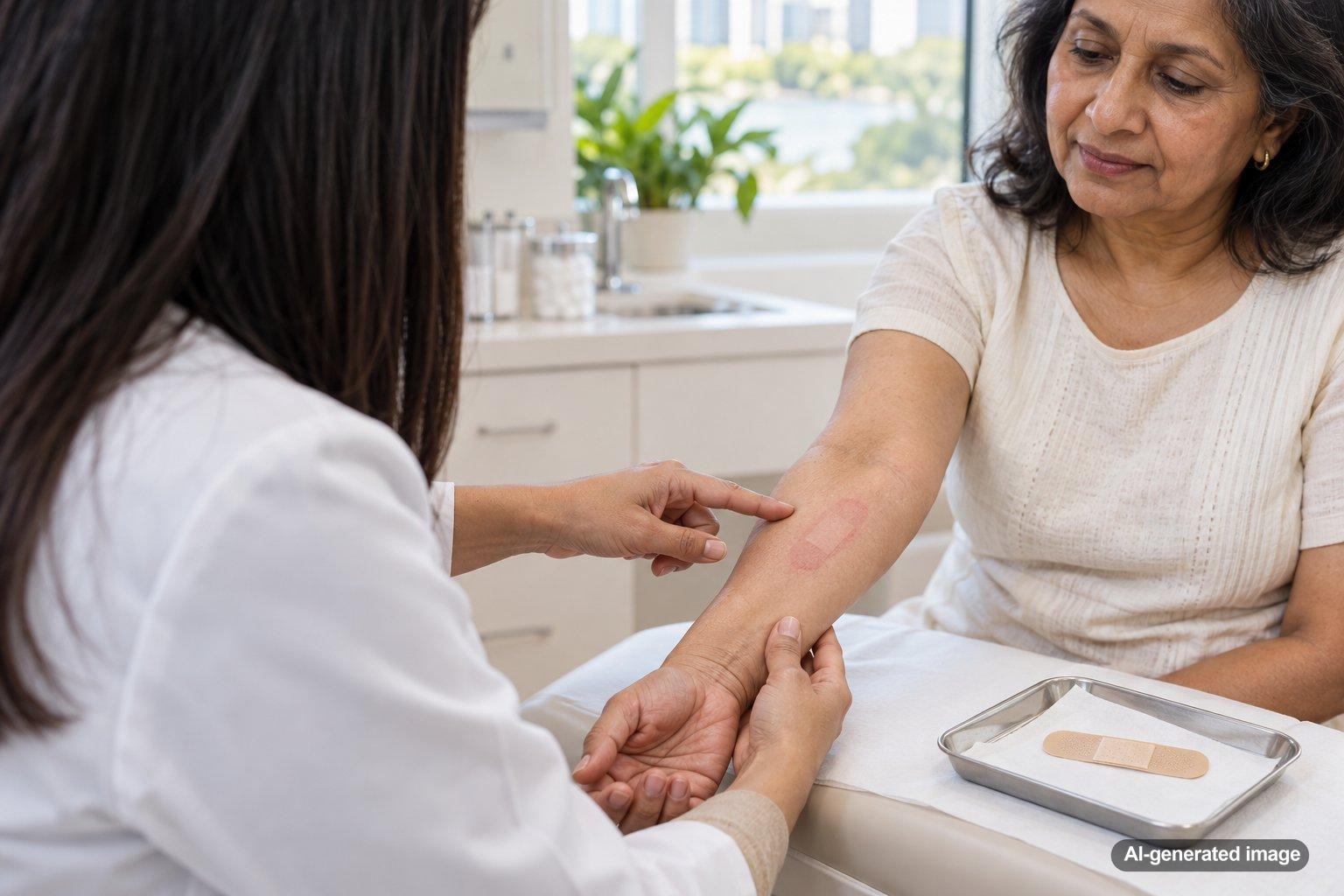
You remove a bandage after a minor cut or scrape and notice something unexpected: the skin underneath the sticky edges is red, itchy, or covered in tiny bumps. Even more puzzling, the irritated area forms a nearly perfect outline of the adhesive tape, while the skin beneath the center pad looks relatively normal.
A rash that follows the exact shape of a bandage commonly develops because the skin reacts to something touching it. The reaction may involve irritation from the adhesive, an allergic response to an ingredient, or damage to the outer skin barrier when the bandage is removed. The distinct shape is an important clue because it reflects where the adhesive contacted the skin. Although these reactions are often localized, understanding their cause can help you avoid repeated irritation and recognize when professional evaluation is appropriate.
Quick Answer: Why Does the Rash Match the Bandage?
- Direct contact: Adhesive ingredients touch a defined area of skin, so inflammation may follow the same rectangular or curved outline.
- Irritant contact dermatitis: Adhesive, trapped moisture, friction, or repeated removal can irritate the skin without involving an allergy.
- Allergic contact dermatitis: Some people develop a delayed immune reaction to particular substances in medical adhesives.
- Skin barrier disruption: Removing strongly attached tape can strip away superficial skin cells and produce redness or tenderness.
- Pattern matters, but it is not a diagnosis: A dermatologist can help determine whether the reaction is allergic, irritating, mechanical, or related to another skin condition.
Why the Rash Has Such a Precise Shape
Contact dermatitis is inflammation that develops when the skin encounters an irritating substance or an allergen. Unlike a rash caused by a process affecting the entire body, contact dermatitis often reflects the location of the exposure.
A bandage creates an unusually recognizable contact pattern. Its adhesive border forms a fixed shape against the skin. If inflammation develops primarily where that border touches, the resulting rash can reproduce the outline almost exactly.
The absorbent center pad generally has a different composition from the sticky border. This helps explain why someone might see an irritated rectangle or ring surrounding an area of relatively unaffected skin.
However, the distribution is not always perfect. Irritation may extend beyond the original contact area, particularly when scratching, moisture, or a more extensive allergic response is involved. The appearance alone cannot establish which ingredient or mechanism caused the reaction.
Allergic Contact Dermatitis vs. Simple Adhesive Irritation
Two major explanations for a bandage-shaped rash are allergic contact dermatitis and irritant contact dermatitis. They can look similar but develop through different biological processes.
Allergic Contact Dermatitis
Allergic contact dermatitis occurs when the immune system recognizes a particular substance as an allergen and produces an inflammatory skin reaction after exposure. The reaction generally requires prior sensitization, which can occur through earlier contact with the substance.
Some medical adhesives contain compounds that can trigger contact allergies in susceptible individuals. Potential allergens include certain acrylates, adhesive resins, and rosin-related substances, also called colophony. The specific ingredients vary among products.
Symptoms may include itching, redness, swelling, scaling, or small fluid-filled blisters. The reaction is often delayed, appearing hours to days after contact rather than immediately when the adhesive touches the skin.
Someone who previously tolerated a particular bandage may develop a reaction after repeated exposures. A history of uneventful use does not completely exclude a newly developed contact allergy.
Irritant Contact Dermatitis
Irritant contact dermatitis does not require an immune allergy to a specific ingredient. Instead, irritation develops when exposure disrupts the skin’s protective outer layer.
Bandages may contribute to irritation through prolonged contact, repeated application and removal, friction, moisture accumulation, or contact with adhesive materials. Sensitive or already inflamed skin can be particularly vulnerable.
Irritant reactions may feel more like burning, stinging, tenderness, or tightness, although itching can also occur. Symptoms may appear relatively quickly, especially when the skin barrier is already compromised.
Important distinction: Itching and delayed onset may suggest an allergic mechanism, while immediate stinging or discomfort after tape removal may suggest irritation. These clues overlap and are not reliable enough to confirm a diagnosis without an appropriate evaluation.
Other Reasons Bandage Adhesive Can Irritate Skin
The adhesive formula is not the only possible explanation. Several factors can contribute to a rash that develops after wearing medical tape.
- Repeated tape removal: Peeling tape away can remove superficial skin cells, especially from delicate or frequently bandaged areas.
- Moisture trapped underneath: Sweat or water remaining beneath an occlusive bandage may soften the skin and increase its susceptibility to friction and irritation.
- Heat and perspiration: Warm, humid conditions can make prolonged adhesive contact uncomfortable and may contribute to irritation.
- Friction and movement: Bandages placed over joints or other moving areas may repeatedly pull against the skin.
- Other products beneath the dressing: An ointment, cleanser, or topical medication applied before bandaging may be responsible for some reactions.
- Existing skin sensitivity: Dryness, eczema, or a compromised skin barrier may make adhesive exposure more difficult to tolerate.
In Fort Lauderdale’s warm, humid climate, sweating beneath a bandage may be an additional consideration, particularly during outdoor activities. Humidity does not prove that a reaction is caused by moisture, but it can contribute to conditions that aggravate sensitive skin.
Why the Skin Under the Pad May Look Normal
Many adhesive bandages have an absorbent central pad surrounded by a sticky border. If the reaction is related specifically to the adhesive, the skin under the pad may remain unaffected because it has not experienced the same direct exposure.
This can create a distinctive appearance: a red rectangular outline, a ring of small itchy bumps, or two parallel strips of inflammation corresponding to the tape’s edges.
Dermatologists pay attention to these patterns because the location of a rash can help identify possible exposures. A sharply defined border provides useful information, but it does not automatically distinguish an allergy from an irritant reaction.
If inflammation instead develops mainly beneath the central pad or around the wound itself, other explanations may need consideration, including irritation from wound-care products, moisture-related skin changes, or complications involving the wound.
What You Can Do at Home for a Mild Adhesive Rash
For a small, localized reaction without signs of infection or another concerning symptom, conservative skin care may help reduce further irritation.
- Stop using the suspected adhesive: Avoid applying the same tape directly over the irritated area while the cause is being assessed.
- Clean gently: If the skin is intact, use lukewarm water and a mild, fragrance-free cleanser when needed. Avoid aggressive scrubbing.
- Use a cool compress: A clean, cool compress may provide temporary comfort for itchy or warm skin.
- Protect intact surrounding skin: A plain, fragrance-free moisturizer may help support skin barrier recovery. Avoid applying cosmetic moisturizers directly into an open wound unless advised by a clinician.
- Avoid scratching: Scratching may worsen irritation and increase the risk of skin damage.
- Choose an appropriate alternative dressing: If the wound still requires coverage, ask a clinician or pharmacist about a nonstick dressing and a gentler way to secure it.
- Follow any specific wound-care instructions: Surgical incisions, biopsy sites, and other medically treated wounds may require particular dressings or care protocols.
Do not apply strong adhesive removers, alcohol, exfoliating acids, or fragranced products to inflamed skin in an attempt to remove residual stickiness. These can create additional irritation.
Over-the-counter anti-inflammatory products are sometimes used for contact dermatitis, but they may not be appropriate for open wounds, delicate areas, or certain skin conditions. A clinician can help determine which products, if any, are suitable.
Are Hypoallergenic Bandages and Silicone Tape Better Options?
People who repeatedly experience irritation from standard bandages often consider alternatives marketed for sensitive skin. Options may include silicone-based adhesive dressings, certain paper tapes, and nonadhesive dressings secured with suitable wraps.
Silicone adhesives are designed to provide gentler adhesion and removal in many wound-care applications. However, product characteristics vary, and a silicone dressing is not automatically appropriate for every wound or every person’s skin.
The word hypoallergenic should not be interpreted as an absolute promise that a product cannot cause irritation or an allergic reaction. A product described as gentle may still contain a material that causes problems for a particular individual.
If repeated reactions occur, the more useful approach is to identify which substance or exposure is causing the problem rather than repeatedly switching among products without understanding their ingredients.
How a Dermatologist Can Evaluate a Bandage-Shaped Rash
A dermatologist may begin by examining the distribution, texture, and severity of the rash and asking about the timing of symptoms, previous adhesive exposures, and products applied beneath the bandage.
Helpful details include whether the rash began immediately or after a delay, whether it primarily itches or burns, whether similar reactions have happened with other types of tape, and whether the affected skin was already irritated before the bandage was applied.
If allergic contact dermatitis is suspected, patch testing may be considered. This diagnostic process uses controlled exposure to selected allergens on the skin, followed by evaluations for delayed reactions. Patch testing differs from skin-prick testing used for certain immediate allergies.
When clinically appropriate, a dermatologist may evaluate relevant adhesive ingredients or recommend additional testing based on the person’s exposure history. Not every possible adhesive ingredient is included in standard testing panels.
Professional management may involve identifying and avoiding a suspected trigger, supporting recovery of the skin barrier, and using an appropriate anti-inflammatory treatment when indicated. Any prescription treatment should be selected through individualized medical evaluation.
When to See a Dermatologist
A mild adhesive reaction may improve after the suspected exposure is discontinued, although the time required varies. Professional evaluation is especially worthwhile when symptoms persist, become more severe, or repeatedly return.
Consider scheduling a dermatology appointment if:
- The rash continues to worsen after the bandage is removed.
- Itching, burning, or discomfort interferes with sleep or normal activities.
- Blisters, significant swelling, cracking, or extensive peeling develop.
- Similar reactions occur with several types of medical tape or dressings.
- The rash repeatedly appears after medical procedures or routine wound care.
- You need adhesive dressings regularly and want to identify safer alternatives.
- The appearance or cause remains uncertain.
Seek prompt medical attention if the area becomes increasingly painful, hot, swollen, or produces pus, or if fever or spreading redness develops. These symptoms can indicate an infection or another complication requiring assessment. Rapidly spreading inflammation or severe skin breakdown also deserves prompt evaluation.
Difficulty breathing, swelling of the tongue or throat, or other signs of a severe systemic allergic reaction require emergency medical care rather than a routine dermatology appointment.
Frequently Asked Questions
Does a rash in the exact shape of a bandage mean I am allergic to adhesive?
Not necessarily. A tape-shaped rash suggests a contact-related process, but both allergic and irritant contact dermatitis can follow the adhesive’s outline. Mechanical skin damage during removal can create a similar pattern. A dermatologist can assess which explanation is most likely.
Why does the rash itch more after I remove the bandage?
Inflammation may become more noticeable after the bandage is removed, particularly if an allergic reaction was already developing. Removing adhesive can also expose irritated skin to air, clothing friction, and scratching. The timing of itching alone cannot confirm an allergy.
Can I suddenly become allergic to a bandage I have used before?
Yes. Allergic contact dermatitis may develop after previous exposures to a material that once caused no noticeable problem. This process is called sensitization. However, a new rash can also result from changes in skin condition, bandage formulation, moisture, or removal technique.
How long does a rash from medical tape last?
The duration depends on the cause, severity, continued exposure, and individual skin response. Mild irritation may improve relatively quickly once the trigger is removed, while allergic contact dermatitis can persist longer. A rash that is worsening or not improving warrants medical evaluation.
Can I use hydrocortisone cream on a bandage rash?
Topical corticosteroids are among the treatments clinicians may recommend for certain forms of contact dermatitis. However, their appropriateness depends on the location, severity, whether the skin is broken, and other factors. Avoid applying hydrocortisone to an open wound or infected-looking area without professional guidance.
Will switching to paper tape prevent another rash?
Paper tape may be better tolerated by some people, but it is not a universal solution. Different products use different adhesive ingredients, and even gentle tape can irritate fragile skin. Recurrent reactions may justify evaluation for a specific contact allergy.
Understanding the Pattern Can Help Protect Your Skin
A rash that reproduces the precise outline of a bandage is a useful clue that the skin has reacted to contact with the dressing. In many cases, the explanation involves adhesive irritation, allergic contact dermatitis, or physical disruption of the skin barrier during removal.
The important distinction is that a recognizable pattern does not automatically identify the exact cause. Paying attention to when the rash appears, which products were used, and whether the reaction returns can help guide a more informed discussion with a dermatologist.
For people who repeatedly react to medical tape, identifying the trigger can make future wound care and medical procedures more comfortable and manageable.
Ready to get help?
Schedule an appointment or send a message and our team will get back to you.
Prefer to call? 954-666-3736
Medical Disclaimer
This article is for educational purposes and is not medical advice. For diagnosis and personalized treatment, please book an appointment with a board-certified dermatologist.
Sources & Further Reading
- Cleveland Clinic – Contact Dermatitis: Symptoms, Causes, Types & Treatments
- DermNet – Allergic Contact Dermatitis Due to an Acrylate in a Dressing Adhesive
- American Academy of Dermatology (AAD) – Skin Biopsy: Dermatologist-Recommended Wound Care
