

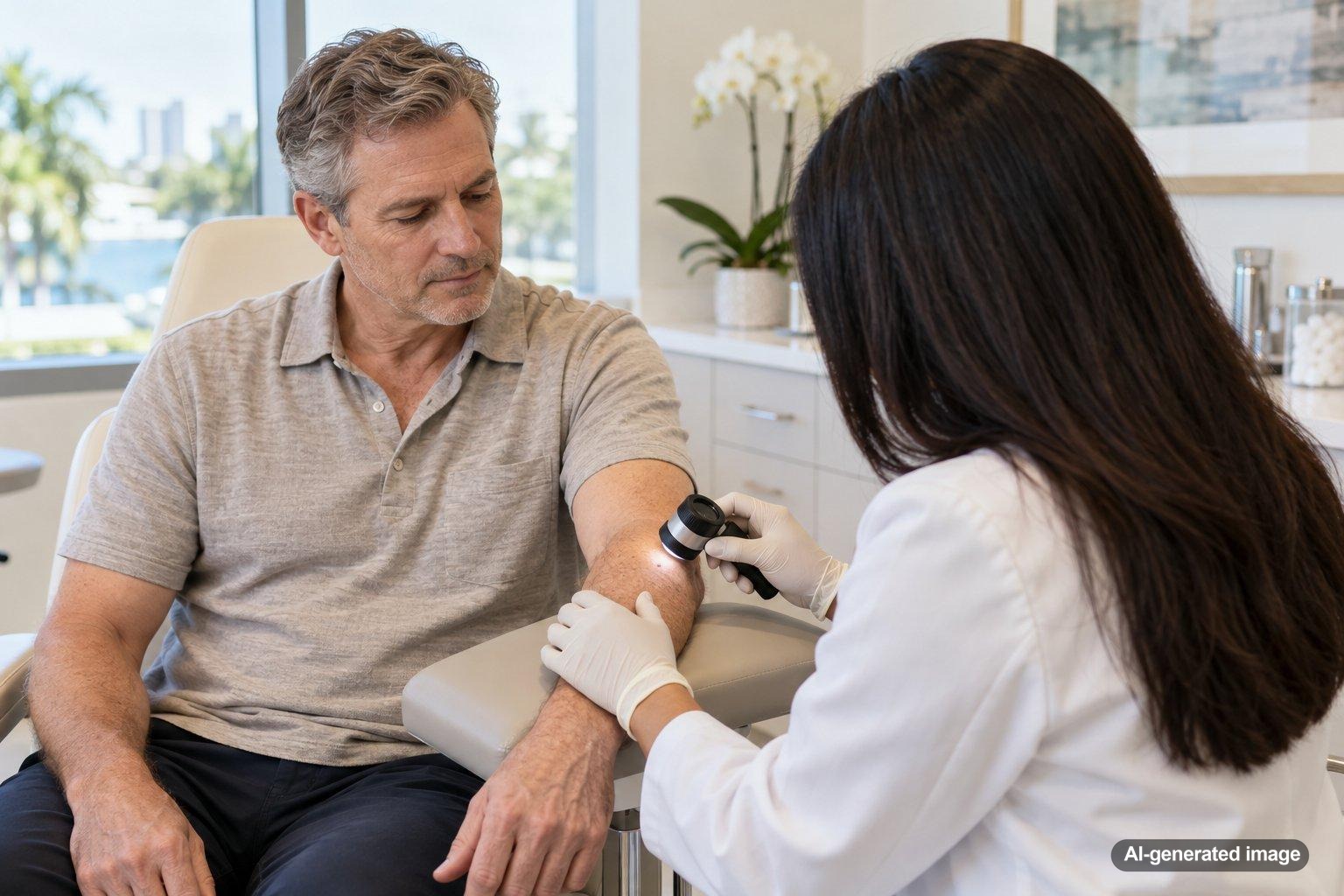
A small red spot on your skin may bleed easily because it contains delicate blood vessels close to the surface, has become irritated, or represents a growth that is particularly prone to bleeding. Sometimes the explanation is a harmless vascular growth, such as a cherry angioma. In other cases, a spot that repeatedly bleeds deserves closer examination because certain skin cancers can also appear as small red or pink lesions.
It can be surprising when something barely larger than a pinhead leaves blood on a towel or clothing. The important clues are whether the spot bleeds only after friction or begins bleeding on its own, whether it is changing, and whether it heals normally. Appearance alone cannot reliably distinguish every harmless growth from a concerning one. A dermatologist can examine the area and determine whether further evaluation is appropriate.
Quick Answer: Why Does a Tiny Red Spot Bleed So Easily?
- Delicate blood vessels: Some red spots are made up of small blood vessels that can bleed when scratched or bumped.
- Cherry angiomas: These usually harmless vascular growths may bleed after accidental injury.
- Pyogenic granulomas: These blood-vessel-rich growths can develop relatively quickly and bleed with minimal contact.
- Repeated irritation: Shaving, clothing, scratching, or rubbing can reopen a fragile surface.
- Possible skin cancer: A spot that bleeds without an obvious injury, changes, crusts repeatedly, or fails to heal should be evaluated by a dermatologist.
The key distinction: A spot that bleeds once after being scratched is different from one that repeatedly bleeds without a clear explanation. Neither bleeding pattern identifies a diagnosis by itself, but spontaneous or recurring bleeding warrants particular attention.
What Is a Small Red Spot That Bleeds Easily?
A small red spot may be flat, slightly raised, or noticeably dome-shaped. Its color may range from bright red to pink, reddish-purple, or a darker shade depending on the underlying tissue, blood vessels, and surrounding skin tone.
Some red spots are vascular lesions, meaning they involve blood vessels. Others develop because of inflammation, minor injury, or abnormal skin-cell growth. When the surface is thin or damaged, even gentle contact may cause bleeding.
A vascular spot may look dramatic when it bleeds because blood comes directly from small vessels near the skin’s surface. However, the amount of visible blood does not reliably establish whether a lesion is harmless or concerning.
Dermatologists consider the lesion’s shape, surface texture, borders, color, location, rate of growth, and history of bleeding. These characteristics provide more useful information together than any single feature.
Common Reasons a Small Red Skin Spot May Bleed
Cherry Angiomas
Cherry angiomas are benign growths composed of small blood vessels. They often appear as smooth, round, bright-red or dark-red bumps, commonly on the trunk, arms, or other areas of the body.
Because these growths contain superficial blood vessels, scratching or accidentally catching one with a fingernail can cause bleeding. Friction from clothing or a towel may also irritate a raised angioma.
Cherry angiomas typically do not require treatment when they are asymptomatic and their diagnosis is clear. However, a new or repeatedly bleeding lesion should not automatically be assumed to be a cherry angioma without examination.
Pyogenic Granulomas
A pyogenic granuloma is a benign vascular growth that can develop relatively quickly. Despite its name, it is not necessarily caused by an infection and is not simply a collection of pus.
These lesions often appear as moist-looking, red or reddish-purple bumps that may have a fragile surface. They can bleed readily after minimal trauma and may form a crust following an episode of bleeding.
Pyogenic granulomas may arise after minor skin injury, although an obvious trigger is not always present. They can occur on the fingers, face, and other locations.
Because a rapidly developing, easily bleeding growth can resemble other skin conditions, dermatologic evaluation is important. A clinician may recommend removal or tissue examination depending on the lesion’s features.
Small Injuries and Repeated Friction
Not every bleeding red spot represents a distinct skin growth. A tiny scratch, irritated hair follicle, or superficial abrasion may appear as a persistent red mark when the area is repeatedly disturbed before it heals.
Common triggers include:
- Shaving over the same area.
- Scratching an itchy spot.
- Rubbing with a washcloth or towel.
- Friction from collars, waistbands, or other clothing.
- Picking away a small scab.
Repeated mechanical irritation may interfere with normal healing. However, if a spot continues reopening despite avoiding friction, a dermatologist should assess whether another condition is responsible.
Basal Cell Carcinoma
Basal cell carcinoma is a form of skin cancer that can appear as a pink or reddish bump, a shiny growth, or a sore that does not heal. Some lesions develop a fragile surface that bleeds, crusts, improves temporarily, and then breaks down again.
These changes can be subtle. A small lesion on the nose, forehead, cheek, or another sun-exposed area may initially resemble a pimple or minor irritation.
Bleeding does not establish that a spot is basal cell carcinoma. Nevertheless, repeated bleeding without clear trauma, especially when accompanied by persistent crusting or gradual growth, is a reason to schedule a dermatology examination.
Squamous Cell Carcinoma and Other Concerning Lesions
Squamous cell carcinoma may develop as a rough, scaly patch, a firm bump, or a sore that repeatedly crusts or bleeds. Some lesions are tender, while others cause little discomfort.
Melanoma and other less common skin cancers can also occasionally appear as pink or red lesions rather than darkly pigmented spots. A lesion does not have to be brown or black to warrant attention.
This is why clinicians look beyond color when evaluating a bleeding skin spot. Changes over time, unusual growth, surface breakdown, and unexplained bleeding all contribute to the decision about whether further testing is needed.
Does Bleeding Mean the Spot Is Skin Cancer?
No. A small red spot that bleeds is not automatically cancerous. Benign vascular growths and ordinary skin injuries can also bleed. However, bleeding is one of several warning signs dermatologists consider when evaluating an unexplained skin lesion.
A spot deserves particular attention if it bleeds spontaneously, repeatedly forms a scab, or remains present without healing. It is also important to assess any lesion that becomes noticeably larger, changes shape, develops irregular borders, or looks different from nearby spots.
Even a very small lesion can require examination. Size alone does not determine whether a skin growth is harmless.
In South Florida, regular exposure to ultraviolet radiation makes sun protection and awareness of changing skin lesions especially relevant. Seasonal residents and visitors should not assume that a persistent spot is simply an irritation caused by heat or sunshine.
Why Does the Same Spot Keep Bleeding and Scabbing Over?
Repeated bleeding can happen when a fragile skin surface is disturbed before it has fully recovered. A raised vascular lesion may catch against clothing, or a healing abrasion may reopen when its scab is removed.
However, a repeating cycle of bleeding, scabbing, apparent improvement, and renewed bleeding can also occur with certain skin cancers.
The question is not simply whether the scab disappears. It is whether the underlying skin returns to its usual appearance and stays healed.
If the same location repeatedly opens, crusts, or bleeds without a clear explanation, arrange a professional evaluation rather than continuing to treat it as an ordinary scratch.
What Can You Do at Home When a Small Red Spot Bleeds?
While the cause is being evaluated, gentle wound care can help protect the skin and reduce unnecessary irritation.
- Apply gentle pressure: Use clean gauze or a clean cloth and maintain steady, uninterrupted pressure until the bleeding stops. Avoid repeatedly lifting the material to check the spot.
- Clean the area carefully: Once bleeding has stopped, gently rinse with water and use a mild cleanser around the area if needed.
- Protect the surface: A thin layer of plain petroleum jelly and a clean, nonstick dressing may help protect a minor superficial wound.
- Avoid picking or squeezing: Trying to drain, scrape, or remove the spot yourself can cause additional bleeding and irritation.
- Reduce friction: Avoid shaving directly over the lesion or repeatedly rubbing it with clothing or towels.
- Document changes: A clear photograph with a familiar size reference can help you describe changes during a dermatology visit.
Avoid using harsh exfoliating acids, home freezing products, or chemical removal solutions on an unidentified bleeding lesion. These approaches may damage surrounding skin and complicate evaluation.
If bleeding is heavy, continues despite firm direct pressure, or is accompanied by dizziness or faintness, seek urgent medical care. People taking medications that affect clotting or who have bleeding disorders may need additional guidance from their healthcare clinician.
How Does a Dermatologist Evaluate a Red Spot That Bleeds?
A dermatologist will generally begin by examining the lesion and asking about its history. Useful details include when it appeared, whether it has changed, whether bleeding follows an identifiable injury, and whether it repeatedly forms a crust.
The examination may include dermoscopy, a technique that uses magnification and specialized lighting to evaluate skin structures not easily visible to the naked eye.
When a lesion has features that raise concern or the diagnosis remains uncertain, a dermatologist may recommend a skin biopsy. A biopsy allows a tissue sample to be examined under a microscope.
Not every red spot requires a biopsy. The decision depends on the examination findings, the history of the lesion, and the dermatologist’s clinical judgment.
What Professional Treatments May Be Considered?
Treatment depends entirely on the diagnosis. A clearly benign, symptom-free spot may not require intervention. A vascular lesion that frequently catches on clothing or bleeds may be considered for removal after evaluation.
Depending on the condition, professional options may include:
- Observation: Monitoring a confirmed benign lesion when treatment is unnecessary.
- Procedural removal: Carefully removing selected benign growths when clinically appropriate.
- Electrosurgical techniques: Using controlled energy for certain diagnosed superficial lesions.
- Vascular laser procedures: Considering appropriately selected benign blood-vessel lesions after their diagnosis has been established.
- Biopsy and diagnosis-specific care: Investigating suspicious lesions before determining an appropriate medical treatment plan.
Some benign vascular spots may be suitable for laser-based management, but an unexplained bleeding lesion should not be treated cosmetically before an appropriate medical assessment.
At Waverly DermSpa, we offer Excel V+ and can help you understand whether it may be appropriate.
When Should You See a Dermatologist?
Arrange a dermatology appointment if a red spot continues bleeding, develops without an obvious explanation, or changes in appearance.
Features that particularly warrant evaluation include:
- Bleeding that begins without scratching, shaving, or another recognizable injury.
- A sore that does not heal or repeatedly heals and reopens.
- A bump that grows noticeably or changes its surface.
- Persistent crusting, ulceration, or unexplained tenderness.
- An unusual spot that differs from surrounding skin lesions.
- A new lesion in an area with substantial past sun exposure.
- Recurring bleeding from a lesion that was previously stable.
Anyone with a history of skin cancer, significant ultraviolet exposure, or a weakened immune system should discuss new or changing lesions with their dermatologist.
If the spot is actively bleeding and the bleeding cannot be controlled with sustained direct pressure, seek urgent medical attention rather than waiting for a routine skin appointment.
Frequently Asked Questions
Why does a tiny red dot bleed when I barely touch it?
Some red spots contain numerous small blood vessels close to the skin’s surface. Cherry angiomas and pyogenic granulomas are examples of vascular lesions that can bleed after minor contact. However, an examination is needed to determine what a particular spot represents.
Can a cherry angioma bleed a lot?
A cherry angioma can bleed when injured because it contains blood vessels. Bleeding may appear disproportionate to the lesion’s small size. If bleeding is recurrent, spontaneous, or difficult to control, a healthcare professional should evaluate the spot.
What if the red spot bleeds but does not hurt?
Lack of pain does not establish that a lesion is harmless. Benign vascular growths may be painless, but certain skin cancers can also cause little or no discomfort. Unexplained or recurring bleeding deserves attention even when the spot is not tender.
Can a bleeding red spot disappear on its own?
Some superficial injuries improve as the skin heals. Other lesions, including many cherry angiomas, may persist. A spot that temporarily improves and repeatedly bleeds again should not be assumed to have resolved. A dermatologist can assess the underlying cause.
Should I cover a small red spot after it bleeds?
A clean, nonstick dressing may protect an irritated area from friction while its surface heals. Gentle cleansing and avoiding unnecessary manipulation are generally sensible measures. Covering the spot does not replace evaluation if bleeding continues or the lesion changes.
Can a red spot be skin cancer even if it is very small?
Yes. Some skin cancers begin as subtle spots or bumps. A small size does not rule out a concerning diagnosis, especially when a lesion grows, bleeds without injury, repeatedly crusts, or fails to heal. A dermatologist can determine whether further examination or biopsy is appropriate.
Ready to get help?
Schedule an appointment or send a message and our team will get back to you.
Prefer to call? 954-666-3736
Disclaimer
This article is for educational purposes and is not medical advice. For diagnosis and personalized treatment, please book an appointment with a board-certified dermatologist.
Sources & Further Reading
- American Academy of Dermatology (AAD) – Skin cancer: Symptoms, diagnosis, and causes
- DermNet – Pyogenic granuloma
- Cleveland Clinic – Cherry Angioma: What It Is, Causes & Removal
- American Academy of Dermatology (AAD) – Basal cell carcinoma: From symptoms to treatments
