

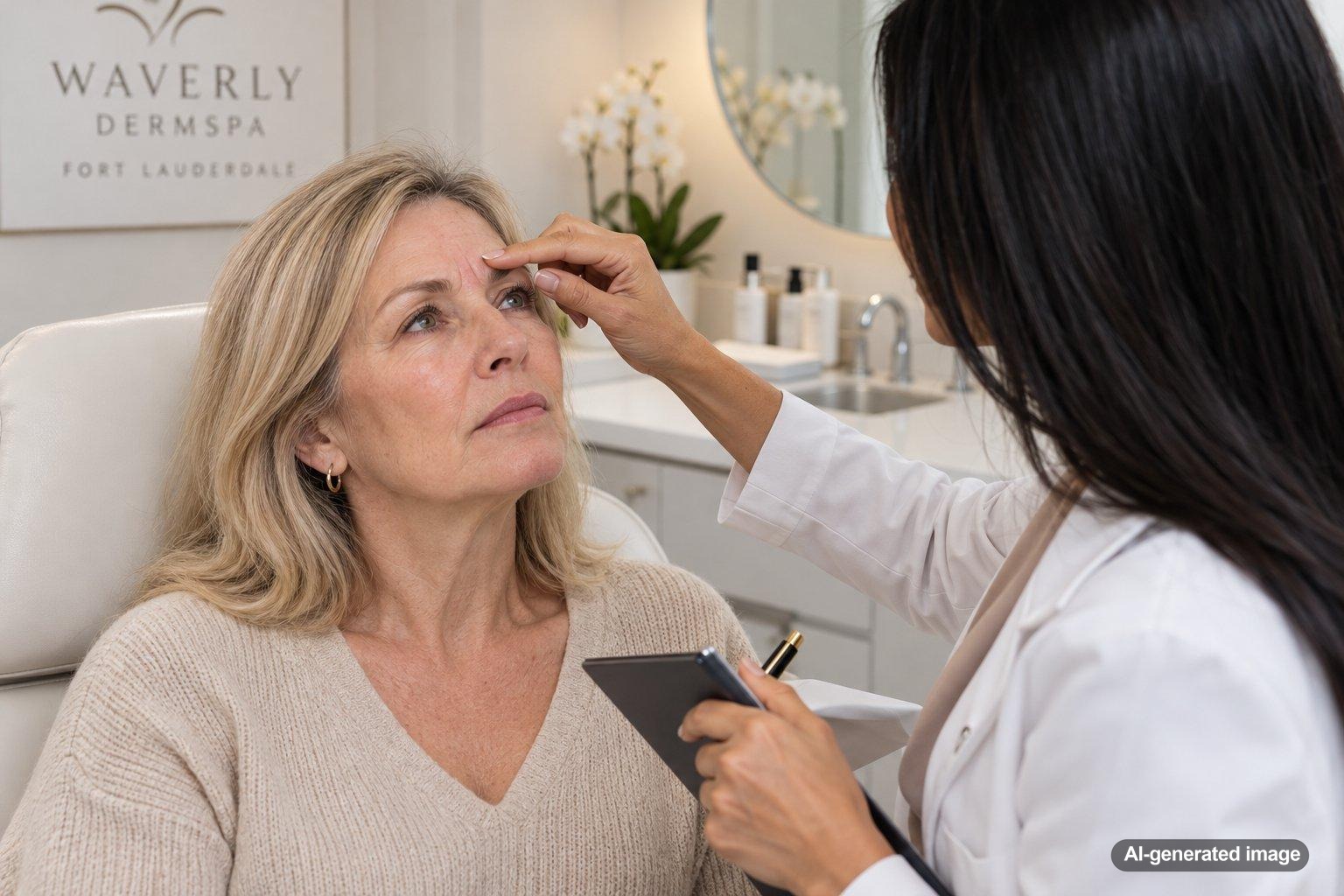
The skin between your eyebrows can be surprisingly persistent when it becomes rough, pink, or flaky. You might notice a small patch that never seems completely smooth, even after applying moisturizer. Sometimes it improves for a few days before returning. Other times, the area remains slightly discolored without much itching or discomfort.
This small region of the forehead, called the glabella, is particularly susceptible to certain inflammatory skin conditions. Seborrheic dermatitis, irritation from skincare products, and eczema are possible explanations. However, not every rough patch is simply dryness. A persistent, localized area of roughness can occasionally reflect sun-related skin changes that deserve professional evaluation. Understanding the differences can help you avoid unnecessary irritation and recognize when a dermatologist should examine the area.
Quick Answer: Why Does This Area Stay Rough and Pink?
- Seborrheic dermatitis: This inflammatory condition frequently affects the eyebrows and central forehead, producing pink or red skin with fine or greasy flakes.
- Skin barrier irritation: Cleansers, exfoliating acids, retinoids, and fragranced products can irritate this relatively small area.
- Contact dermatitis: Ingredients in cosmetics, sunscreen, hair products, or eyebrow treatments may trigger irritation or an allergic reaction.
- Other inflammatory conditions: Eczema and psoriasis can sometimes produce persistent roughness and discoloration.
- Sun-related changes: A rough patch that remains in one place, particularly on sun-exposed skin, should be assessed to exclude actinic keratosis or another lesion.
The appearance, location, duration, and associated symptoms help a dermatologist distinguish among these possibilities.
What Makes the Skin Between Your Eyebrows Different?
The glabella sits within the central facial region, where oil-producing glands are relatively active. This matters because certain inflammatory conditions, particularly seborrheic dermatitis, tend to develop in areas with greater oil production.
The skin also encounters repeated contact with facial cleansers, sunscreen, makeup, eyebrow products, and treatments intended for the forehead. Products may collect around eyebrow hairs or remain in contact with the skin longer than expected.
Facial movements can make an irritated area more noticeable, but repeatedly raising or furrowing your eyebrows does not by itself explain a persistent scaly rash.
Although people often describe the patch as pink, inflammation can look different across skin tones. Some individuals notice redness, while others see purple, brown, grayish, or lighter areas accompanied by subtle scaling.
Seborrheic Dermatitis Is a Common Possibility
Seborrheic dermatitis is an inflammatory skin condition that frequently appears between the eyebrows, along the eyebrows themselves, around the nose, and on the scalp. It can create patches that look simultaneously oily and dry.
Typical features may include:
- Fine white flakes or slightly yellow, greasy scales.
- Pinkness, redness, or another visible change in skin color.
- Mild itching, burning, or no discomfort at all.
- Similar flaking around the sides of the nose, ears, or hairline.
- Periods of improvement followed by recurring symptoms.
This condition involves an inflammatory response associated with factors including Malassezia yeast, which normally lives on human skin. It is not simply a sign of poor hygiene.
Seborrheic dermatitis can be persistent or recurrent, so applying an ordinary moisturizer may soften the flakes without adequately addressing the underlying inflammation. A dermatologist can determine whether this condition fits the appearance and discuss appropriate management.
Other Reasons the Skin May Remain Irritated
Overuse of Exfoliating or Active Skincare Products
Retinoids, exfoliating acids, abrasive scrubs, and certain acne treatments can contribute to dryness, stinging, and visible irritation. Using several active products together may increase irritation, especially when the skin barrier is already compromised.
Sometimes the rest of the forehead tolerates a routine while the area between the eyebrows becomes noticeably more sensitive.
Contact Dermatitis From Everyday Products
Contact dermatitis occurs when the skin reacts to an irritating substance or develops an allergic response to an ingredient. Potential exposures include eyebrow makeup, tinting products, fragrances, hair products, preservatives, and certain cosmetic adhesives.
Clues may include burning or itching after product application, a rash that appears following a new treatment, or symptoms that repeatedly return with the same exposure.
Eczema or Psoriasis
Other inflammatory conditions can also affect the central forehead. Eczema may produce dry, sensitive, itchy skin, while psoriasis can cause more defined areas of scaling and inflammation.
These conditions sometimes resemble seborrheic dermatitis. Their treatments are not necessarily interchangeable, which is one reason persistent symptoms should be evaluated rather than repeatedly treated through trial and error.
Sun-Related Roughness
Long-term ultraviolet exposure can contribute to actinic keratoses, which are rough or scaly skin lesions that may appear pink, red, or close to the surrounding skin color. These lesions are considered precancerous because some can develop into squamous cell carcinoma.
An actinic keratosis cannot be identified reliably through texture alone. However, a localized rough spot that repeatedly returns in exactly the same place, particularly when it does not respond to gentle skincare, deserves a dermatologist’s attention.
Common Triggers That May Make the Patch Worse
Even when the underlying cause is inflammatory, everyday exposures can influence how noticeable the irritation becomes.
- Harsh cleansing: Aggressive washing may strip moisture and increase sensitivity.
- Frequent exfoliation: Repeated scrubbing can aggravate an already compromised skin barrier.
- Fragranced products: Fragrance and certain cosmetic ingredients can irritate susceptible skin.
- Eyebrow grooming: Waxing, tinting, and other grooming procedures may temporarily irritate the area.
- Environmental changes: Dry indoor air, seasonal transitions, and changes in humidity may influence symptoms.
- Stress: Some people with seborrheic dermatitis notice flare-ups during stressful periods.
In Fort Lauderdale, outdoor sun exposure, perspiration, and frequent sunscreen application may also complicate an existing skincare routine. Florida’s humid climate does not prevent inflammatory facial conditions, and visitors arriving from colder climates may notice changes as their skin adjusts to different environments.
What Can You Do at Home?
When the area appears mildly irritated, simplifying your skincare routine is generally a reasonable starting point while arranging an evaluation if symptoms persist.
- Choose a gentle cleanser. Look for a mild, fragrance-free formula and avoid vigorous rubbing.
- Apply a simple moisturizer. A fragrance-free moisturizer may help support the skin barrier and reduce the feeling of tightness.
- Temporarily reduce potentially irritating products. Consider avoiding scrubs and strong exfoliating products on the affected area until the irritation has been assessed.
- Use sun protection. A broad-spectrum sunscreen with SPF 30 or higher can help protect exposed facial skin. Choose a formula your skin tolerates comfortably.
- Avoid picking flakes. Removing scale forcefully can worsen irritation and make the patch more noticeable.
- Observe patterns. Take note of whether the irritation changes after eyebrow grooming, new cosmetics, or adjustments to your skincare routine.
Avoid repeatedly applying medicated creams without understanding what is causing the rash. In particular, topical corticosteroids require care on facial skin because inappropriate or prolonged use can contribute to unwanted effects.
Similarly, medicated dandruff products are sometimes used for facial seborrheic dermatitis under professional guidance, but formulations and directions vary. Products intended for the scalp may irritate the face or eyes if used incorrectly.
How a Dermatologist Can Evaluate Persistent Roughness
A dermatology visit begins with examining the appearance and distribution of the affected skin. Your clinician may ask how long the patch has been present, whether it itches, which products you use, and whether similar changes occur around your scalp, nose, or ears.
For suspected seborrheic dermatitis, professional options may include appropriately selected antifungal treatments, anti-inflammatory medications, and a maintenance skincare plan. Contact dermatitis may prompt a review of potential exposures and, in selected cases, allergy patch testing.
If the area resembles psoriasis, eczema, or another inflammatory disorder, your dermatologist can recommend a condition-specific approach rather than relying on a single product for every type of facial redness.
A distinctly localized, persistent, or changing lesion may need closer examination. When the diagnosis remains uncertain or a concerning growth is suspected, a dermatologist may recommend a biopsy.
Cosmetic exfoliation, peels, and resurfacing procedures should not be used simply to smooth an unexplained rough patch. Identifying the cause comes first, especially when the skin is actively inflamed or a sun-related lesion needs to be excluded.
When Should You See a Dermatologist?
It is worth scheduling an evaluation when the roughness persists despite a gentle routine, repeatedly returns in the same location, or begins interfering with your comfort.
More specific reasons to seek professional assessment include:
- A spot that remains rough or scaly for several weeks without a clear explanation.
- Bleeding, crusting, ulceration, or a sore that does not heal.
- Noticeable growth, changing borders, or evolving color.
- Pain, increasing tenderness, or worsening inflammation.
- Repeated irritation despite discontinuing suspected products.
- Extensive scaling involving the eyebrows, eyelids, scalp, or other facial areas.
Rapidly spreading redness, significant swelling, fever, or eye pain warrants prompt medical attention. These features should not be managed as an ordinary dry patch.
People with substantial cumulative sun exposure or a history of skin cancer should be particularly attentive to new or persistent textured lesions.
Frequently Asked Questions
Why does moisturizer help temporarily but the roughness returns?
Moisturizer can reduce surface dryness, but recurring inflammation may have another cause. Seborrheic dermatitis, contact dermatitis, and other conditions can persist even when the skin feels better immediately after moisturizing.
Can seborrheic dermatitis occur without dandruff?
Yes. Seborrheic dermatitis can affect the eyebrows and facial skin even when scalp flaking is minimal or absent. The distribution and appearance of the rash help guide evaluation.
Is pink skin between my eyebrows always eczema?
No. Eczema is one possibility, but seborrheic dermatitis, product irritation, psoriasis, and sun-related changes can produce overlapping symptoms. A visual examination may be needed to distinguish them.
Should I exfoliate the rough patch to make it smooth?
Exfoliating an inflamed patch may increase irritation. Gentle cleansing and moisturizing are preferable while the cause remains uncertain. A persistent focal lesion should be examined before pursuing resurfacing treatments.
Could this be related to sun damage?
It is possible, particularly when a rough spot remains in one location on sun-exposed skin. Actinic keratoses and other lesions can sometimes resemble ordinary dryness, so persistent or changing patches deserve professional evaluation.
Will the discoloration fade when the irritation improves?
Inflammation-related color changes may gradually become less noticeable as the underlying condition improves, but the course varies by diagnosis and skin tone. Persistent discoloration or texture changes should be discussed with a dermatologist.
A Thoughtful Approach to Persistent Facial Irritation
The skin between your eyebrows may occupy only a small area, but persistent roughness can have several different explanations. The most useful approach is to protect the skin barrier, avoid repeatedly irritating the patch, and seek an accurate diagnosis when symptoms continue.
At Waverly DermSpa in Fort Lauderdale, Dr. Maryann Mikhail, MD, can evaluate persistent facial irritation and help distinguish inflammatory conditions from skin changes that may require additional examination. An individualized assessment can clarify which steps are appropriate for your skin.
Ready to get help?
Schedule an appointment or send a message and our team will get back to you.
Prefer to call? 954-666-3736
Disclaimer
This article is for educational purposes and is not medical advice. For diagnosis and personalized treatment, please book an appointment with a board-certified dermatologist.
Sources & Further Reading
- American Academy of Dermatology (AAD) – Seborrheic dermatitis: Signs and symptoms
- DermNet – Seborrhoeic dermatitis
- American Academy of Dermatology (AAD) – Seborrheic dermatitis: Diagnosis and treatment
