

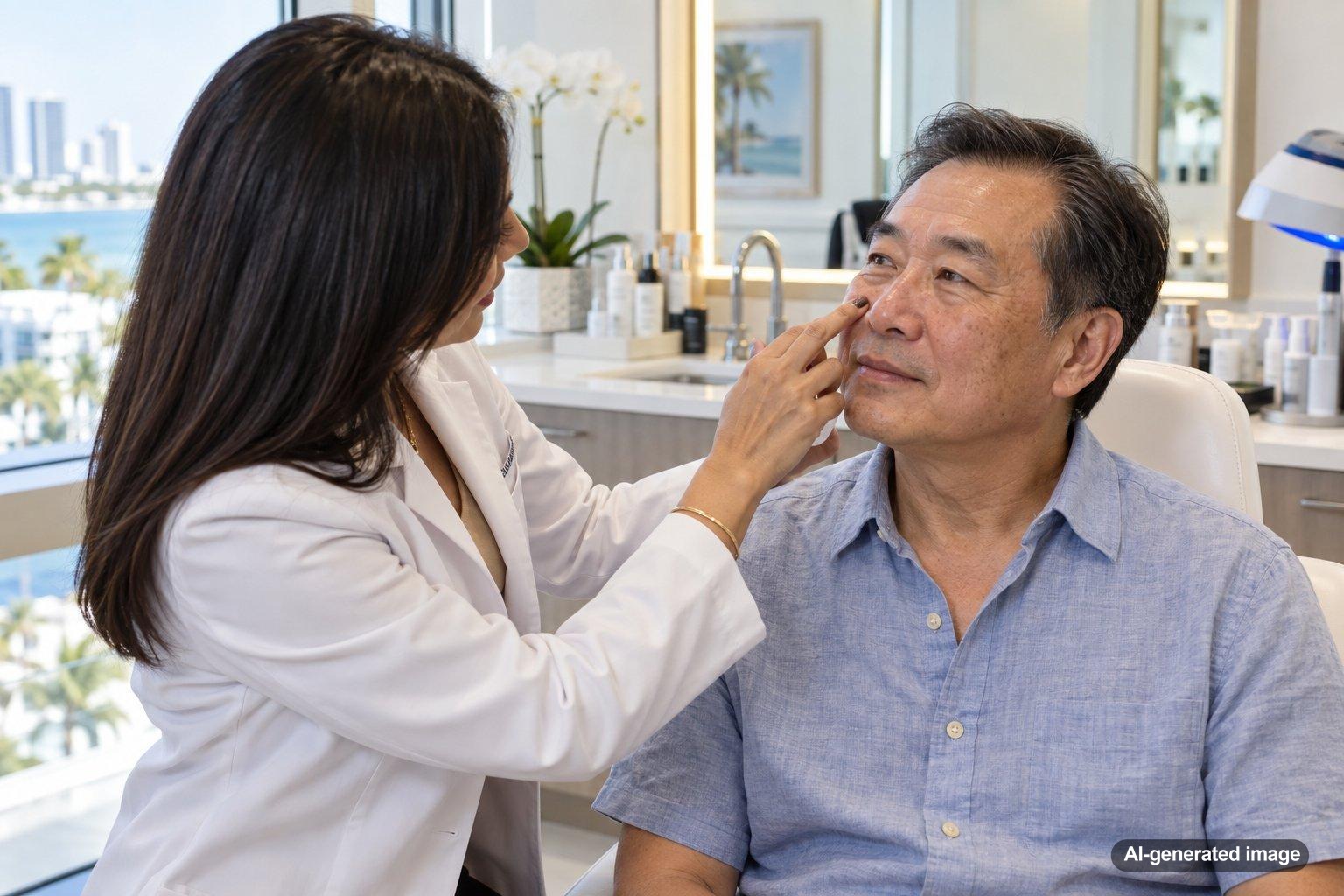
Actinic keratoses can develop on areas that have accumulated years of ultraviolet exposure, making the nose and cheeks common places for these rough or scaly spots to appear. In South Florida, where sun exposure is a year-round consideration, a dermatologist may recommend treating both visible lesions and a broader area of sun-damaged skin. Photodynamic therapy, or PDT, is one office-based option that may be considered for certain actinic keratoses on the face.
PDT uses a light-sensitive medication followed by a controlled light treatment. Whether it makes sense for a particular area depends on the appearance, number, location, and clinical assessment of the lesions, so an in-person dermatology evaluation is important before choosing a treatment.
Quick answer
- PDT may be used to treat certain actinic keratoses, including multiple lesions on sun-exposed facial skin.
- The treatment combines a topical light-sensitive medication with a controlled light source.
- Temporary redness, sensitivity, swelling, peeling, or crusting can occur after treatment.
- Careful light avoidance and sun protection after PDT are important because treated skin can remain especially sensitive to light for a period of time.
- A dermatologist should evaluate suspicious, thick, tender, bleeding, rapidly changing, or persistent lesions before treatment.
What photodynamic therapy is
Photodynamic therapy is a dermatologic treatment that pairs a photosensitizing medication with a specific light exposure. The medication is applied to the treatment area and allowed to remain on the skin for a clinician-selected period. The area is then exposed to a controlled light source that activates the medication.
For actinic keratoses, PDT can be useful when a dermatologist wants to address a broader sun-damaged area rather than treating only one isolated spot. This is sometimes called a field-directed approach because visible lesions may exist alongside additional areas of ultraviolet-damaged skin that are less obvious.
Why actinic keratoses often appear on the nose and cheeks
Actinic keratoses are associated with cumulative ultraviolet damage. The nose and cheeks receive frequent sun exposure during everyday activities such as driving, walking, exercising, boating, or spending time outdoors. In South Florida, consistent sun-protective habits are particularly relevant because outdoor exposure can occur throughout the year.
An actinic keratosis may feel rough, gritty, scaly, or crusted and can vary in color. Appearance alone is not enough to confirm what a spot is. A dermatologist can examine the area and determine whether it appears consistent with an actinic keratosis or whether additional evaluation is appropriate.
Common factors that influence whether PDT is considered
- The number of actinic keratoses present
- Whether lesions are clustered across a sun-damaged area
- The thickness and appearance of individual spots
- The location of the lesions on the face
- Previous treatment history
- Skin sensitivity and other individual medical considerations
- Whether any lesion has features that warrant closer examination or a different approach
PDT is not the only option for actinic keratoses. Depending on the clinical situation, a dermatologist may discuss lesion-directed procedures, prescription topical therapies, PDT, or a combination approach.
What you can do at home
Home care cannot replace an evaluation of a suspected actinic keratosis, but consistent sun protection can help reduce additional ultraviolet exposure. Practical habits include seeking shade when possible, wearing a broad-brimmed hat, using sun-protective clothing, and applying broad-spectrum sunscreen to exposed skin according to its directions.
Avoid picking, scraping, or trying to remove a persistent rough spot yourself. It can also be useful to pay attention to whether a lesion changes in size, color, texture, tenderness, or bleeding and to bring those observations to a dermatology appointment.
What to expect from professional treatment
If PDT is selected, the exact protocol can vary based on the medication, light source, treatment area, and clinician’s plan. A photosensitizing medication is generally applied to the skin before light activation. During or after illumination, people may experience sensations such as warmth, stinging, or burning, although individual experiences vary.
After treatment, the area may become red, swollen, tender, flaky, crusted, or peel. The degree and duration of these changes can differ from person to person. Your clinician will provide specific post-treatment instructions, including guidance about avoiding bright light and ultraviolet exposure while the treated skin is photosensitive.
When to see a dermatologist
Any persistent rough or scaly spot on sun-exposed skin is worth having evaluated, especially if it is new, changing, repeatedly crusting, tender, bleeding, growing, or not healing. Actinic keratoses are considered precancerous lesions because some can progress to squamous cell carcinoma, and it is not possible to determine simply by looking at a lesion which one might progress.
A dermatologist can examine lesions on the nose and cheeks, distinguish actinic keratoses from other conditions, and discuss whether PDT or another treatment approach is appropriate.
FAQ
Can PDT treat several actinic keratoses at once?
It may be used as a field-directed treatment when multiple actinic keratoses are present in a sun-damaged area. Your dermatologist can determine whether that approach fits the pattern and characteristics of your lesions.
Is PDT only for the face?
PDT can be used in dermatology for selected treatment areas, but the appropriate location depends on the specific medication, light source, diagnosis, and treatment plan. Facial actinic keratoses are a common reason a dermatologist may discuss PDT.
Will my face be red afterward?
Redness is a common temporary reaction after PDT, and swelling, peeling, crusting, or sensitivity may also occur. The intensity and duration vary, so your clinician should give you individualized aftercare instructions.
Why is sunlight avoidance important after PDT?
The photosensitizing medication can leave treated skin unusually sensitive to light for a period after treatment. Following your clinician’s instructions about light avoidance and sun protection helps reduce the risk of an excessive reaction.
Can I assume a rough spot on my nose is an actinic keratosis?
No. Several skin conditions can produce rough, scaly, or persistent facial spots. A dermatologist can evaluate the area and determine whether it appears consistent with an actinic keratosis or needs additional assessment.
At Waverly DermSpa, we offer Photodynamic Therapy (PDT) and can help you understand whether it may be appropriate.
Ready to get help?
Schedule an appointment or send a message and our team will get back to you.
Prefer to call? 954-666-3736
This article is for educational purposes and is not medical advice. For diagnosis and personalized treatment, please book an appointment with a board-certified dermatologist.
Sources & further reading
- American Academy of Dermatology (AAD) – 5 facts you should know about precancerous skin growths
- The Skin Cancer Foundation – Actinic Keratosis Treatment
