

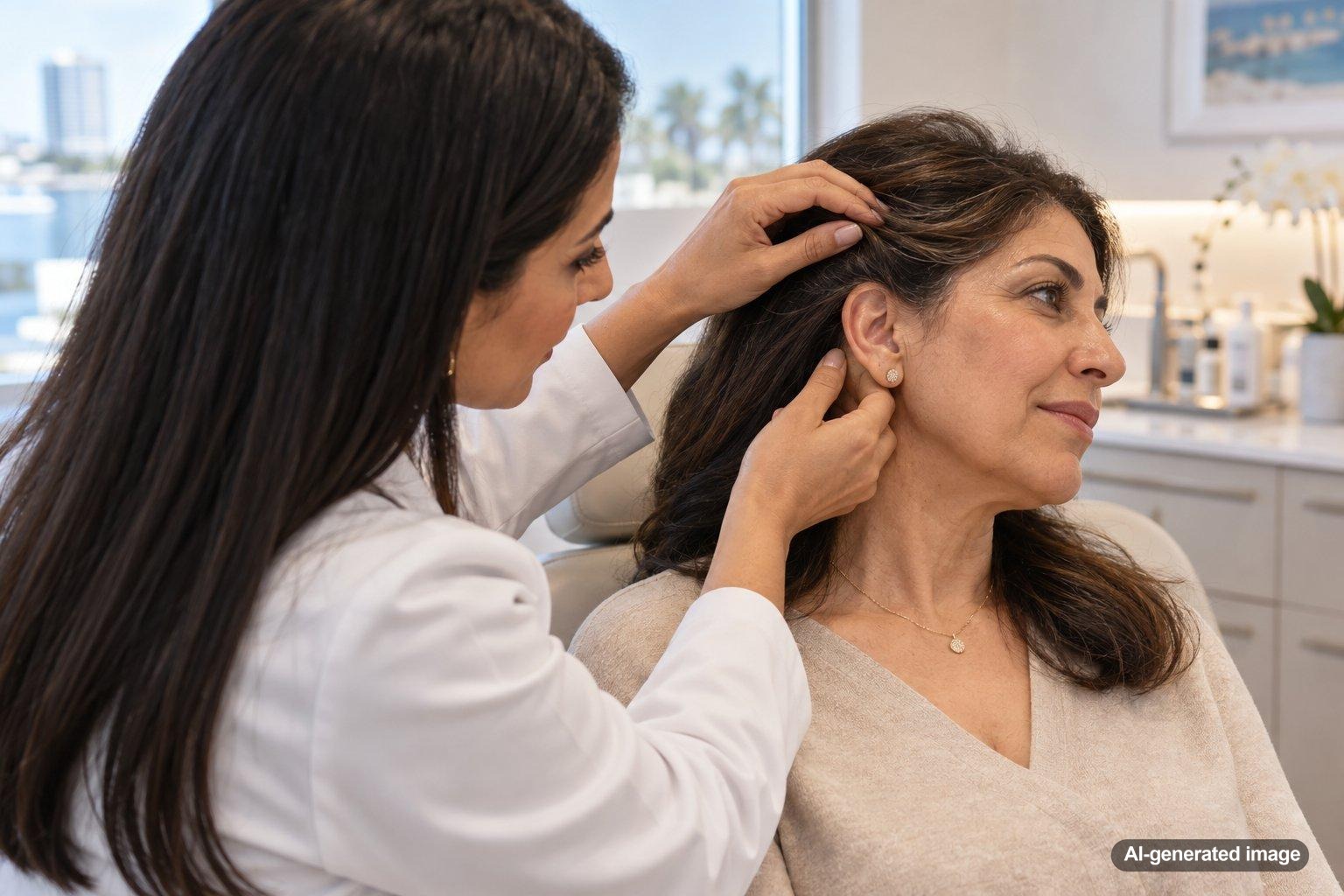
A recurrent sore spot behind one ear can happen for several reasons, and the location offers a few useful clues. The fold behind the ear collects moisture, oil, sweat, hair products, and friction from everyday items, so irritation can return in exactly the same place. In other cases, inflammation around a hair follicle, dermatitis, or another localized skin change may be responsible. Because different conditions can look similar, a spot that repeatedly becomes sore, crusted, swollen, or slow to heal is worth having evaluated rather than repeatedly treating it on your own.
Quick answer
- Repeated friction or pressure from glasses, headphones, masks, hair accessories, or sleeping position can irritate the skin behind an ear.
- Eczema, seborrheic dermatitis, and contact dermatitis can affect the fold behind the ear and may flare repeatedly.
- An inflamed or infected hair follicle can create a tender bump that seems to return in the same area.
- Hair products, fragrance, metals, and skin-care products can sometimes trigger localized irritation.
- A dermatologist should evaluate a spot that repeatedly breaks down, drains, becomes increasingly painful, changes in appearance, or does not heal normally.
Why can the same spot keep becoming sore?
The skin behind the ear sits in a narrow crease where heat, moisture, friction, and residue can accumulate. DermNet notes that several inflammatory skin conditions can involve this area, including atopic dermatitis, seborrheic dermatitis, and contact allergic dermatitis. A recurring problem does not necessarily mean the exact same trigger is responsible every time, but repeated exposure to the same irritant or an underlying tendency toward inflammation can make one location especially vulnerable.
The pattern can be informative. A flat, flaky, itchy area suggests a different process than a firm tender bump, a fluid-filled spot, or a lesion that repeatedly crusts and opens. A dermatologist can examine the skin directly and distinguish among possibilities that may look very similar at home.
Common causes and triggers
- Friction and pressure: Eyeglass arms, over-ear headphones, helmet straps, mask loops, hair accessories, and even a favored sleeping position can repeatedly rub the same area.
- Contact irritation or allergy: Hair dye, shampoo, conditioner, styling products, fragrance, jewelry metals, and skin-care products can contact the skin around or behind the ear.
- Seborrheic dermatitis: This inflammatory condition commonly affects oily areas and can involve the scalp, ears, and skin behind the ears, sometimes producing redness and scale.
- Eczema or sensitive skin: Dryness and inflammation can weaken the skin barrier and make the area more reactive to sweat, rubbing, or personal-care products.
- Follicle inflammation: Folliculitis occurs when a hair follicle becomes inflamed and sometimes infected. It may appear as a red, tender, itchy, or pimple-like bump.
- A cyst or other localized growth: A bump beneath the skin may periodically become irritated or tender, especially when it is rubbed or compressed.
What you can do at home
For mild irritation without significant swelling, drainage, or other concerning changes, focus on reducing friction and keeping the area comfortable. Avoid picking, squeezing, or repeatedly checking the spot, since manipulation can prolong irritation.
- Gently wash the area and pat it dry rather than scrubbing.
- Temporarily avoid new or strongly fragranced hair and skin products that contact the area.
- Clean eyeglass arms, headphones, and other objects that regularly touch the skin.
- Reduce pressure from tight accessories when practical.
- If the area is dry or easily irritated, use a simple fragrance-free moisturizer that you already tolerate.
- Take a clear photo when the spot is active so you can show your dermatologist if it improves before an appointment.
Avoid repeatedly applying antibiotic, antifungal, steroid, acne, or antiseptic products without knowing what is causing the problem. Products that help one condition can irritate another, and persistent symptoms may need an examination.
What a dermatologist may look for
A dermatologist can evaluate whether the area appears primarily irritated, inflammatory, follicular, cystic, infectious, or related to another type of skin lesion. The appearance of the skin, exact location, texture, tenderness, presence of scale or drainage, and pattern of recurrence can all help narrow the possibilities.
Professional options depend on the cause. They may include changes to skin-care habits, topical treatments for an inflammatory condition, treatment directed at follicle inflammation or infection when appropriate, or further evaluation of a persistent lesion. If the diagnosis is uncertain, your dermatologist can decide whether additional testing is useful.
When should you see a dermatologist?
Consider scheduling an evaluation if the sore spot repeatedly returns in exactly the same place, especially if you cannot identify a clear friction or product trigger. It is also worth getting checked if the area is persistent or changing rather than cycling predictably with an obvious irritant.
- The spot is becoming more painful, swollen, warm, or firm.
- There is pus, persistent drainage, bleeding, or repeated crusting.
- Redness is spreading beyond the original area.
- You develop fever, chills, or feel generally unwell along with the skin problem.
- The area does not heal normally or repeatedly opens after appearing to heal.
- The spot develops a noticeable change in size, color, surface, or shape.
FAQ
Can glasses cause a sore spot behind one ear?
Yes. The arm of a pair of glasses can create repeated pressure or friction, particularly if the fit is uneven or the same area is rubbed throughout the day. If changing or adjusting the glasses reduces the problem, friction may be contributing, although persistent skin changes still deserve evaluation.
Can dandruff affect the skin behind my ears?
It can. Seborrheic dermatitis commonly involves the scalp and may also affect the ears and the skin behind them. The area may look red, flaky, or scaly rather than simply feeling sore.
Could a recurring bump behind my ear be an inflamed hair follicle?
Possibly. Folliculitis can cause small red, tender, itchy, or pimple-like bumps around hair follicles. Recurrent, painful, spreading, or draining bumps should be evaluated so the underlying cause can be identified.
Should I squeeze a tender bump behind my ear?
It is generally better not to squeeze or pick it. Manipulation can increase irritation, damage the skin barrier, and potentially worsen inflammation. A dermatologist can assess a persistent bump and recommend an appropriate approach.
Why does the spot improve and then come back?
A recurring trigger may still be present, such as friction, moisture, hair products, or an inflammatory skin condition that tends to flare. A recurring lesion can also have causes that are difficult to distinguish without examining the area, which is why repeated episodes are worth discussing with a dermatologist.
Ready to get help?
Schedule an appointment or send a message and our team will get back to you.
Prefer to call? 954-666-3736
Disclaimer: This article is for educational purposes and is not medical advice. For diagnosis and personalized treatment, please book an appointment with a board-certified dermatologist.
